



With WSP, Partners, CapMetro Sets the Stage for Scalable Automation
The technology demonstration at CapMetro’s North Operations and Maintenance Facility showcases the potential of automation to optimize bus yard operations, increase efficiency, and improve transit personnel's safety.

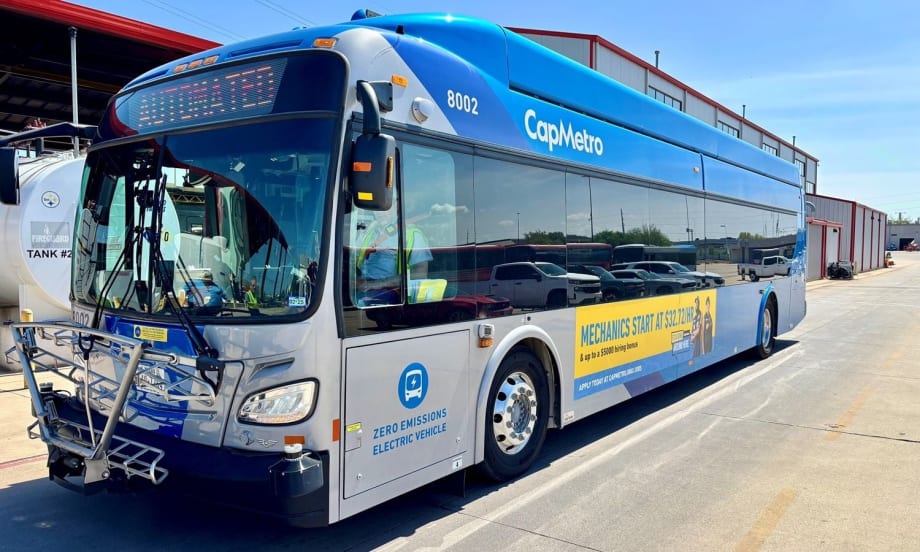
The CapMetro demonstration, led by WSP USA, tasked the fully autonomous bus with navigating real-world challenges, such as braking for pedestrians and obstacles, maneuvering around vehicles, and executing complex parking tasks in a live yard setting.
Photo: WSP USA
Following years of research, planning, and public-private collaboration, Austin, Texas’s Capital Metropolitan Transportation Authority (CapMetro) achieved a significant industry milestone with the deployment of North America’s first SAE Level 4 autonomous 40-foot battery electric bus (BEB) operating within an active transit yard environment.
The technology demonstration at CapMetro’s North Operations and Maintenance Facility showcases the potential of automation to optimize bus yard operations, increase efficiency, and improve transit personnel's safety.
The project is part of CapMetro’s Yard Automation Research and Deployment (YARD) Program. It represents a key step toward integrating intelligent automation into the day-to-day operations of zero-emission fleets.
Precision Without a Driver
The demonstration, led by WSP USA, tasked the fully autonomous bus with navigating real-world challenges, such as braking for pedestrians and obstacles, maneuvering around vehicles, and executing complex parking tasks in a live yard setting.
“During the demonstration, the bus encountered pedestrians, vehicles, and large objects, and instantly reacted appropriately to changing situations,” said Severin Skolrud, VP, critical and emerging technology, at WSP USA. “It's most complex maneuver involved precisely positioning itself beneath an overhead pantograph charging dispenser, within five to seven centimeters of accuracy, and initiating a charging session, all without a driver in the seat.”
The unprecedented level of automation demonstrates the viability of SAE Level 4 driverless technology in transit environments where safety, spatial efficiency, and operational precision are paramount.
Transforming Transit Yards
Beyond the technological milestone, the implications for transit agencies are far-reaching. According to WSP USA, automation in bus yards can:
Increase yard capacity by up to 90%.
Improve safety for frontline staff.
Reduce operating costs through time and labor savings.
Enable more innovative facility planning, including opportunities to repurpose or monetize land.
According to early testing data, by automating vehicle movements during key phases, such as pre-trip staging, charging, and parking, agencies can streamline operations and reduce average trip times by six to eight minutes per bus.
A Public-Private Innovation Ecosystem
The CapMetro initiative brings together a consortium of expert partners, including program lead WSP USA, Perrone Robotics Inc., and Clever Devices.
The project was made possible by a $950,000 grant from the Federal Transit Administration (FTA) as part of its ADAS and Automated Transit Bus Maintenance and Yard Operations Demonstration Program. According to officials, total project costs reached approximately $1.26 million.
CapMetro and its partners are already envisioning a Phase Two expansion that will:
Deploy three fully autonomous BEBs.
Enable multi-year integration and testing.
Develop automated dispatch software to start remotely, pre-condition, and route buses.
Allow vehicles to autonomously reposition for operator boarding and inspection.
This phase will further evaluate how automation can support end-to-end yard operations while laying the groundwork for broader deployment across the agency’s zero-emission fleet.
More Technology

From Hardware to Digital Partner: Luminator Charts Its Next Chapter
CEO Magnus Friberg discusses Luminator’s shift toward becoming a digital partner, the growing importance of software and interoperability, and how AI can help agencies improve operations and passenger experience.
Read More →
Beyond the Checklist: A Structured Approach to Transit Maintenance
Reliability-Centered Maintenance helps transit agencies move beyond routine checklists to focus limited resources on the assets and failures that have the greatest impact on safety, reliability, and service.
Read More →
NJ TRANSIT Advances Bus Technology Upgrades Across Statewide Fleet
More than 1,500 buses now feature upgraded technology designed to improve arrival predictions and provide free Wi-Fi, with deployment expected to reach nearly 2,000 buses by the end of 2026.
Read More →

Building a Flexible Path to Transit Electrification
John Hroncich discusses BAE Systems’ modular and scalable approach, lessons learned from decades of real-world operations, and how agencies can identify electrification strategies that fit their fleets.
Read More →
Biz Briefs: Alstom Lands Canadian Contract, LYT to Supply California TSP, and More
In METRO's latest installment, we take a look at recent news from Complete Coach Works, Beep, FlixBus, and more partnerships making headlines across the transportation sector.
Read More →
From Legacy Silos to Conversational Intelligence
What if transit leaders could ask any operational question and get a trusted answer in seconds? Conversational AI is transforming how agencies use their data.
Read More →
USDOT Announces Rail Vehicle Replacement Grants, Chattanooga AV Shuttle Funding
More than $191 million in federal funding will help three transit agencies replace aging rail vehicles and support a new autonomous shuttle service in Chattanooga.
Read More →
Bus Tech Talk: Keeping Transit Technicians Ahead of the Technology Curve
LA Metro’s Obed Mejia discusses technician training, evolving maintenance technology, fleet replacement, and strategies for getting the most out of today’s transit fleets.
Read More →
Biz Briefs: RIPTA Unveils New Frontrunners, Clevland RTA Adds New Siemens, and More
In METRO's latest installment, we take a look at recent news from Siemens, Prevost, Dodge, and more partnerships making headlines across the transportation sector.
Read More →
Why Simulating Pedestrian Movement Has Become Essential for Modern Rail Stations
Pedestrian microsimulation is helping rail planners identify bottlenecks, test station designs, and prepare complex transit hubs for growing passenger volumes.
Read More →