



RELATED: Consultants address latest transit trends, challenges
Committee creates value for small, disadvantaged business in transit
Jose Bustamante, chair of APTA's Small Business Committee, discuses his role, and how he is trying to help businesses succeed.
by Janna Starcic, Executive Editor
July 31, 2019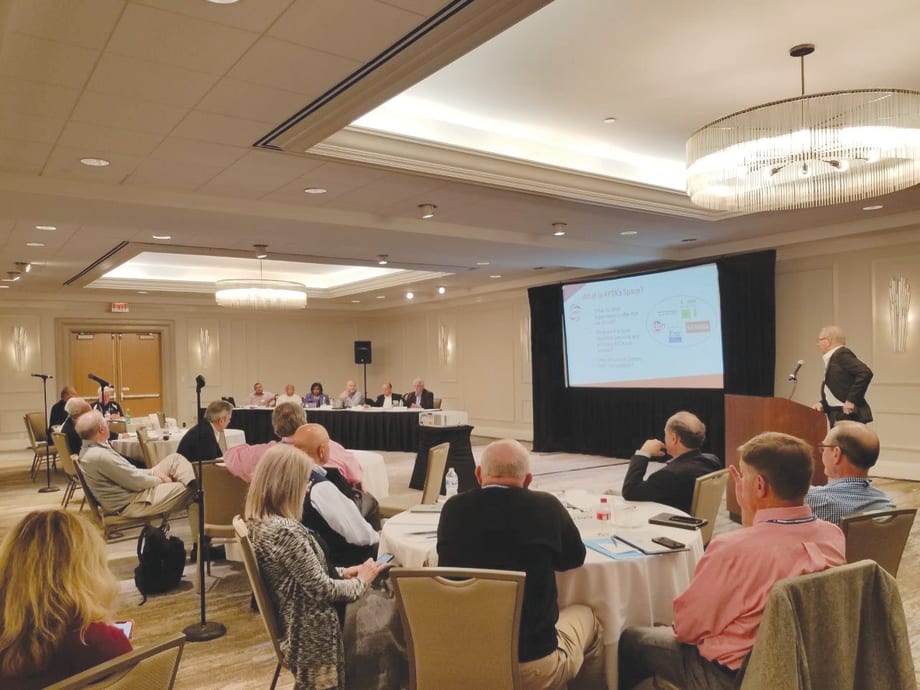
A session from the January 2019 Business Member Board of Governor's meeting held in Naples, Fla.
APTA
9 min to read
A session from the January 2019 Business Member Board of Governor's meeting held in Naples, Fla.
APTA
As Chair of APTA's Small Business Committee, José Bustamante, PE, VP/North America Business Development Director, Transportation & Infrastructure Division, for STV Inc., is tasked with offering members of the committee programs and activities that facilitate networking and ultimately generate new business opportunities for them. METRO spoke to him about his role and how the committee is finding ways of creating value for the small and disadvantaged business members of APTA.
Explain aspects of your role as Chair of the APTA’s Small Business Committee?
Providing access to information and services that benefit small businesses, as well as sustaining awareness of small business perspectives as they relate to APTA’s broader mission on diversity and inclusion, are key elements of my role as Chair of this committee. Over the past few years, we have developed an agenda to do the best we can to represent small business interests, see that issues of concern to them are being addressed, and make sure the voice of the small business community is being heard throughout APTA. As a member of the Business Member Board of Governors [BMBG] and Chair of this committee, I believe we’re making quite a bit of progress in advancing our main objective.
What do you bring to your role in terms of past experience and your current role at STV?
I’ve been in the transit industry for a little over 30 years. Throughout those years, I’ve partnered with a number of small businesses, working closely with them to deliver the highest level of service. I’ve learned a lot about the challenges facing small businesses and how they tend to approach adversity. I hope that I’ve contributed to the growth of many small businesses and formed some long-lasting relationships with many of them. More importantly, I’ve learned a lot from them. I’ve learned true partnering is key to the development of any successful relationship; therefore, my goal is always to collaborate and partner with small businesses so we can all be successful. I believe that has allowed me to gain the right perspective regarding some of the key issues affecting small businesses in our industry.
At STV, as National Business Development Director, I am always looking for partners in the small business sector, so our company can have a positive impact on every community that we work in. With more than 40 offices across the country and in Canada, we’re not the firm from out of town. We live in the communities where we work. We take our commitment to these local communities seriously, and in my role, I’m always aware of the social responsibility we have to see that the benefits are trickling down to the local small business communities. In fact, STV takes the responsibility of mentoring and working with small businesses very seriously. We have an established mentoring program with small businesses. We think that’s important and a way of giving back.
Discuss the agenda of the committee and how it is working to assist small and disadvantaged businesses?
As one of the key BMBG committees, the Small Business Committee has been established for a long time, and the mission has remained very consistent. To represent the interests of small businesses, we developed a cohesive framework consisting of three different programs, specifically tailored to what’s going on throughout the country.
1. There’s a 'Networking' program that encourages APTA small businesses to establish meaningful relationships with potential partners. As part of this program, we have developed a few events that take place at different APTA conferences throughout the year including SB2SB (Small Business to Small Business) and a Networking Breakfast. These events offer the opportunity to meet potential clients including owners, transit authorities, and prime consulting firms. Conversations are facilitated in a social setting.
During our networking breakfast, small businesses can introduce themselves to prime consultants and different transit authorities. Both of these events have been very successful over the years.
2. We have a 'Value of Membership' program to provide small businesses opportunities to maximize the value of their APTA membership. We are currently working closely with APTA staff to develop a more reliable APTA member database that allows bigger businesses to have access to the small businesses’ primary contacts and types of services they offer. This is important as prime consultants are more likely to work with APTA members as they have a common point of reference. Likewise, small businesses would have the opportunity to reach bigger companies for partnerships.
We also are creating a series of webinars and working sessions where small businesses can learn more about key legislative and/or regulatory issues affecting their businesses. We expect these sessions to begin in early 2020.
3. There is a 'Legislative' program geared toward developing a legislative agenda tailored and focused on issues affecting small businesses. The intent is to make this agenda available to small businesses during visits with legislators at the APTA Legislative Conference and scheduled APTA fly-ins throughout the year, normally one or two sessions per year.
Small businesses are a powerful voice to legislators in our nation’s capital, and our goal is to provide the tools necessary to speak with a single voice.

Bustamante
What types of challenges are DBEs faced with and how are they trying to overcome them?
Starting with ever-climbing healthcare costs, professional liability requirements, and project delays, DBEs are facing numerous challenges today. Our committee is keenly aware of those challenges, and we remain focused on finding ways to help small businesses navigate through some of them. Back in May, we hosted a panel of transit CEOs and two business members during the Mobility Conference held in Louisville, Ky. The discussion focused on the challenges facing small business and what transit CEOs are doing on their end to help DBEs stay ahead of the game. One of the challenges for small businesses over the past four or five years is due to design-build, P3s, and CM-at-Risk becoming the preferred delivery method for many clients. Lower multipliers and sweat equity are required during the pre-award stage, and they have become a way of doing business. That’s tough for small businesses, as they can’t reasonably sustain that model for too long.
Additionally, insurance requirements continue to climb, and small businesses are faced with coverage far beyond what they ever anticipated. That creates financial stress on their end. So, we do the best we can to work with owners and find ways to lower those requirements, whenever appropriate.
The third item that comes to mind is the limited resources in our industry. Talent is a challenge for small businesses. They are having a tough time finding the right talent, and they are faced with escalating training costs to develop and grow their staff.
Discuss some success stories of how the committee has benefited member DBEs.
Once again, our primary objective is to create the right venues for small businesses to network with transit providers, prime consultants, and contractors, as well as other small businesses. We have found that these casual and friendly settings bring out the best in people and have seen some great results. A couple of years ago, we had a Small Business to Small Business networking event where a few transit CEOs showed up, as well as board members from different transit agencies. A year later, we learned that several small businesses in the room benefitted from the event. They were able to connect one-on-one with transit properties and prime consultants and learned about specific procurements coming up around the country. Some of those opportunities might have been missed by those small businesses.
These networking events are critical because they give the small businesses opportunities to learn about things that they may otherwise miss — connecting one-on-one with the people responsible
for procuring services or those assembling teams to pursue the work is invaluable.
What takeaways you can provide to DBEs with regard to benefiting the most from being part of this group within APTA?
I think being and feeling part of a community is important to any business. Having a sense of belonging is critical to our success as professionals and businesses. That is what we offer at the BMBG Small Business Committee. Our goal is to help small businesses grow in the transit industry by providing guidance and by facilitating conversations among peers throughout the industry, especially with transit providers and prime consultants. To that end, we created multiple tracks to provide small businesses ample opportunity to network and learn first-hand about business opportunities. We also created a platform for small businesses to voice their concerns and see that those concerns are incorporated into APTA’s vision for its future.
When compared to APTA’s overall membership body, the small business community representation is not as large as we’d like it to be. We’re working on recruiting more small businesses into APTA and have structured the membership dues to better align with small businesses’ objectives. As a result, small businesses joining APTA now pay a fraction of the dues they paid eight to 10 years ago.
Additionally, this committee is working to revamp APTA’s current database to allow transit providers and prime consultants as well as contractors to have access to APTA small businesses. The new database will make it easier for APTA members to access and contact small businesses when needed. One of the main benefits of being a member of APTA is networking.
I also want to reiterate that being an APTA member means having access to a comprehensive library of technical standards and guidelines, as well as numerous technical committees where key technological advancements are being discussed. When you look at the benefits of membership, it far outweighs the cost. If you are engaged and attending the events, you will find real, tangible benefits in
your membership.
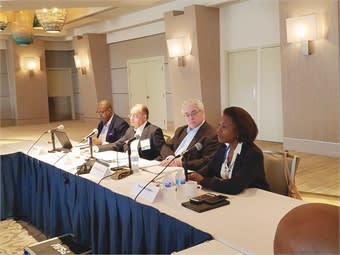
APTA Executive Committee members (L to R): Freddie Fuller, Paul Skoutelas, David Stackrow, and Nuria Fernandez attending a BMBG meeting.
APTA
Discuss DBE trends an their impacts.
First, there is a consistent increase of minority goals and participation for procurements throughout the country. From Los Angeles to Chicago to Texas to New York, these goals are trending to reflect the fabric of local communities. Small businesses need to capitalize on these opportunities by training their workforce to meet the market demand.
The challenge is that small businesses need to make employee training and development a priority to create sustainable long-term growth. In fact, training and workforce development are going to prove invaluable to everyone, particularly when you evaluate the changes being created by the new mobility paradigm we’ve experienced over the past three to four years.
The other thing we’re seeing is that with the private sector involvement being higher, small businesses are now being challenged to be more creative in terms of delivering their services. That can create stress because the tools to deliver those services are very different than ones used years ago. I think DBEs are benefitting from those challenges and demands, and they are stepping up to the plate. I’m optimistic.
Subscribe to Our Newsletter
More Management

METRO Opens Submissions for 2026 Motorcoach Awards
Nominations are now being accepted for METRO Magazine’s Operator of the Year and Innovative Operator of the Year awards.
Read More →
New York MTA Advances Final Contract for Second Avenue Subway Expansion
Contract Four is the largest in the Second Avenue Subway Phase 2 project and includes construction of station infrastructure, tracks, and signals for the subway expansion, MTA officials said. Work on Contract Four will begin in 2027.
Read More →
Transit Agencies Highlight Safety Gains at National Summit
Leaders from 15 major transit systems shared crime-reduction results and safety initiatives while discussing the role of continued federal support.
Read More →

NITA Names New Leadership, Expands Reduced-Fare Program at First Board Meeting
The new regional transit authority appointed its first board chair and interim executive director while extending reduced fares across CTA, Metra, and Pace for eligible riders.
Read More →
Beyond the Checklist: A Structured Approach to Transit Maintenance
Reliability-Centered Maintenance helps transit agencies move beyond routine checklists to focus limited resources on the assets and failures that have the greatest impact on safety, reliability, and service.
Read More →
APTA 2026 Nominating Committee Selects Leadership Slate, Names Chair and Vice Chair Nominees
Leadership changes will help shape the association’s priorities and its representation of the transportation industry during the 2026–2027 term.
Read More →
DART Launches Major Security, Fare Enforcement Initiative
The 90-day demonstration will deploy coordinated security teams at five light rail stations while testing controlled access and gathering data to guide future investments.
Read More →
Sponsored•September 9, 2026
Advancing Fare Collection Through Technology and Innovation
Learn about delivering 1300 gates at 91 stations while managing fare evasion. Explore the large scale deployment, solution customization and real-world results that affect the region. Prepare for deployment in your region now.
Read More →
Game Day in Motion: Moving Millions During the 2026 World Cup
Between packed transit stations and team motorcoaches, see how agencies and operators across North America tackled the transportation demands of the 2026 FIFA World Cup.
Read More →
Surface Transportation Extension Averts Shutdown, Leaves Transit Funding Gap
The stopgap keeps federal transportation programs moving, but missing advance funding could complicate the transit and rail projects agencies are planning next.
Read More →