



RELATED:
Jefferson Lines 'Listens to Customers' Needs'
Celebrating its 100th Anniversary in 2019, the Minneapolis-based operator was recently named METRO’s Innovative Operatorof the Year Award.
by Alex Roman, Managing Editor
February 25, 2019
Jefferson Lines
6 min to read
Jefferson Lines
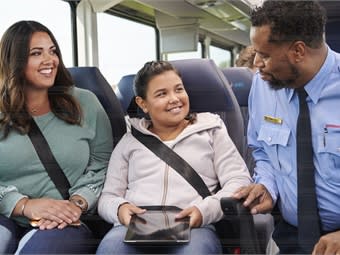
Marking its 100th anniversary this year, Minneapolis’ Jefferson Lines owes much of its success to delivering the best customer experience through innovation and quality service.
“If you look at our history, it’s fascinating to see the tremendous spirit of innovation that has built our reputation,” says Steve Woelfel, president of Jefferson Lines. “Since 1919, Jefferson looked to develop the technology of the times to deliver the best experience for our customers. More recently, we have really focused on using technology to improve the customer experience.”
A key component is always listening to the needs of the customer. Jefferson uses customer satisfaction survey data, which the company collects on a monthly basis through the help of an independent third party.
Woelfel explains that while the company has learned much from the surveys, it is their proactive approach that has really helped them improve the customer experience.
One such change they were able to implement is an improvement in their on-time performance on their line-run services.
“In 2012, we looked at what on-time performance meant to our customers and found that in the fixed-route industry, the focus was on departure time rather than arrival time,” Woelfel says. “So, basically, that means if we get somewhere two hours late, but departed on time, that was still considered on-time. We realized that with vehicle-tracking devices and the ability to use geofencing and other technology, we could probably do better.”
To revamp what it meant to be “on time,” Jefferson re-defined the measure to mean that their buses must arrive within 10 minutes of its scheduled arrival to be considered “on time.” To begin the process, Jefferson examined their schedules to make sure they were realistic and solicited feedback from drivers and other frontline employees to see how they could meet their new goal.
“When we first measured using our new metric, we were on time 45 percent of the time, but through refining our processes we now average 85 percent on time,” Woelfel says. “With many of our trips hundreds of miles long, a lot can go wrong, but we took the customer’s feedback and made it our priority.”
Measuring performance is key
■ Woelfel says that being part of a Spader 20 Group has also contributed to Jefferson’s success, particularly through the use of Key Performance Indicators (KPIs). As a group, Woelfel explains that his Spader Group decided to explore how to create and use operational KPIs to improve their businesses.
“Financial KPIs were working well for us, but we wanted to create operational KPIs as well,” he explains. “So, we agreed on what was important to measure, created definitions, and developed measurements in operational topics, including safety and maintenance.”
Woelfel says the operation uses KPIs to not only compare how they are doing internally, but also how they rate against their peers. One benefit he notes is the ability to reach out to those peer companies to ask questions about what they are doing to score so well, and vice versa.
Woelfel adds the company uses a cloud-based platform that allows it to view those KPIs and other critical business measures easily, so it can make changes more nimbly. It also shares that information with employees on video screens around the office.
Developing professional drivers
■ Over its 100 years, Jefferson Lines has been an innovator in the industry, including being one of the first companies to carry insurance policies up to $200,000 to demonstrate its commitment to passenger safety in 1922; originating time schedules for buses in 1942; and piloting the usage of diesel engines as way to reduce fuel usage and prolong the life of the engine in the mid-1940s.
One innovation that remains a key to their success, though, was the creation of a professional driving school in 1979. Since its creation, Jefferson has trained over 6,500 drivers for public agencies, corporations, and other bus carriers, and according to one study, has helped reduce the frequency of avoidable accidents by more than 50%.
The driving school continues to help the company as it deals with the industry-wide issue of recruiting and retaining drivers. Woelfel explains that its driver training program, which includes customer service and Smith’s System training, enables them to only hire potential candidates that are the best fit for the company.
“We are a bit picky, but if we find somebody we think is the best person for the job but may not necessarily have the driving experience we need, we are confident that our team can work with them to give them the tools they need to become a safe driver,” he says.
While Jefferson, like most operators, is facing a challenge with the driver shortage, Woelfel says the company has seen a consistent flow of candidates come through its pipeline, thanks to a full suite of recruitment tools, including digital targeted marketing campaigns.
Woelfel adds that one edge that Jefferson has over its competition is the ability to offer steady work.
“Because of our business portfolio, we are able to offer about 90 percent of our drivers full-time work with a full benefits package, which I think is very attractive to potential candidates,” he says.
Part of that business portfolio includes fixed-route intercity service that is connected to rural public transit feeder services. Jefferson launched one of the nation’s first rural transit feeder systems in Iowa during the 1980’s. Today, the company has about 10 such contracts around its 14-state network and has played an important role in supporting multimodal transportation in the cities they serve. In fact, Woelfel believes motorcoach companies can play a key role in multimodal networks throughout the nation.
“If you think about it, motorcoach is not only the most environmentally-friendly and safest mode of transportation, but it is also the most flexible,” he explains. “Airplanes, trains, and other modes of transportation have a fixed area where they can operate, but when you are looking at ways to stitch all modes of transportation together, I think the motorcoach industry is positioned better than any other form of transportation to really make it happen.”
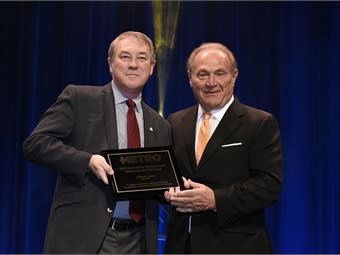
Steve Woelfel and METRO's Frank Di Giacomo at Marketplace in January.
KRR Photography
Marking milestones, moving ahead
■ In recognition of these best practices, Jefferson Lines was named METRO’s 2019 Innovative Operator of the Year at this year’s American Bus Association Marketplace, which was held in Louisville, Kentucky in January.
“We are truly humbled to receive this award,” Woelfel says. “There are more than 3,000 bus companies out there, and many, if not most, are innovating each and every day, So, to be recognized in this way is truly a tremendous honor for all the employees of Jefferson Lines.”
Looking forward, Jefferson is working on launching new features to improve the customer experience through paperless boarding, ticketing kiosks, and a Jefferson mobile phone app. All of these items keep Jefferson on the leading edge to provide a top-notch experience for its customers. Jefferson will mark its 100-year anniversary, at a large anniversary celebration in St. Paul in September.
“Our core belief in 1919 is still our core belief today and that is that every community deserves safe, convenient, and affordable transportation that exceeds their expectations,” says Woelfel. “To mark this 100-year milestone, we’re not only focused on what we’ve done in the past, but more importantly where we are headed in the future.”
Subscribe to Our Newsletter
More Motorcoach

METRO Opens Submissions for 2026 Motorcoach Awards
Nominations are now being accepted for METRO Magazine’s Operator of the Year and Innovative Operator of the Year awards.
Read More →
Biz Briefs: Alstom Lands Canadian Contract, LYT to Supply California TSP, and More
In METRO's latest installment, we take a look at recent news from Complete Coach Works, Beep, FlixBus, and more partnerships making headlines across the transportation sector.
Read More →
Biz Briefs: RIPTA Unveils New Frontrunners, Clevland RTA Adds New Siemens, and More
In METRO's latest installment, we take a look at recent news from Siemens, Prevost, Dodge, and more partnerships making headlines across the transportation sector.
Read More →
People Movement: Holly Arnold Joins Transdev and More
In this edition, we also cover recent appointments and announcements at Pace, CamTran, MCI, and more, showcasing the individuals helping to shape the future of transportation.
Read More →
ABA Report: Motorcoach Travel Generates $161.6B Economic Impact
The 2025 analysis finds motorcoach travel supported nearly 900,000 jobs and generated $28 billion in federal, state, and local taxes.
Read More →
CharterUP’s Armir Harris on Technology, AI, and the Future of Group Mobility
In a recent episode of METROspectives, CharterUP Founder/CEO Armir Harris discussed the company’s evolution from an online charter bus marketplace into a technology platform supporting public- and private-sector mobility and much more.
Read More →
People Movement: ABC Names John Walsh as Chief Commercial Officer
In this edition, METRO also covers recent appointments and announcements at the DART, STV, and more, showcasing the individuals helping to shape the future of transportation.
Read More →
From Surviving to Thriving: Building Stronger Transportation Organizations
Bus Business Consultants founder Brian Dickson shares lessons on leadership, organizational health, and creating options for long-term success in a changing transportation industry.
Read More →
Biz Briefs: Luminator Marks Milestone and More
From manufacturers and suppliers to transit agencies and motorcoach operators, these updates offer a snapshot of the projects, partnerships and business moves driving the industry forward.
Read More →
ABAF Study Reveals Growing Insurance Crisis for Motorcoach Operators
Preliminary findings show 98% of operators faced premium increases over the past five years, while shrinking insurer participation is putting added pressure on businesses and customers.
Read More →