



L.A. Metro 'Ups the Ante' with Zero-Emission Fleet Plan
The transition to electric buses, Metro believes, can be paired with workforce development programs to bolster the local economy and create jobs and a pathway to the middle class for Angelenos.
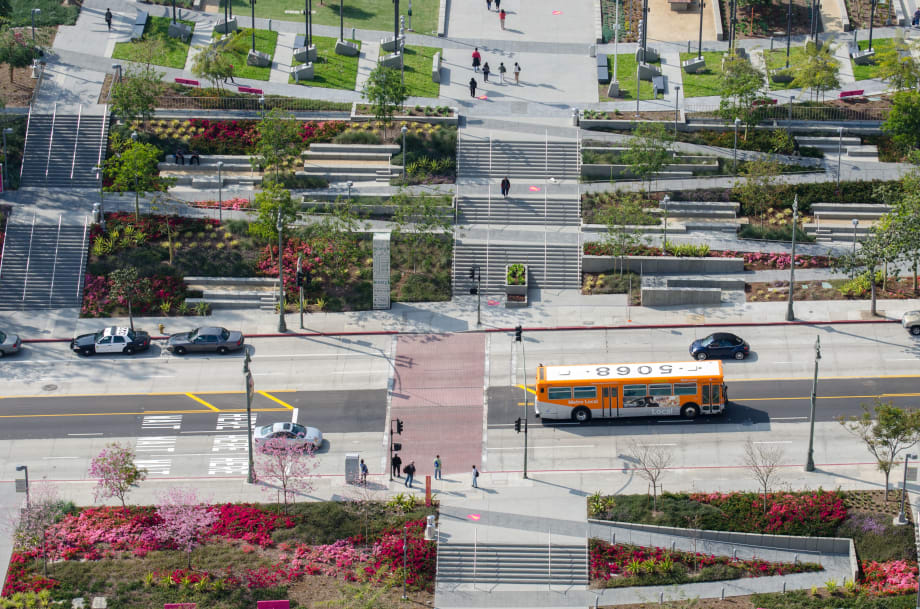
L.A. Metro adopted a Climate Action Plan in 2012 that seeks to continually lower greenhouse gas emissions, which led to the exploration of electric buses.
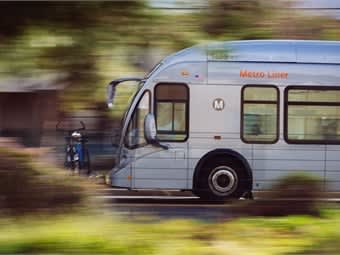
All photos courtesy L.A. Metro
On any given weekday morning, about the time the sun peeks over the mountains that ring Los Angeles County, hundreds of Metro buses roll from their divisions and begin a long day crisscrossing the region’s wide boulevards and endless freeways.
Metro runs the second-busiest bus system in the U.S. with 900,000 or so boardings on the average weekday. The numbers are telling: 170 bus routes with more than 15,000 stops amid some of the heaviest traffic congestion in the nation.
These alone are daunting challenges. But last summer, Metro’s Board of Directors upped the ante by unanimously approving a plan to become the first major transit agency in the U.S. to have a fleet of entirely zero-emission buses. And, to do it by 2030. It was an audacious move considering the agency has about 2,240 buses in its active fleet and had just finished converting its fleet from diesel-powered buses to cleaner compressed natural gas (CNG) in 2011.
“We can’t go fast enough or soon enough. If people don’t think we can do this now, the city of Beijing will soon have 100-percent electric buses,” said Los Angeles Mayor and Metro Board Chair Eric Garcetti, who pushed the hardest for the plan, citing the need to further improve the region’s air quality and reduce greenhouse-gas emissions. “Human beings can move quickly and technology is already moving quickly.”
Challenges, transition plans
The plan was not without opposition. Some in the natural gas industry fought it. Others said the agency should focus on near-zero-emission buses that already exist. Yet many applauded the move, including groups such as the Sierra Club, Earth Justice, and the American Lung Association.
“When Metro, the nation’s second-largest public transit agency, announces plans to shift to zero-emission buses, it sends a signal across the industry,” wrote the Los Angeles Times’ editorial board. “It shows manufacturers that there are buyers for electric buses. It shows other agencies that the technology is ready for prime time, and it could encourage them to switch as well.”
Metro officials acknowledge the hurdles. Electric buses don’t yet have the range of CNG buses and cost more. The agency is also restructuring its bus service and expanding its transit network after the passage of sales tax ballot measures in 2008 and 2016. Metro’s bus system will likely be busier in the years ahead — and that service will have to be maintained during the transition from CNG to electric.
“What we’re doing now is working to get the latest and greatest emission technology into our current CNG fleet,” says Marc Manning, Metro’s sr. director of vehicle engineering and acquisition. “But then, we’re going to go zero emission and try to take things to the next level.”
The agency is planning to spend $1 billion on bus procurements in the next decade. The transition to electric buses, Metro believes, can be paired with workforce development programs to bolster the local economy and create jobs and a pathway to the middle class for Angelenos. That is not a small consideration.

L.A. Metro adopted a Climate Action Plan in 2012 that seeks to continually lower greenhouse gas emissions, which led to the exploration of electric buses.
Clean air consideration
It is hardly surprising that the zero-emission bus effort would unfold in the Los Angeles area. When the Spanish first sailed into the area in 1542, they dubbed it “Baya de los Fumos,” which translates to Bay of the Smokes.
The smoke was probably from the many Native American villages that dotted the area. As the Spanish, Mexican, and American settlers in Southern California would learn in the years ahead, the area’s mountains — while lovely — also help trap foul air, whether it’s from a campfire or motor vehicle.
Air pollution in the L.A. area reached its zenith in the 1950s through 1970s. Increasingly stringent regulations have since eliminated the very worst smog days. But air in the L.A. region still regularly exceeds federal health standards and a variety of conditions — including drought and wildfires — conspired to produce higher-than-usual pollution days in the past year.
Across the region, buses are not a particularly large overall source of pollution — they contribute to air pollution slightly more than do recreational boats, according to the SCAQMD.
Nonetheless, buses are a potent symbol for air pollution. Metro has the area’s largest fleet and the buses are painted bright orange and red and very visible. They move — not un-quietly — through residential neighborhoods just a few feet from sidewalks and pedestrians, bike lanes and cyclists, homes and children, and all sorts of businesses.
Metro’s CNG buses are significantly cleaner than the diesel buses they replaced, producing less particulate matter and fewer greenhouse gases (GHGs). But, CNG is still a greenhouse gas and awareness of climate change has grown since Metro began pursuing CNG buses in the 1990s. The Earth, too, has literally grown warmer.
In response, the agency adopted a Climate Action Plan in 2012 that seeks to continually lower GHGs. Metro has made good progress, reducing carbon dioxide emissions by 25% since 2012. Overall, the agency displaces more CO2 than it uses, due to people switching from driving to taking transit. The fact remains, however, that the majority of the 354,000 metric tons of CO2 released by the agency in 2017 came from bus operations and facilities.
It only takes a few minutes for Metro’s CNG buses to be filled with enough fuel to last all day. That can’t be done with present-day electric buses, because of limitations in charging power due to charging equipment grid capacity, battery chemistry, and real estate for charging stations. So, that’s one obstacle: finding a way to recharge buses several times each day.

Both the Silver and Orange Line BRT systems have high ridership and space for the installation of electric bus charging equipment.
Metro is in the process of hiring a consultant to help write the fine details on a zero-emission conversion strategy. In the meantime, the agency is focused on an interim goal: using only electric buses on its two bus rapid transit (BRT) lines by 2020. The BRT lines both have high ridership and space along their routes for the installation of charging equipment.
The Metro Board has also approved the purchase of 105 electric buses from two different manufacturers to use on the two BRT lines. The agency is also trying to purchase renewable natural gas to lower greenhouse gases.
Power sources
There are still many questions the agency is seeking to answer — especially concerning the local electrical grid and the sources of electricity to be used to power buses. Some of the electricity used in the L.A. area is created by burning coal in neighboring states — a situation known as “moving the tailpipe.”
There will almost certainly be issues. At a recent Metro Board meeting, CEO Phil Washington noted that cobalt is a key ingredient in electric batteries. Much of the world’s cobalt comes from the Democratic Republic of the Congo, which has a poor record on human rights. That, Washington said, is a situation that Metro will have to monitor.
“There is no doubt that this is a heavy lift with everything else that we have going on at Metro,” Washington said recently. “The bottom line is that Metro is responsible for more than 2,200 large vehicles that are part of the fabric of our community.
“It would be easy to say we’ve done enough and there are other, larger polluters,” Washington added. “But, I would rather us lead than follow and the socially responsible thing to do is make sure those buses are as clean as humanly possible and to do that right here, right now.”
Steve Hymon is with Los Angeles Metro Public Relations team.
More Technology

From Hardware to Digital Partner: Luminator Charts Its Next Chapter
CEO Magnus Friberg discusses Luminator’s shift toward becoming a digital partner, the growing importance of software and interoperability, and how AI can help agencies improve operations and passenger experience.
Read More →
Beyond the Checklist: A Structured Approach to Transit Maintenance
Reliability-Centered Maintenance helps transit agencies move beyond routine checklists to focus limited resources on the assets and failures that have the greatest impact on safety, reliability, and service.
Read More →
NJ TRANSIT Advances Bus Technology Upgrades Across Statewide Fleet
More than 1,500 buses now feature upgraded technology designed to improve arrival predictions and provide free Wi-Fi, with deployment expected to reach nearly 2,000 buses by the end of 2026.
Read More →

Building a Flexible Path to Transit Electrification
John Hroncich discusses BAE Systems’ modular and scalable approach, lessons learned from decades of real-world operations, and how agencies can identify electrification strategies that fit their fleets.
Read More →
Biz Briefs: Alstom Lands Canadian Contract, LYT to Supply California TSP, and More
In METRO's latest installment, we take a look at recent news from Complete Coach Works, Beep, FlixBus, and more partnerships making headlines across the transportation sector.
Read More →
From Legacy Silos to Conversational Intelligence
What if transit leaders could ask any operational question and get a trusted answer in seconds? Conversational AI is transforming how agencies use their data.
Read More →
USDOT Announces Rail Vehicle Replacement Grants, Chattanooga AV Shuttle Funding
More than $191 million in federal funding will help three transit agencies replace aging rail vehicles and support a new autonomous shuttle service in Chattanooga.
Read More →
Bus Tech Talk: Keeping Transit Technicians Ahead of the Technology Curve
LA Metro’s Obed Mejia discusses technician training, evolving maintenance technology, fleet replacement, and strategies for getting the most out of today’s transit fleets.
Read More →
Biz Briefs: RIPTA Unveils New Frontrunners, Clevland RTA Adds New Siemens, and More
In METRO's latest installment, we take a look at recent news from Siemens, Prevost, Dodge, and more partnerships making headlines across the transportation sector.
Read More →
Why Simulating Pedestrian Movement Has Become Essential for Modern Rail Stations
Pedestrian microsimulation is helping rail planners identify bottlenecks, test station designs, and prepare complex transit hubs for growing passenger volumes.
Read More →