



Q&A with Palm Tran Executive Director Clinton B. Forbes
METRO Magazine Managing Editor Alex Roman talked to Forbes about the agency’s workforce development program, its route maximization project, and his plans for the future of Palm Tran.

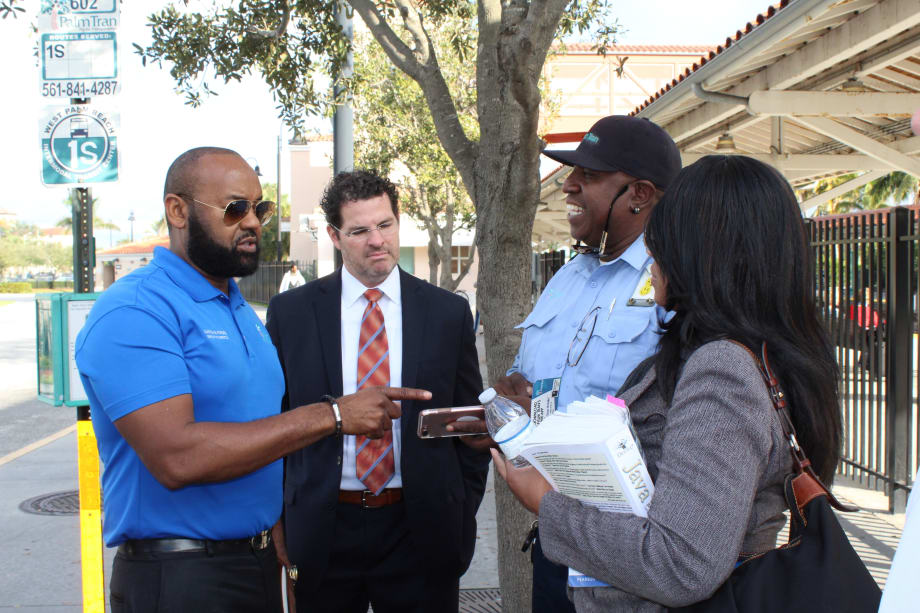
Since taking the helm at Palm Tran, Clinton B. Forbes (shown far left with Palm Beach County Assistant Administrator Todd J. Bonlarron and Bus Operator Richard Folks) has focused on re-organizing the agency’s structure and developing its workforce.
Since taking the helm at Palm Tran, Clinton B. Forbes (shown far left with Palm Beach County Assistant Administrator Todd J. Bonlarron and Bus Operator Richard Folks) has focused on re-organizing the agency’s structure and developing its workforce.
Clinton B. Forbes is a Fla.-born native, who previously served in senior management and leadership positions at the Miami-Dade Metropolitan Planning Organization, Miami-Dade Transit, and the Jacksonville Transportation Authority. After a stint at Columbus’ Central Ohio Transit Agency, Forbes returned to his home state in 2015 to lead Palm Tran.
METRO Magazine Managing Editor Alex Roman talked to Forbes about the agency’s workforce development program, its route maximization project, and his plans for the future of Palm Tran.
You’ve said that the greatest obstacle to improving Palm Tran’s performance was the previous organizational and leadership culture. How are you changing it?
You have to start with these fundamental foundational things in an organization, right? I wanted to take six months to start making any significant change to really do a fair assessment of the organization. I have ambitious plans and projects in mind for this organization but I think before that you have to start with the foundation, which is your organizational structure. What I found was that it was a little disjointed. You know, there were people pointing in different directions with different visions, so we really wanted to reorganize our organization so that it was nimbler and able to quickly react to the community’s needs.
And so that’s what I did. I had a series of town hall meetings to speak with the rank-and-file folks. I had one-on-one meetings with every administrative employee, and that’s how I began my understanding of the organization and the people who are so vitally important to our organization. Once I went through my assessment period, I actually had a few peer organizations converge on our property for a week or two, and there was a tremendous sharing of intellectual property from those transit agencies that helped me with my assessment. From there, we reorganized Palm Tran to have clearer lines of responsibility for key functional areas, so we could react quickly and effectively in meeting the mobility needs of our community and execute our mission.
Tell me about the agency’s workforce development programs.
We want to attract the best-in-class, and I think we have attracted some of the best leaders across the country to join Palm Tran. We have done a great job at that, but we also have to ensure that we have workforce development for our legacy employees, those that have made important contributions before I arrived. To do that, we created a program called ‘Upward Mobility,’ which centers on facilitating a path toward career advancement within the agency for our existing employees through training, mentoring, and resume writing. We have a person in our organizational development office that’s dedicated to this.
I am proud to say that in the two years or so that I’ve been here, we have been able to promote more than 60 existing employees to higher-level jobs. Making sure they are ready to take on that promotion is important, and I tell them all, that it’s all competitive. You have to win the job. We don’t have handouts. And, we’ve made our internal folks more competitive with those folks that may be coming from outside that are competing for the same jobs.
How does this program work?
Sometimes, it’s as simple as somebody saying to an employee, ‘let’s try to match your skillset with the minimum requirements of a job that may be available,’ because employees really don’t think about that when they are applying. Many times, they see the increase in pay and decide to just go for it. So, when they meet with our organizational development professional, they will sit down with the employee and tell them that although they may not be qualified for a particular job, we are going to work with them to find something they are qualified for, and then, build a pathway for them to eventually get to that mid- to high-level administrative job. It’s really more mentorship coaching and actively doing that with the employee that’s interested in upward mobility. And really that is the first step; the employee has to express the interest and take the initial step.
Palm Tran is working on a route maximization project, what does this involve?
As a part of my assessment, I learned that we have not had any significant change in our route structure in over 20 years. In that time, population has changed, density has changed, structure and the roadway network has changed, but we have not changed and kept pace with population growth. Our planning division estimates that by 2020, another 120,000 people will reside in Palm Beach County. We’re at 1.46 million now. By 2025, our planners predict that we may be somewhere around 1.55 million. Based on the 25-year employment forecast, employment is projected to increase by 25,000 jobs per year. We are living in paradise in Palm Beach County. Folks will continue to come to Palm Beach, whether we ask them to come or not. Are we ready to deal with the congestion that comes with that? That’s one of the things that we are undertaking is to rework our transit system comprehensively to make it more efficient, reliable, and customer-friendly.
Our project is called ‘Route Performance Maximization,’ or RPM. When you increase RPMs, you increase a vehicle’s speed. So, RPM in Palm Beach symbolizes our route reorganization program at Palm Tran, by making it faster to get to the customer’s destination. We wanted to make sure that we branded it, so that it had meaning to draw a quick association to our employees and customers on what this project will do. We are targeted to make those changes in September 2018. We are first going to start with a very robust public outreach campaign that will start in April, and then, take the plan to the board.
There is this value conversation that’s out there about coverage versus ridership. And essentially it is: should the county focus the resources they spend on transit on a sizable geographic footprint, aiming to ensure that a transit-dependent resident can access a bus wherever the rider is located? Or, should we focus on increasing ridership by having frequent buses in the areas with the biggest potential for transit use? It is definitely a trade-off, and that is the dichotomy to which we will have to work within.
The policy makers — our board — in a perfect world would want to provide transit service to everyone in Palm Beach County, but they recognize that there are not enough resources to serve everyone. For an area the geographical size larger than several states, we recognize that the coverage and ridership tradeoff will be extremely challenging. Nevertheless, we believe that our redesign will result in better transit service for the residents and visitors of Palm Beach County.

Forbes at FITTEAM Ballpark of the Palm Beaches, where he threw out the first pith in March.
What is Palm Tran doing to help bridge the funding gap that many transit agencies experience?
We don’t have a dedicated source of funding. Fifty percent of our funds come from the county through ad valorem equivalent support, such as gas taxes and property taxes, and the remaining is fare revenue, state, and federal funding. That totals about $149 million annually. Again, we want to try to optimize this funding. Over the next few years, I’m really going to be working hard to continue to be prudent with our existing funding support. Of course, we are looking at small gains, in terms of working with the TNCs to reduce some of the paratransit costs, and looking at our farebox to make sure we’re getting maximum farebox recovery. We are implementing projects, which probably will not generate a huge yield, but will make us more efficient in working on the expense side of our balance sheet.
The greatest challenge is always money, but I think probably second to that is getting the energy and the passion from people in the organization to understand and fulfill your mission. Can you get the majority of your staff to get on the proverbial bus, sit in the right seats, and go in the same direction? That is what we are working on. I work hard on making sure our people understand what's going on in our organization, and connecting more with our ‘why.’
We spent four days revising our mission statement, because we really wanted to get connected to that why — why are we doing this? Our mission statement is very simple, and I wanted to make sure it was very simple and to the point and easily remembered. So, our mission statement is simply ‘to provide access to opportunity for everyone, safely, efficiently, and courteously.’
Recently, somebody pointed out to me that transit or transportation doesn’t appear in our mission statement. But really, it's all over the mission statement, because when we talk about access, we talk about our mission statement — access to opportunity to go seek employment, to go to your job. Our mission statement says that we're contributing to improving the economy. We’re getting people to the gym to improve their health, to the beach, to the parks, to fulfill important medical appointments. We're providing access to that opportunity. And when we do it, we want to make sure we do it safely, efficiently, and with great customer service. That's our mission statement. And, to get everyone to understand that mission statement and execute it is a challenge, but after two years leading this organization, I see progress, because more and more of our employees are on the bus, in the right seats, and moving in the same direction.
More Management

METRO Opens Submissions for 2026 Motorcoach Awards
Nominations are now being accepted for METRO Magazine’s Operator of the Year and Innovative Operator of the Year awards.
Read More →
New York MTA Advances Final Contract for Second Avenue Subway Expansion
Contract Four is the largest in the Second Avenue Subway Phase 2 project and includes construction of station infrastructure, tracks, and signals for the subway expansion, MTA officials said. Work on Contract Four will begin in 2027.
Read More →
Transit Agencies Highlight Safety Gains at National Summit
Leaders from 15 major transit systems shared crime-reduction results and safety initiatives while discussing the role of continued federal support.
Read More →

NITA Names New Leadership, Expands Reduced-Fare Program at First Board Meeting
The new regional transit authority appointed its first board chair and interim executive director while extending reduced fares across CTA, Metra, and Pace for eligible riders.
Read More →
Beyond the Checklist: A Structured Approach to Transit Maintenance
Reliability-Centered Maintenance helps transit agencies move beyond routine checklists to focus limited resources on the assets and failures that have the greatest impact on safety, reliability, and service.
Read More →
APTA 2026 Nominating Committee Selects Leadership Slate, Names Chair and Vice Chair Nominees
Leadership changes will help shape the association’s priorities and its representation of the transportation industry during the 2026–2027 term.
Read More →
DART Launches Major Security, Fare Enforcement Initiative
The 90-day demonstration will deploy coordinated security teams at five light rail stations while testing controlled access and gathering data to guide future investments.
Read More →
Advancing Fare Collection Through Technology and Innovation
Learn about delivering 1300 gates at 91 stations while managing fare evasion. Explore the large scale deployment, solution customization and real-world results that affect the region. Prepare for deployment in your region now.
Read More →
Game Day in Motion: Moving Millions During the 2026 World Cup
Between packed transit stations and team motorcoaches, see how agencies and operators across North America tackled the transportation demands of the 2026 FIFA World Cup.
Read More →
Surface Transportation Extension Averts Shutdown, Leaves Transit Funding Gap
The stopgap keeps federal transportation programs moving, but missing advance funding could complicate the transit and rail projects agencies are planning next.
Read More →