



Mineta: Public Support for Mileage Fee Grows
The survey findings offer a snapshot of current public opinion about mileage fees at a time when both Democratic and Republican officials are openly discussing them as a possible replacement for the gas tax.
MTI
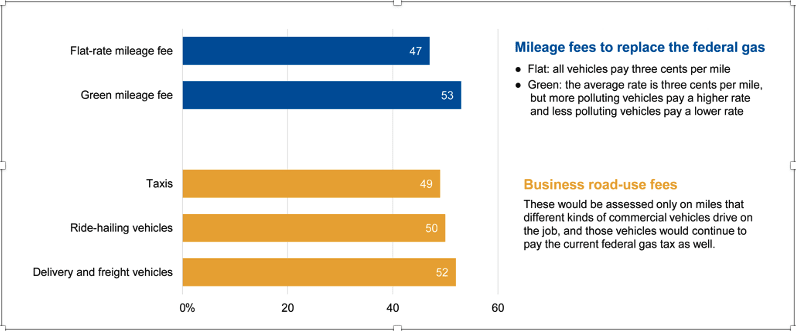
The Mineta Transportation Institute (MTI) released the topline results from its 12th annual survey exploring public support for federal transportation taxes and fees, which found that 53% of Americans supported the concept of a “green” mileage fee. The fee described would charge drivers an average rate of three cents per mile driven, with lower rates for less polluting vehicles and higher rates for more polluting vehicles.
The survey findings offer a snapshot of current public opinion about mileage fees at a time when both Democratic and Republican officials are openly discussing them as a possible replacement for the gas tax. Mileage fees are expected to be part of the conversation when Transportation Secretary Pete Buttigieg speaks about President Biden’s infrastructure priorities to the House Committee on Transportation and Infrastructure. Both ranking members of that committee — Rep. Pete DeFazio (D-OR) and Rep. Sam Graves (R-MO) — have already expressed support for investigating mileage fees.
The MTI survey series has documented steadily increasing growth in mileage fees. In 2010, the first year of the survey series, support for the green mileage fee was only 33%. This year’s 53% support is 20 percentage points higher.
This year’s survey also found that Americans would like to see any new mileage fee consider equity and ability to pay. Close to two-thirds (62%) thought that if Congress adopts a mileage fee, low-income drivers should pay a reduced rate.
Other key 2021 survey findings about mileage fees include:
Just over half of respondents (52%) thought mileage fee rates should be lower for electric vehicles than for gas and diesel vehicles.
If Congress were to adopt a federal mileage fee to replace the gas tax, three quarters of people (76%) would prefer to pay monthly or at the time they buy fuel or charge a vehicle. By comparison, only 24% who would prefer to pay an annual bill.
Approximately half of respondents also supported the idea of a “business road-use fee” that would be assessed on the miles that commercial vehicles drive on the job: 52% of people supported such a fee on delivery and freight trucks, 50% supported such a fee on ridehailing vehicles, and 49% supported such a fee on taxis.
The survey data for this study was collected from a nationally representative sample of 2,516 adults living in the U.S. Respondents completed the online survey between February 5 and February 23, 2021.
In June, the Mineta Transportation Institute will release a detailed report on the survey findings. This report will present findings related to both the federal gas tax and mileage fees, compare the opinions of different population subgroups (e.g., people who drive vs. those who do not), and discuss how public opinion on federal transportation taxes has evolved since 2010.
More New Mobility

ENC Unveils ZAVIR Medium-Duty Electric Shuttle at APTA EXPO
The new ZAVIR brand targets shuttle and paratransit operations with battery-electric and range-extended electric vehicle options.
Read More →
Public Transit Conference Returning to GFX in 2027, Call for Papers Now Open
The Call for Papers is now open, allowing transit agency professionals and industry experts to help shape the PTC educational program by submitting session ideas for consideration.
Read More →
Everett Transit, Community Transit Outline Consolidation Agreement
The proposed agreement calls for a 50% increase in bus service in Everett, a new microtransit zone, continued paratransit service, and the transfer of Everett Transit operations to Community Transit.
Read More →
What Multimodal Data Can Tell Transit Agencies About Rider Demand
See how bike-on-bus data is giving transit agencies new insight into rider demand, capacity constraints, and gaps in first- and last-mile connections.
Read More →
From Hardware to Digital Partner: Luminator Charts Its Next Chapter
CEO Magnus Friberg discusses Luminator’s shift toward becoming a digital partner, the growing importance of software and interoperability, and how AI can help agencies improve operations and passenger experience.
Read More →
Biz Briefs: Alstom Lands Canadian Contract, LYT to Supply California TSP, and More
In METRO's latest installment, we take a look at recent news from Complete Coach Works, Beep, FlixBus, and more partnerships making headlines across the transportation sector.
Read More →
CharterUP’s Armir Harris on Technology, AI, and the Future of Group Mobility
In a recent episode of METROspectives, CharterUP Founder/CEO Armir Harris discussed the company’s evolution from an online charter bus marketplace into a technology platform supporting public- and private-sector mobility and much more.
Read More →
Jacksonville’s NAVI Project Charts a New Course for Autonomous Public Transportation
Through its NAVI program, JTA is showing how autonomous vehicles, intelligent infrastructure, and coordinated operations can work together to deliver everyday public transportation.
Read More →
Biz Briefs: Luminator Marks Milestone and More
From manufacturers and suppliers to transit agencies and motorcoach operators, these updates offer a snapshot of the projects, partnerships and business moves driving the industry forward.
Read More →
New Tricks for Old Bureaucracies: Joshua Schank on Making Transit Innovation Stick
Former LA Metro Chief Innovation Officer Joshua Schank discusses why good ideas aren't enough, how transit agencies can overcome resistance to change, and why today's challenges demand more innovation.
Read More →