



L.A. Metro Breaks Ground on ‘Rail to Rail’ Active Transportation Corridor Project
The new 5.5-mile bicycle and pedestrian path that will transform a blighted, unused rail corridor in South Los Angeles and connect local bicyclists and walkers to current and future Metro rail lines in South Los Angeles.

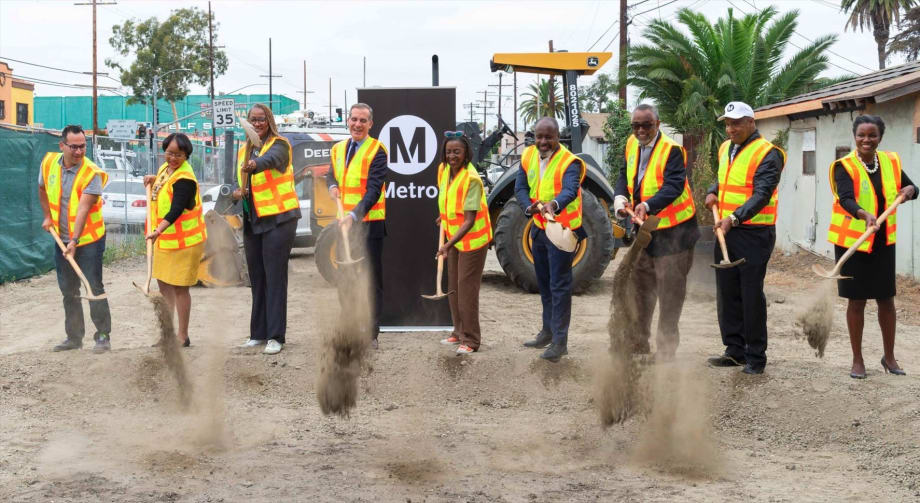
The $143 million project, paid for by a variety of city, county, state, and federal funding sources, is a significant investment in the South L.A. community and will inject new life and vibrancy into the historically disadvantaged area.
L.A. Metro
The Los Angeles County Metropolitan Transportation Authority (Metro) broke ground on the Rail to Rail Active Transportation Corridor Project, a new 5.5-mile bicycle and pedestrian path that will transform a blighted, unused rail corridor in South Los Angeles and connect local bicyclists and walkers to current and future Metro rail lines in South Los Angeles.
The $143 million project, paid for by a variety of city, county, state, and federal funding sources, is a significant investment in the South L.A. community and will inject new life and vibrancy into the historically disadvantaged area. It is expected to be completed in 2024.
The path will connect the future K Line (Crenshaw/LAX) Fairview Heights Station, Metro Silver Line, and the A Line (Blue) Slauson Station with a two-way Class I, II, and III bike path and pedestrian walkway along Metro-owned right-of-way and along city and county streets. Path amenities will include extensive landscaping, including several hundred shade trees, greenery, lights, security cameras, street furniture, and wayfinding signage, among others.
The path will be constructed along the former Harbor Subdivision and will improve access to the neighborhood communities of Hyde Park, Chesterfield Square, Harvard Park, Vermont-Slauson, South Park, and Central-Alameda.
Rail to Rail was funded through a variety of sources, including a federal TIGER grant, Transportation Development Act funds, proceeds from Metro’s 2008 Measure R sales tax, L.A. County’s Measure W Safe and Clean Water Grant, L.A. County Repurposed Earmark, the State Active Transportation Program Grant, and a CalSTA Soil Mitigation Grant.
“I could not be happier to see this important active transportation project break ground,” said Metro CEO Stephanie Wiggins. “The Rail to Rail project will improve on a well-worn path thousands of people in the community used every day, improving access to transit and adding beautiful amenities to the community in the process. Thank you to the Metro Board, the City of L.A., our federal and state partners, and everyone else who worked so hard to bring this project to the people of South L.A.”
The latest census data reveals that this corridor has some of the county’s highest percentages of people who rely on transit, biking, and walking to commute. Nearly 19% of households in the area do not have access to a car. Census data also indicates that nearly 4,300 pedestrians and 2,500 cyclists use the corridor each day. Rail to Rail will provide a significant safety benefit for bicyclists and pedestrians because the new path will be mainly separated from busy, congested local streets.
Adding to new transit options in the area, Metro anticipates opening the K Line later this year. The K Line will extend from E Line (Expo) at Expo/Crenshaw Station and merge with C Line (Green) at Aviation/LAX Station, connecting the Crenshaw Corridor, Inglewood, and El Segundo. It will add another 8.5 miles to the 106-mile Metro Rail System.
More New Mobility

Biz Briefs: Alstom Lands Canadian Contract, LYT to Supply California TSP, and More
In METRO's latest installment, we take a look at recent news from Complete Coach Works, Beep, FlixBus, and more partnerships making headlines across the transportation sector.
Read More →
CharterUP’s Armir Harris on Technology, AI, and the Future of Group Mobility
In a recent episode of METROspectives, CharterUP Founder/CEO Armir Harris discussed the company’s evolution from an online charter bus marketplace into a technology platform supporting public- and private-sector mobility and much more.
Read More →
Jacksonville’s NAVI Project Charts a New Course for Autonomous Public Transportation
Through its NAVI program, JTA is showing how autonomous vehicles, intelligent infrastructure, and coordinated operations can work together to deliver everyday public transportation.
Read More →
Biz Briefs: Luminator Marks Milestone and More
From manufacturers and suppliers to transit agencies and motorcoach operators, these updates offer a snapshot of the projects, partnerships and business moves driving the industry forward.
Read More →
New Tricks for Old Bureaucracies: Joshua Schank on Making Transit Innovation Stick
Former LA Metro Chief Innovation Officer Joshua Schank discusses why good ideas aren't enough, how transit agencies can overcome resistance to change, and why today's challenges demand more innovation.
Read More →
How DART's GoPass Is Redefining Regional Mobility
Serving 14 transit agencies, GoPass simplifies multimodal travel by allowing riders to plan, pay for, and manage an entire trip through one app.
Read More →
Biz Briefs: OCTA Taps Clean Energy for Hydrogen Station, Stadler to Supply Via Rail Vehicles, and More
From manufacturers and suppliers to transit agencies and motorcoach operators, these updates offer a snapshot of the projects, partnerships and business moves driving the industry forward.
Read More →CharterUP Expands Into New Mobility and Autonomous Transportation
Vice President of New Mobility Stephen Joos discusses how CharterUP is leveraging its nationwide transportation network, technology platform, and autonomous vehicle partnerships to expand into workforce mobility, campus shuttles, and transit solutions.
Read More →
METRO Magazine Announces 2026 Innovative Solutions Awards Winners
Projects Recognized for Advancing Mobility Through Technology, Accessibility, Workforce Innovation, and Operational Excellence
Read More →
Biz Briefs: STV teams with Amtrak, Motorcoach Operators Boost Fleet and Land Contracts, and More
From manufacturers and suppliers to transit agencies and motorcoach operators, these updates offer a snapshot of the projects, partnerships and business moves driving the industry forward.
Read More →