




A Good Sign: L.A. Metro Saw Ridership Increase in 2022
L.A. Metro Board Approves Contract for Light Rail Project
The new 6.7-mile light rail is planned to include 11 new light rail stations along Van Nuys Boulevard.
February 28, 2023
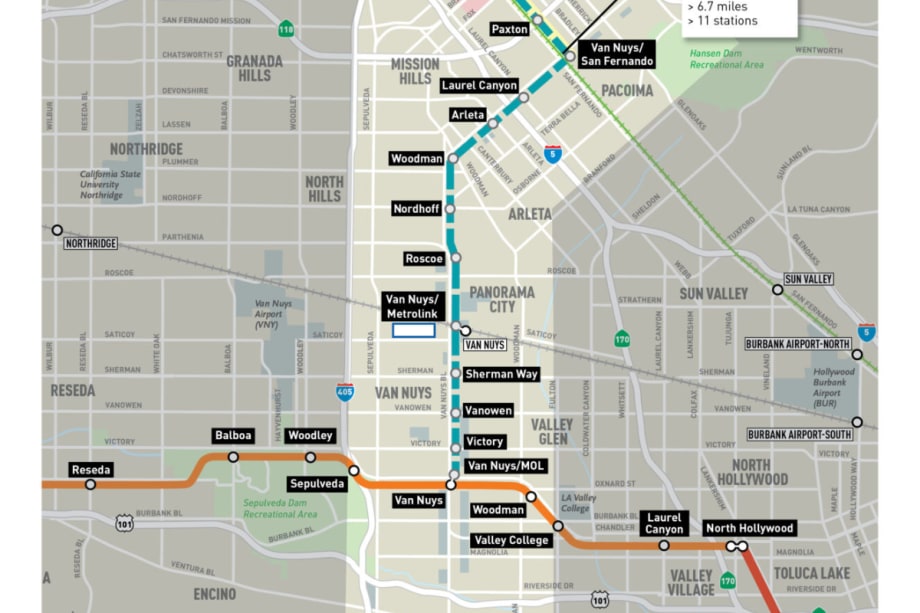
The rail line will also provide key linkages with Metro bus lines, including the G Line (Orange) in Van Nuys and municipally operated bus lines.
Photo: Metro
4 min to read
The Los Angeles County Metropolitan Transportation Authority (Metro) announced its Board of Directors has approved a $31 million pre-construction services contract with San Fernando Transit Constructors for the East San Fernando Valley (ESFV) Light Rail Transit Line Project.
Provisions within the contract will ensure SFTC implements a plan to interact cross-culturally with the diverse communities along the project corridor, according to Metro's news release.
The new 6.7-mile light rail is planned to include 11 new light rail stations along Van Nuys Boulevard and will improve connections to and access between Van Nuys and Pacoima. Several Equity Focus Communities are close to the planned rail line.
Progressive Design-Build
Metro said is planning to employ Progressive Design-Build (PDB) to build the light rail line. PDB has become more common in public-sector projects in recent years and has proven to help decrease project change orders, delays, and cost overruns.
PDB allows design, engineering, and construction teams to work together during the earliest stages of project development, rather than the traditional design method that utilizes a more siloed approach, enabling greater engagement, transparency, and collaboration between all parties on a project.
PDB can also help reduce scope and schedule creep by addressing the highest risk elements much earlier in the process, well before construction begins, according to Metro.
SFTC will also utilize the Board-approved PDB contract method for its pre-construction services contract.
"This contract approval confirms our commitment to moving forward on this transformational project in the most efficient and cost-effective way," said Ara J. Najarian, Metro Board chair. "We’re employing an innovative method to do this pre-construction work, as well as requiring a ‘cultural competency’ component – a first of its kind at Metro – that will help us ensure we engage nearby communities in a manner that is equitable, inclusive and culturally sensitive to their needs."
Cultural Competency Built-In
SFTC had the highest-rated plan for "cultural competency" in its contract proposal. SFTVC’s cultural competency plan best-encompassed consideration of race, ethnicity, gender, immigration status, languages spoken, socioeconomics, and public transportation dependency, among others.
The joint venture firm identified at least 20 community-based stakeholder organizations to engage as part of the pre-construction design-build process, with a particular focus on Spanish-language outreach.
"The communities that surround the new East San Fernando Valley Light Rail corridor are highly transit-dependent and predominantly Latino," said Paul Krekorian, L.A. City Council president. "That’s why it’s especially important that our contractor be committed to community-specific approaches like language translation and interpretation so all residents clearly understand the planned pre-construction services work as well as the overall benefits this new line will bring to their communities."
With the Board's approval of this contract, SFTC will, as part of Phase 1, review existing design work, conduct a constructability review, and perform value engineering and bottoms-up cost estimating and scheduling.
During Phase I, SFTC will complete design validation, identify and negotiate early works packages such as advanced utility relocations and final design, and develop the scope of work and price for Phase 2.
Phase 1 will end if Metro and SFTC agree to a guaranteed maximum price and Metro will issue a supplement to the project contract to proceed to Phase 2, kicking off the construction portion of the project.
The East San Fernando Valley Line
The rail line’s first segment will travel along the median of Van Nuys Boulevard and include 11 new stations that will connect the cities of Van Nuys, Panorama City, Arleta, and Pacoima. Destinations available along the new line will include the Van Nuys Civic Center, Panorama Mall, Van Nuys multi-residential housing complexes, and Arleta High School, among others.
The rail line will also provide key linkages with Metro bus lines, including the G Line (Orange) in Van Nuys and municipally operated bus lines.
The second planned segment will potentially turn northwest into the Metro-owned right-of-way along San Fernando Road and connect to the City of San Fernando.
This project will improve transit equity for Valley commuters by bringing cost-effective mobility options and greater access to opportunity for its residents.
East San Fernando Valley Light Rail Transit Line Project is funded by 2008 Measure R and 2016 Measure M transportation sales tax measures, as well as funding from county, state, and federal resources.
More Rail

Stadler, CapMetro Sign Long-Term Rail Fleet Support Agreement
Beginning in 2027, Stadler will provide on-site technical expertise, spare parts support, training, and obsolescence management to help extend the reliability and longevity of CapMetro’s GTW fleet.
Read More →
Biz Briefs: Alstom Lands Canadian Contract, LYT to Supply California TSP, and More
In METRO's latest installment, we take a look at recent news from Complete Coach Works, Beep, FlixBus, and more partnerships making headlines across the transportation sector.
Read More →
CATS Gold Line Marks 5 Years of Service, 2.8M Passenger Trips
With a six-mile expansion planned, the Charlotte streetcar is positioned to connect more neighborhoods and major transit hubs across the region.
Read More →
Why Simulating Pedestrian Movement Has Become Essential for Modern Rail Stations
Pedestrian microsimulation is helping rail planners identify bottlenecks, test station designs, and prepare complex transit hubs for growing passenger volumes.
Read More →
Amtrak Begins Major Construction at New York’s Sunnyside Yard
The new maintenance facility will support Amtrak’s Airo trainsets while improving maintenance efficiency and turnaround times in New York.
Read More →
Chicago Leaders Unveil Plans for O’Hare Airport Express Train
The privately developed project would offer a 15-minute trip between downtown and O’Hare’s Terminal 2, with trains operating every 15 minutes on a dedicated track. The service would use battery-electric trains and three existing freight rail rights-of-way.
Read More →
OCTA Maps Out 30-Year Strategy to Protect Coastal Rail Corridor
The draft feasibility report identifies strategies to protect the coastal rail line for decades as the agency continues near-term stabilization and sand placement efforts.
Read More →
The Business Voice Behind Public Transportation
As chair of APTA’s Business Members Board of Governors, Ray Melleady explains how more than 850 business members are partnering with transit agencies to advance funding, innovation, and industry-wide collaboration.
Read More →
FRA Announces $5.3B in Rail Investments, Including $2B for Amtrak
Funding will support grade-crossing improvements, infrastructure upgrades, and new Amtrak equipment in 23 states.
Read More →
Finding the ‘Happy Medium’: Optimizing Maintenance Without Sacrificing Reliability
The key to maintenance optimization isn’t doing less work—it’s doing the right work at the right time on the right assets.
Read More →