



Ohio's SARTA Approves Revised Budget to Tackle Shortfall
The first resolution revises the 2024 revenue and capital budget from $33 million to $29.9 million and reflects a $994,511 shortfall in sales tax revenue, $76,000 reduction in proceeds from fares, a $2.2 million decrease in anticipated federal funding, and an $800,000 increase in SARTA’s local share of capital budget projects.

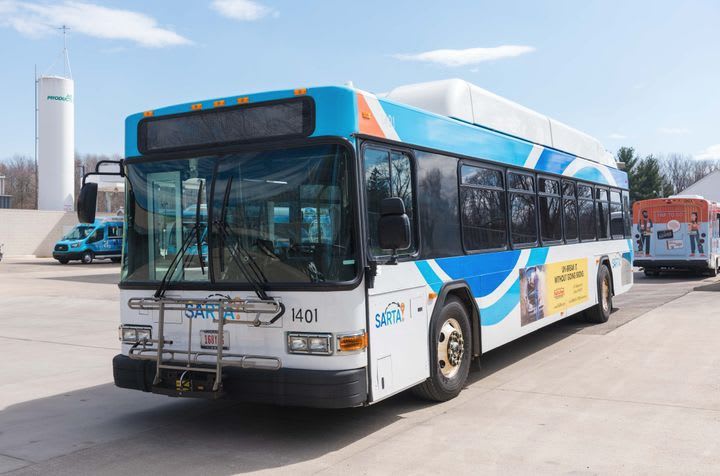
SARTA approved a $5.2 million operating and capital budget for January and February 2025. A budget for the remainder of the year is being formulated and will be based on a projected $1 million reduction in sales tax revenue and a $3.7 million decrease in anticipated federal operating assistance in 2025.
Photo: SARTA
During its regularly scheduled meeting, the members of Canton, Ohio’s Stark Area Regional Transit Authority (SARTA) board approved a number of resolutions that will enable the agency to effectively deal with fiscal challenges caused by significant reductions in projected tax revenue, fares, and federal funding that, left unaddressed, would have resulted in a $4.1 million budget deficit for the year 2024.
The first resolution revises the 2024 revenue and capital budget from $33 million to $29.9 million and reflects a $994,511 shortfall in sales tax revenue, $76,000 reduction in proceeds from fares, a $2.2 million decrease in anticipated federal funding, and an $800,000 increase in SARTA’s local share of capital budget projects.
Additional Board Actions
The SARTA board also:
Approved a $5.2 million operating and capital budget for January and February 2025. A budget for the remainder of the year is being formulated and will be based on a projected $1 million reduction in sales tax revenue and a $3.7 million decrease in anticipated federal operating assistance in 2025.
Signed off on the previously announced suspension of five fixed routes.
Authorized the restructuring of Proline — SARTA’s Americans with Disabilities Act (ADA) compliant service to serve only origins and destinations within .75 miles of a fixed route.
“The steps we took today will enable us to effectively and responsibly address the fiscal challenges we now face and carefully plan for the future,” said SARTA CEO Kirt Conrad.
He also said SARTA will do everything possible in the days, weeks, and months ahead to:
Enhance the quality of life in the community by providing efficient, affordable, and sustainable mobility options for Stark County.
Ensure that residents have access to education, employment, medical care, shopping, libraries, recreational venues, and thousands of destinations across Stark County and beyond.
Operate within the budget and in a fiscally responsible manner.
Offer mobility options that meet the diverse needs of the public.
Maintain the agency's commitment to sustainability and zero-emission technology.
Restructuring of ADA Program
Conrad acknowledged that riders, family members, and agencies SARTA works with and partners with are extremely concerned about the impending restructuring of Proline.
“We understand those concerns and we will work with all interested parties and stakeholders to develop and implement a new service model, but we’ve known for more than four years that continuing to operate Proline as a countywide, on demand, point-to-point, unlimited service is simply not sustainable from a fiscal, logistical, or managerial standpoint,” he said.
“The existing model, which has not been changed significantly in 25 years, gives us no control over the number of trips a rider may take a day or the destination(s), length or purpose of those trips,” Conrad continued. “As a result, we must have vehicles and operators on standby ready to answer calls and provide rides as they are requested. That alone generates 100 hours of overtime per day which places an incredible strain on our budget. SARTA is the only transit system in Ohio that operates countywide complementary ADA paratransit service.”
Conrad added that despite that strain, the agency had planned to continue operating Proline as-is until it was prepared to fully implement new proven ADA and on demand services that would be accepted and embraced by SARTA stakeholders.
“The fiscal challenges we now face disrupted that plan and require us to begin making incremental changes that will substantially reduce Proline’s negative fiscal impact when they take effect in February,” Conrad said.
New Countywide Paratransit Service
The board was provided an outline of the first iteration of the restructured service during the board meeting.
Under this proposal SARTA will provide ADA and Non-ADA trips. Customer Service Representatives will use scheduling software to determine if a trip is ADA or Non-ADA.
“While this situation may be disconcerting to some, we are confident that we are on the road to developing a new innovative service that will enable us to achieve the twin goals of delivering the greatest value for the taxpayer dollars we receive, as well as the outstanding public transit service the residents of Stark County want, need, and deserve,” said Conrad.
The board will be asked to approve the new non-ADA service in early January, with the revised services set to go into effect February 10.
More Management

METRO Opens Submissions for 2026 Motorcoach Awards
Nominations are now being accepted for METRO Magazine’s Operator of the Year and Innovative Operator of the Year awards.
Read More →
New York MTA Advances Final Contract for Second Avenue Subway Expansion
Contract Four is the largest in the Second Avenue Subway Phase 2 project and includes construction of station infrastructure, tracks, and signals for the subway expansion, MTA officials said. Work on Contract Four will begin in 2027.
Read More →
Transit Agencies Highlight Safety Gains at National Summit
Leaders from 15 major transit systems shared crime-reduction results and safety initiatives while discussing the role of continued federal support.
Read More →

NITA Names New Leadership, Expands Reduced-Fare Program at First Board Meeting
The new regional transit authority appointed its first board chair and interim executive director while extending reduced fares across CTA, Metra, and Pace for eligible riders.
Read More →
Beyond the Checklist: A Structured Approach to Transit Maintenance
Reliability-Centered Maintenance helps transit agencies move beyond routine checklists to focus limited resources on the assets and failures that have the greatest impact on safety, reliability, and service.
Read More →
APTA 2026 Nominating Committee Selects Leadership Slate, Names Chair and Vice Chair Nominees
Leadership changes will help shape the association’s priorities and its representation of the transportation industry during the 2026–2027 term.
Read More →
DART Launches Major Security, Fare Enforcement Initiative
The 90-day demonstration will deploy coordinated security teams at five light rail stations while testing controlled access and gathering data to guide future investments.
Read More →
Advancing Fare Collection Through Technology and Innovation
Learn about delivering 1300 gates at 91 stations while managing fare evasion. Explore the large scale deployment, solution customization and real-world results that affect the region. Prepare for deployment in your region now.
Read More →
Game Day in Motion: Moving Millions During the 2026 World Cup
Between packed transit stations and team motorcoaches, see how agencies and operators across North America tackled the transportation demands of the 2026 FIFA World Cup.
Read More →
Surface Transportation Extension Averts Shutdown, Leaves Transit Funding Gap
The stopgap keeps federal transportation programs moving, but missing advance funding could complicate the transit and rail projects agencies are planning next.
Read More →