



Greenlink’s New Expanded Facility Opens Opportunities in Transit
Greenlink’s new maintenance facility gives the agency room to expand. The agency is preparing to increase its services to keep up with area growth and help bring communities together.

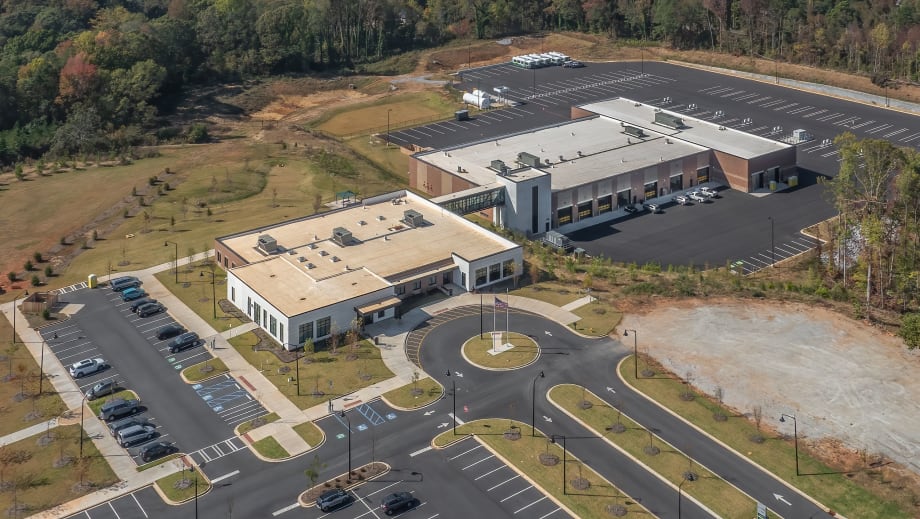
Greenlink’s new 26-acre maintenance facility gives them plenty of room to maintain their current fleet while allowing them to expand their service and implement more alternative fuel vehicles.
Photo: Greenlink/J and /J D Images
- Greenlink's new maintenance facility provides the necessary space for service expansion.
- The agency plans to enhance transit services in response to regional growth.
- The expanded facility aims to foster community connectivity.
*Summarized by AI
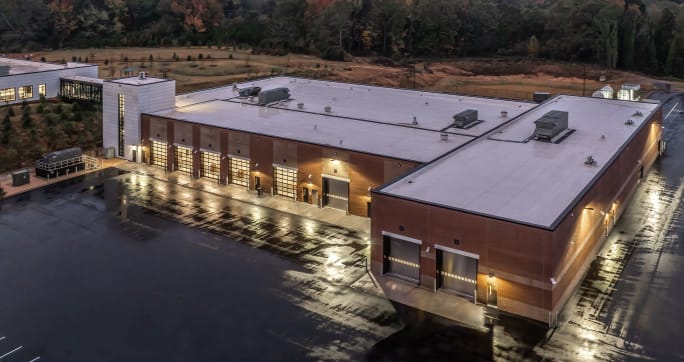
Greenlink’s new maintenance facility features a shop area large enough to accommodate the expansion of its fleet and has everything needed to maintain and fuel alternative-fuel buses.
Photo: Greenlink/J and /J D Images
Greenville, S.C., recently saw an upgrade to Greenlink Transit’s network thanks to the completion of a new maintenance facility. This facility marks the first step in preparing the agency to expand and improve its services.
Getting Started on the New Facility
The project started after a comprehensive operations analysis in 2017, and a transit development plan was established in 2018. With these completed, it was quickly confirmed that a new maintenance facility would be needed to expand their services.
“The transit development plan we developed in 2018 included expanding routes and our service,” said James Keel, Greenlink’s director. “We expanded our weeknight service in January 2021 and would like to introduce expanded Saturday service and bus frequencies, as well as add Sunday service and 19 new bus routes. We recognized we would need a larger maintenance facility to accomplish this.”
Another key reason a new facility was considered is the ability to keep up with the area's growth. Increasing services will be necessary as Greenville continues to grow.
Greenlink is also considering expanding to new areas to help connect its community with others. One way it hopes to accomplish this is by establishing an airport service.
Outside bus routes, the agency has a trolley and paratransit service. While the paratransit service is currently smaller than its bus service, plans are underway to expand it as well.
Once a need was identified, the project officially got underway when the Federal Transit Administration awarded it an $11 million grant. With 80% of the project funded with the grant, the remaining $2.75 million was required to be provided by local sources.
The City of Greenville contributed $1.4 million to the project, and Greenville County agreed to donate the 26-acre property on which the facility was built. The land donation was finalized in 2020, enabling construction of the new facility.
Selecting the Site
The process of selecting the site of the new facility began in 2015, when Greenlink looked at nine locations to construct a new maintenance facility. Another search was conducted in 2016, looking at seven additional sites. However, neither site study was pursued due to a lack of funding.
After their work on the transit development plan was underway, a site owned by the Greenville Housing Authority was considered. This site was ultimately rejected because it was outside walking distance of an existing bus route, preventing it from being used for public meetings and depriving employees of access to public transit.
Two other locations were considered, but additional work would be needed to address environmental issues.
Recognizing that the land would likely need to be donated due to funding constraints, the agency began looking into county-owned land.
After eliminating several sites, the eventual location of the maintenance facility was selected due to its large size, access to utilities, and proximity to existing bus routes and Greenlink’s transit center.
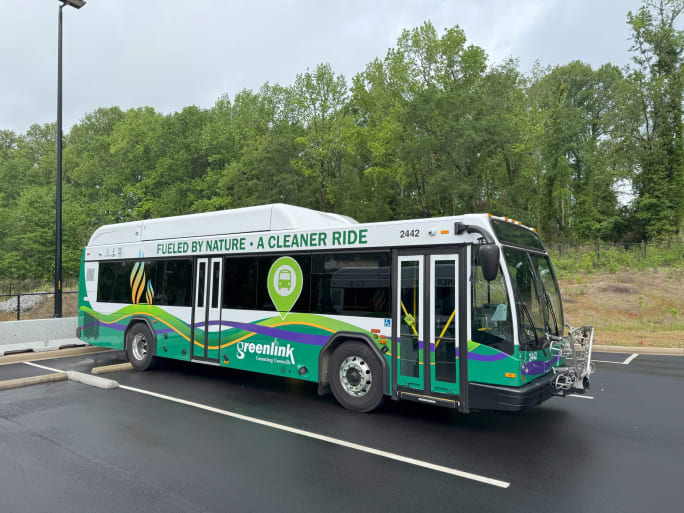
The facility was planned to include CNG fueling and an increased number of electric bus chargers to maximize the utilization of alternative fuels.
Photo: Greenlink
Moving Away from Diesel
When planning the new facility, the agency and the transit agency saw an opportunity to continue moving away from a pure diesel fleet.
The facility was planned to include compressed natural gas (CNG) fueling and an increased number of electric bus chargers to maximize the utilization of alternative fuels.
“We are working on getting away from a pure diesel fleet,” said Keel. “Maintaining a clean environment is important to us, and using alternative fuels, such as electric, can improve the rider experience.”
In addition to the fueling stations, the facility was built with electric vehicle maintenance in mind, with the tools to help mechanics work on electric vehicles.
Overall, the facility is a big step up from the previous one, and they hope that its quality will attract new employees.
“The facility has a number of new amenities: CNG fueling, additional electric bus chargers, in-ground lifts, an automatic bus wash, larger break rooms, showers and locker rooms, tire equipment, adequate parts storage, etc,” said Jason Sanders, Greenlink fleet manager. “In general, everything works better. We have more space; our mechanics and staff seem happier. There is a sense of pride in what we have built — an ownership that makes people want to work here. We have had to learn how some of the new equipment works, and there have been some issues to work through, but overall, we are happy to be here.”

Greenlink’s new maintenance facility is stocked with all the equipment mechanics need to keep the fleet running smoothly, including setups to help them maintain electric buses.
Photo: Greenlink/J and /J D Images
Expanding the Workforce
Greenlink will need an expanded workforce, both behind the wheel and in the background, to implement its proposed service expansions.
“We believe in having a quality workforce and hope the new facility will help attract that,” said Keel. “With more room and quality facilities, we hope that workers will be proud to work at the facility and will stick with us for the long term.”
With the help of an outside moving company, transferring to the new facility went smoothly, and the shop was set up fairly quickly. With everything at the new location, the agency could assume full operation of the facility in 2024.
The biggest obstacle to the move was setting up and organizing the new parts room. While larger than their previous parts room, considering growth, it challenged the organization.
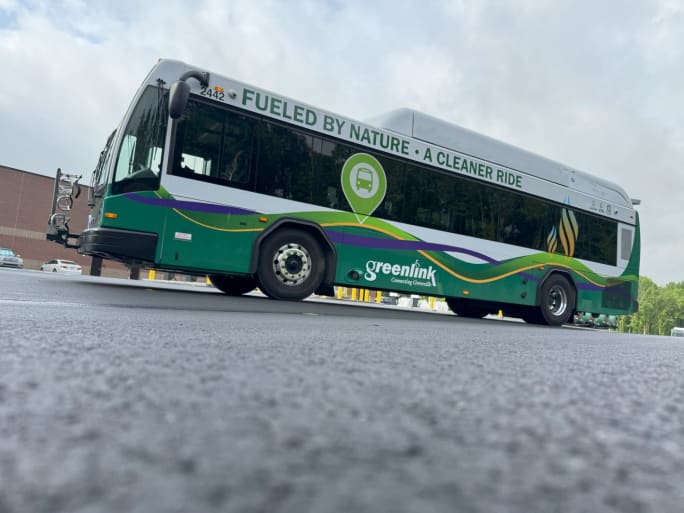
Greenlink will need an expanded workforce, both behind the wheel and in the background, to implement its proposed service expansions.
Photo: Greenlink
Other Challenges With the New Facility
Despite the city's grant and backing, funding remained Greenlink's biggest obstacle.
They have no dedicated funding source and rely on stakeholders to help fill funding gaps.
With funding challenges, the agency's biggest goal is not to lose progress.
“We currently have no dedicated funding source,” said Keel. “Luckily, our community shows a lot of support for us, and we have been able to keep going. However, it does make planning difficult.”
Some upcoming projects on the agency’s radar include replacing a large portion of its aging fleet, improving bus stops, and reimagining the downtown transit center.
Greenlink’s new maintenance facility is its pride and joy, and workers are taking advantage of the increased space.
In the long term, the new facility will enable Greenlink's expansion plans and serve as something the company can grow into as it increases its services.
Quick Answers
Greenlink's new facility is a maintenance center designed to provide the agency with the ability to expand its operations and better accommodate regional growth.
*Summarized by AI
More Bus

New York MTA Plans Largest Bus Fleet Upgrade in More Than a Decade
The agency is seeking manufacturers for 650 new CNG buses to replace aging vehicles, improve reliability, and advance its broader fleet modernization strategy.
Read More →
Building a Flexible Path to Transit Electrification
John Hroncich discusses BAE Systems’ modular and scalable approach, lessons learned from decades of real-world operations, and how agencies can identify electrification strategies that fit their fleets.
Read More →
Bus Tech Talk: Keeping Transit Technicians Ahead of the Technology Curve
LA Metro’s Obed Mejia discusses technician training, evolving maintenance technology, fleet replacement, and strategies for getting the most out of today’s transit fleets.
Read More →
Biz Briefs: RIPTA Unveils New Frontrunners, Clevland RTA Adds New Siemens, and More
In METRO's latest installment, we take a look at recent news from Siemens, Prevost, Dodge, and more partnerships making headlines across the transportation sector.
Read More →
People Movement: Holly Arnold Joins Transdev and More
In this edition, we also cover recent appointments and announcements at Pace, CamTran, MCI, and more, showcasing the individuals helping to shape the future of transportation.
Read More →
The High Cost of Transit Buses: Industry Leaders Look to Procurement Reform
Transit leaders and policymakers examine how standardized bus designs, streamlined procurement, and predictable funding could help agencies stretch budgets and deliver better service.
Read More →
The Business Voice Behind Public Transportation
As chair of APTA’s Business Members Board of Governors, Ray Melleady explains how more than 850 business members are partnering with transit agencies to advance funding, innovation, and industry-wide collaboration.
Read More →
From Surviving to Thriving: Building Stronger Transportation Organizations
Bus Business Consultants founder Brian Dickson shares lessons on leadership, organizational health, and creating options for long-term success in a changing transportation industry.
Read More →
Finding the ‘Happy Medium’: Optimizing Maintenance Without Sacrificing Reliability
The key to maintenance optimization isn’t doing less work—it’s doing the right work at the right time on the right assets.
Read More →
LA Metro, City of West Hollywood, and Partners Advance Smarter Bus Lane Enforcement
The award-winning partnership combines AI-powered detection with human oversight to improve bus reliability, accessibility, and enforcement efficiency.
Read More →