




Today’s Regional Transit Strategies Require a Multimodal Approach
How Trans-Bridge Lines Continues to Reinvent Itself After 84 Years in Transit
From pandemic recovery to digital upgrades, this family-run motorcoach company adapts to change and drives forward.
September 10, 2025
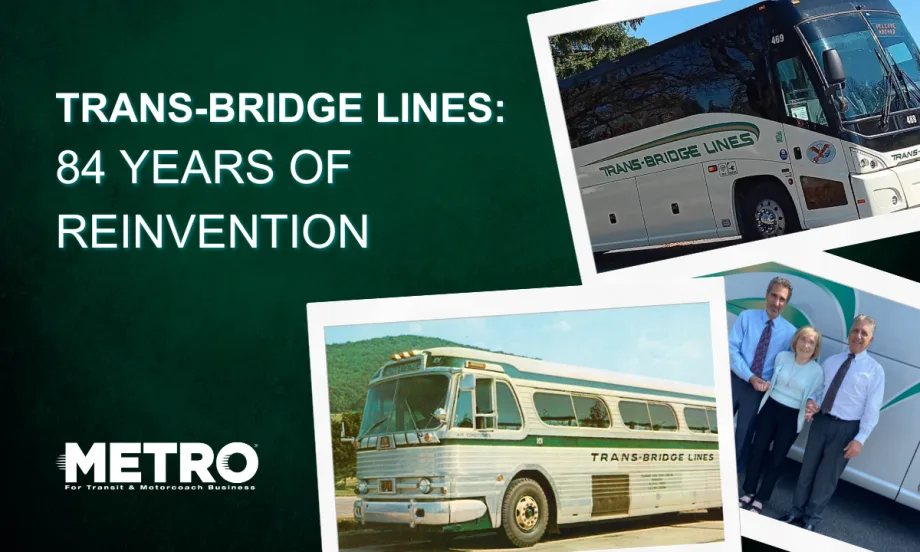
Trans-Bridge Lines has been on the road for 84 years. From the vintage buses of the 1950's to modern buses of today, the company continues to roll through any challenge.
Photo: Trans-Bridge Lines / METRO
6 min to read
- Trans-Bridge Lines, a family-operated motorcoach company, has been adept at adapting to changes over its 84-year history, ensuring continuous operational success.
- The company is focusing on pandemic recovery strategies to maintain service levels and meet evolving customer needs.
- Embracing digital upgrades, Trans-Bridge Lines aims to enhance its operational efficiency and customer experience.
*Summarized by AI
After 84 years on the road, Trans-Bridge Lines, based in Bethlehem, Pennsylvania, knows a thing or two about navigating the twists and turns of running a business in the transportation industry.
The motorcoach company operates a fleet of 39 buses:
- Twenty-nine MCI J4500s seating between 54-60 passengers.
- Three Prevost H3-45 executive coaches seating 33-36 passengers.
- Seven MCI D4500 New Jersey Transit buses seating 55 passengers.
In addition, the company operates four mini–New Jersey Transit buses and uses one MCI D4500 as a training bus.
Yet despite its long-standing presence, the biggest challenges for Trans-Bridge Lines, and the motorcoach industry in general, are decreased regular commuter ridership with the shift in popularity to remote work. At the same time, competition from warehouse and trucking jobs has made it more difficult to retain drivers and shop employees.
"Our company has faced many issues and events over the years. Some have been within our control to handle, and others have presented our team with unique situations that required new perspectives on how we do things," said Trans-Bridge Lines President Tom JeBran.
He cited the pandemic as the most prominent example, noting his grandfather, A.J. Ferraro, founder of Trans-Bridge Lines, would have been shocked by the effects the COVID-19 pandemic had on "how we do virtually everything."
A Legacy Rooted in Family and Service
Tom JeBran draws inspiration from his grandfather's vision of offering convenient service and operating the most modern buses.
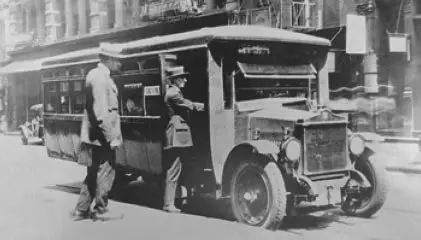
New York City, 1921. A.J. Ferraro, owner and operator, boards the bus. This bus was the nation’s first all-steel body bus built by the G. C. Kuhlman Car Company of Cleveland, Ohio.
Photo: Trans-Bridge Lines
Ferraro started his journey in the bus industry in 1917 when he added sideboards to a truck, converting it into a makeshift bus and transporting troops to Fort Dix, New Jersey. His passion led him to become a manager, consultant, partner, and owner of various New York, New Jersey, Pennsylvania, and Washington, D.C. bus companies.
In 1941, Ferraro established Trans-Bridge Lines when he took over the New Jersey Interurban Transportation Company, which was established in 1902. Trans-Bridge Lines had its roots in Warren County, NJ, where it began operating buses from a garage in Washington before moving to Broadway and eventually to Phillipsburg in 1946.
Routes served the towns of Hackettstown, Washington, Alpha, Phillipsburg, Easton, and Allentown (with sister company, Delaware River Coach Lines, Inc., founded in 1943). The company expanded under his son, John, and daughter, Camille.
At that time, Trans-Bridge Lines operated local transit service along the Port Colden, Washington, Broadway, and Phillipsburg, New Jersey corridor to Easton, Pennsylvania, and eventually grew to include Allentown, Pennsylvania. The company also operated a few charters and tour excursions.
Delaware River Coach Lines, affiliated with Trans-Bridge Lines, began local transit service between Easton and Phillipsburg in 1943, continuing today under an agreement with NJ Transit. In 1969, John Ferraro launched Holiday Tours, offering trips across the U.S. and Canada, later renamed Trans-Bridge Tours in 1980 to provide one-day, multi-day, casino, and air and cruise vacations.
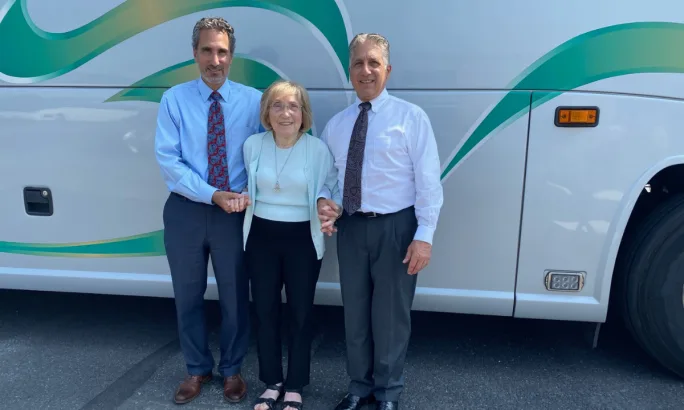
From left to right: James JeBran, executive vice president and Treasurer; Camille JeBran, corporate secretary; and Thomas JeBran, president.
Photo: Trans-Bridge Lines
Passing the Torch: A Multi-Generational Operation
After A.J. Ferraro died in 1977, his children, John, Joseph, Camille, and her husband, James JeBran, took over company leadership. By 1980, the third generation, including Camille's sons Tom and Jim JeBran, worked full-time in various roles.
"The business was always part of our everyday lives," said Executive VP/Treasurer Jim JeBran. "Being around the operation continually, Tom and I were aware of when our family was struggling."
"Our family also faced bankruptcy in 1970, after years of bleeding money trying to operate the failing transit service that Trans-Bridge and Delaware River Coaches had operated since the 40s, and before that, by predecessor companies. Due to the falling ridership and coinbox fares, we had to stop the service completely," Jim JeBran added.
Before 1981, the JeBran family operated four transportation companies across New Jersey and Pennsylvania:
- Trans-Bridge Lines and Delaware River Coaches in Phillipsburg.
- Tri-City Coach and Trans-Bridge Tours in Bethlehem.
Trans-Bridge Lines and Tri-City Coaches ran charter services with 32 buses, including vintage GMC models from the 1950s to 1970s. Meanwhile, Delaware River Coaches provided contract transit service for the New Jersey Department of Transportation using three state-owned buses, supported by Trans-Bridge's older transit vehicles.
In 1981, Trans-Bridge Lines and Tri-City Coaches merged and relocated to a 27,470-square-foot facility in Bethlehem's Lehigh Valley Industrial Park, where the company remains headquartered today. The 10-acre site houses all major departments, including maintenance, operations, and customer service, along with space for its current 39-bus fleet, repair garages, a body shop, and a mobile paint station.
Strategic Growth Through Acquisition
In 1990, John and Joe Ferraro retired, and James, Camille, Tom, and Jim JeBran began ownership. Trans-Bridge Lines purchased West Hunterdon Transit Company in 1991, increasing Trans-Bridge Lines' service area. The service area then covered the entire Lehigh Valley, New Hope, Doylestown, and Quakertown, in Pennsylvania, and Clinton, Flemington, and Lambertville, regions in New Jersey.
The company's last acquisition came in 1997 when Jim Thorpe Transportation was acquired, expanding the company's charter department.
"I was an employee of Jim Thorpe Transportation for ten years. When Trans-Bridge Lines bought the company, they offered me a position in their organization, and I have now worked here for over 26 years," said Charter Manager Susan Heffelfinger.
In the wake of the COVID-19 pandemic, Trans-Bridge Lines has shifted its focus toward its charter services, recognizing their importance for long-term sustainability. The company actively partners with schools, businesses, and groups to meet diverse transportation needs, including serving as the official transportation provider for the Lehigh Valley IronPigs and Lehigh Valley Phantoms.
Trans-Bridge operates three Prevost executive motorcoaches for transporting sports teams and maintains a fleet of over 29 full-size, standard MCI 54-60 passenger motorcoaches. The fleet mainly consists of J4500 models, along with some MCI D4500s, which are all wheelchair accessible.
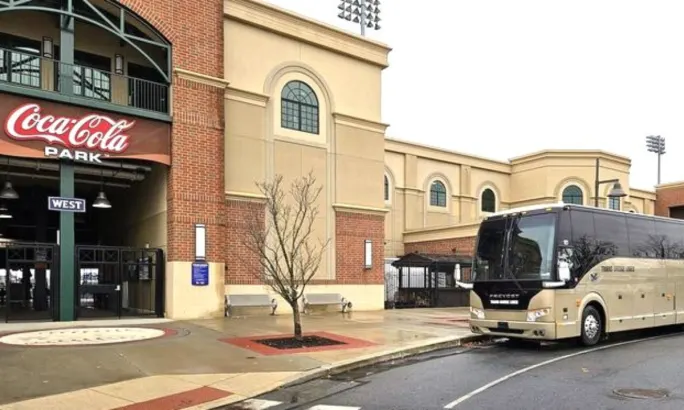
Trans-Bridge Lines Bus 127 at the Lehigh Valley IronPigs baseball stadium, Coca-Cola Park, in Allentown, Pennsylvania. Trans-Bridge Lines is the official transportation provider for the team.
Photo: Trans-Bridge Lines
Facing Today's Challenges with an Eye Toward Innovation
As Trans-Bridge Lines continues to evolve, company leadership remains focused on adapting to industry demands and rider expectations. In a competitive hiring landscape shaped by a surge in warehouse jobs and a need for truck drivers, the company has adjusted its recruitment strategy to highlight unique benefits like increased at-home time, paid training, sign-on bonuses, and employee referral incentives.
Reflecting on past ventures, President Tom JeBran acknowledges that not every initiative has succeeded, but adaptability is their strong suit.
"We have learned many lessons over the years," he said. "Some of the ideas we've implemented have failed on more than one occasion. Our company is willing to try new ventures and act nimbly, though we must also be cautious."
One forward move was the rollout of a secure and modern online ticketing system, which is something JeBran believes has reshaped how passengers interact with the company.
Building on that, the company will be adding an app, continuing to work with its vendor on the latest technologies available in preventing theft and fraud, and streamlining processes to make the customer experience efficient and convenient.
"We realized this was necessary to accommodate our travelers in managing their travel seamlessly," he said. "With the ticketing platform, Trans-Bridge Lines offers complete service, whether online, in person, or over the phone."
Overall, the family-owned motorcoach company has weathered economic challenges, shifting travel habits, and a global pandemic, emerging each time with a renewed commitment to innovation, customer service, and operational excellence.
Quick Answers
Trans-Bridge Lines has adapted by implementing pandemic recovery measures and embracing digital upgrades to remain competitive and efficient after 84 years in operation.
*Summarized by AI
Subscribe to Our Newsletter
More Management

ENC Lands MATA Contract and More in Biz Briefs
In this edition of Biz Briefs, we spotlight the latest developments shaping the future of mobility.
Read More →
From Surviving to Thriving: Building Stronger Transportation Organizations
Bus Business Consultants founder Brian Dickson shares lessons on leadership, organizational health, and creating options for long-term success in a changing transportation industry.
Read More →
Everett Transit, Community Transit Outline Consolidation Agreement
The proposed agreement calls for a 50% increase in bus service in Everett, a new microtransit zone, continued paratransit service, and the transfer of Everett Transit operations to Community Transit.
Read More →

Strada360’s Steve Lassey on Turning Transit Data Into Better Decisions
From breaking down data silos to preparing for AI, Strada360 CEO Steve Lassey discusses how transit agencies can use technology to improve operations, customer information, and long-term decision-making.
Read More →
People Movement: Phil Washington Joins HNTB, Denver RTD Launches CEO Search, and More
In this edition, we also spotlight recent personnel moves at STV, the Eno Center for Transportation, and more, highlighting the people taking on new roles across the transportation industry.
Read More →
SEPTA Details Accelerate Vision for Transit System
The plan outlines investments in trolley modernization, new Metro and Regional Rail vehicles, accessible stations, and more frequent bus and rail service.
Read More →
FTA Ends Direct Oversight of MBTA Safety Actions
The federal agency closed its remaining special directive to the Massachusetts Department of Public Utilities following a safety review that began in 2022.
Read More →
Report: Transit Bus Manufacturing Supports 34,100 Jobs, $5.1B in GDP
The “Buses Mean Business” report examines the transit bus manufacturing industry’s economic footprint, supply chain, and rising demand for vehicle replacements.
Read More →
LIT Marks 10-Year Milestone at Annual Summit
Hosted by the COTA from September 10 to 13, the Summit carried the theme “Celebrating 10 Years of Excellence, Leadership, and Impact,” with every part of the program honoring the people, agencies, and partners who built LIT over its first decade.
Read More →
People Movement: Dan Dipert Coaches Adds Third-Generation Leader, Keolis Names New Valley Metro VP/GM, and More
In this edition, we also cover recent appointments and announcements at the Wabtec, SilverRide, HNTB, and more, showcasing the individuals helping to shape the future of transportation.
Read More →