




Keep Reading: LA Metro Leverages Parking Tech to Simplify, Fuel Public Transit Usage
LA Metro Releases Final Environmental Impact Report for Transit Extension
The agency board is expected to consider project certification this fall as the project links Torrance and Redondo Beach directly to LAX and the regional rail network.
September 12, 2025
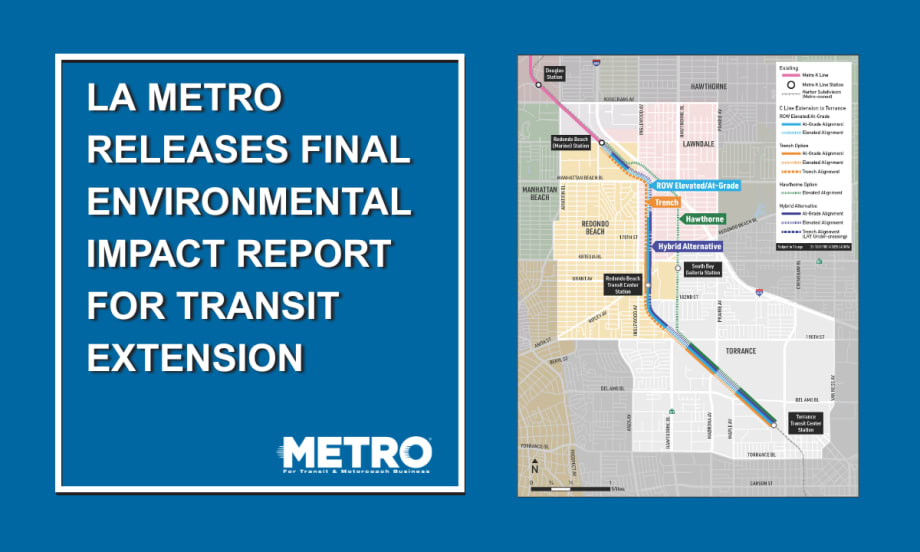
At key crossings, such as 170th Street and 182nd Street, the tracks will be placed below roadways in trenches to enhance safety, reduce noise, and minimize traffic delays for pedestrians and motorists.
Photo: METRO
3 min to read
The Los Angeles County Metropolitan Transportation Authority recently released the Final Environmental Impact Report (FEIR) for the C Line Extension to Torrance, marking a major milestone in the project.
Expanding rail service deeper into the South Bay, from the LA Metro K Line’s Redondo Beach station to the planned Torrance Transit Center station, the project would provide faster and more reliable connections, offering riders a 19-minute trip from Torrance to LAX. The project is funded in part by the voter-approved Measures R and M.
Construction could start as early as 2027, and the extension is estimated to open in 2036.
“This project represents a major step forward for the South Bay and for the entire LA Metro system,” said LA Metro Board Chair and Whittier City Council Member Fernando Dutra. “By extending rail service to Torrance, we are giving more Angelenos access to good jobs, faster commutes, and cleaner air. We look forward to working hand-in-hand with our community partners to ensure that this project best serves the needs of the community now and for generations to come.”
The FEIR reflects input from more than 2,000 public comments and includes design refinements, clarifications, and corrections. LA Metro also released updated cost estimates and a report about the real estate acquisitions that would be required to complete the project.
C Line Extension to Support Daily Trips and Reduce Vehicle Miles
In May 2024, the LA Metro Board approved the proposed route, the Hybrid Alternative, also known as the Locally Preferred Alternative, to follow LA Metro’s existing Harbor Subdivision right-of-way. It combines elevated, at-grade (street-level), and trench (below street-level) sections.
At key crossings, such as 170th Street and 182nd Street, the tracks will be placed below roadways in trenches to enhance safety, reduce noise, and minimize traffic delays for pedestrians and motorists.
Once in operation, the extension would support more than 11,500 daily trips, attract up to 1.49 million new riders annually, and reduce vehicle miles traveled on local roads by nearly 19.5 million miles each year.
By 2045, jobs in the South Bay are projected to grow nearly twice as fast as the population, while congestion could increase by almost 30 percent. The C Line Extension to Torrance offers a cost-effective way to add capacity, ease traffic, and strengthen the region’s economy.
The C Line Extension to Torrance is about connecting people and places,” said LA Metro CEO Stephanie Wiggins. “It will allow riders to travel between LAX and Torrance via rail, link local communities to our expanding transit system, and provide a faster, more reliable alternative to sitting in traffic.”
The LA Metro Board of Directors is expected to consider certification of the FEIR and project approval this fall. If approved, LA Metro will move forward with design and engineering, first/last mile planning with cities, and preparations for construction.
More Management

METRO Opens Submissions for 2026 Motorcoach Awards
Nominations are now being accepted for METRO Magazine’s Operator of the Year and Innovative Operator of the Year awards.
Read More →
New York MTA Advances Final Contract for Second Avenue Subway Expansion
Contract Four is the largest in the Second Avenue Subway Phase 2 project and includes construction of station infrastructure, tracks, and signals for the subway expansion, MTA officials said. Work on Contract Four will begin in 2027.
Read More →
Transit Agencies Highlight Safety Gains at National Summit
Leaders from 15 major transit systems shared crime-reduction results and safety initiatives while discussing the role of continued federal support.
Read More →

NITA Names New Leadership, Expands Reduced-Fare Program at First Board Meeting
The new regional transit authority appointed its first board chair and interim executive director while extending reduced fares across CTA, Metra, and Pace for eligible riders.
Read More →
Beyond the Checklist: A Structured Approach to Transit Maintenance
Reliability-Centered Maintenance helps transit agencies move beyond routine checklists to focus limited resources on the assets and failures that have the greatest impact on safety, reliability, and service.
Read More →
APTA 2026 Nominating Committee Selects Leadership Slate, Names Chair and Vice Chair Nominees
Leadership changes will help shape the association’s priorities and its representation of the transportation industry during the 2026–2027 term.
Read More →
DART Launches Major Security, Fare Enforcement Initiative
The 90-day demonstration will deploy coordinated security teams at five light rail stations while testing controlled access and gathering data to guide future investments.
Read More →
Sponsored•September 9, 2026
Advancing Fare Collection Through Technology and Innovation
Learn about delivering 1300 gates at 91 stations while managing fare evasion. Explore the large scale deployment, solution customization and real-world results that affect the region. Prepare for deployment in your region now.
Read More →
Game Day in Motion: Moving Millions During the 2026 World Cup
Between packed transit stations and team motorcoaches, see how agencies and operators across North America tackled the transportation demands of the 2026 FIFA World Cup.
Read More →
Surface Transportation Extension Averts Shutdown, Leaves Transit Funding Gap
The stopgap keeps federal transportation programs moving, but missing advance funding could complicate the transit and rail projects agencies are planning next.
Read More →