




Miss This? MBTA Joins Federal Renewable Fuel Standard Program
Boston's MBTA Celebrates Accessibility Upgrade at Franklin Station
The agency's innovative mini-high platform design brings level boarding to the Franklin/Foxboro Commuter Rail.
October 22, 2025
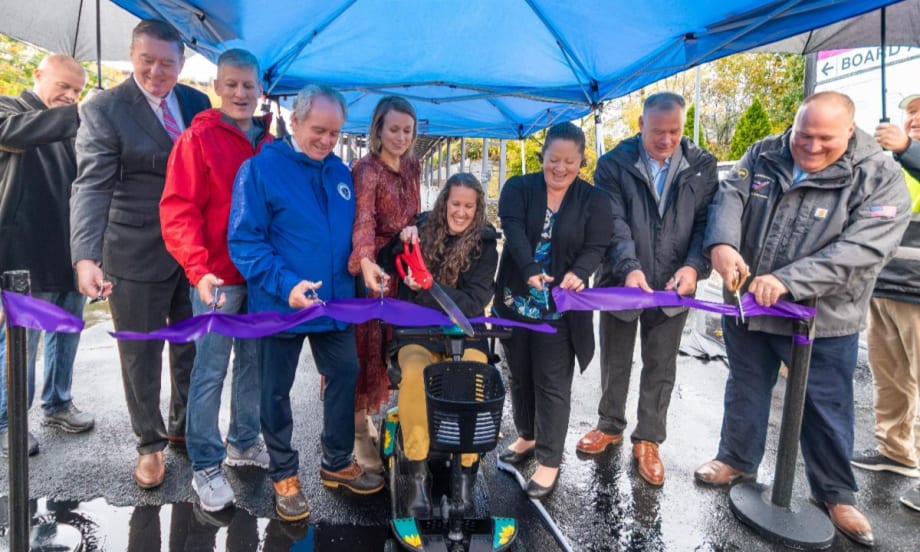
MBTA Leadership, Franklin officials, and community advocates cut a ribbon at Franklin Station.
Photo: MBTA
2 min to read
The Massachusetts Bay Transportation Authority (MBTA) held an official ribbon-cutting ceremony to honor accessibility upgrades at Franklin Station on the MBTA's Franklin/Foxboro Commuter Rail line.
The project ensures all riders can now experience stair-free, level boarding, a critical improvement from the station's previous platform, which required stairs to board trains. The station officially reopened in March 2025.
"I am proud of the teams across MBTA for continuing to deliver these projects, making it easier for everyone to use Commuter Rail," said Interim MassDOT Secretary and MBTA General Manager Phillip Eng. "Under the leadership of the Healey-Driscoll Administration, we are committed to delivering meaningful projects like this one in Franklin. There are more commuter rail stations accessible today than ever in MBTA history, and we're not done yet."
MBTA Chief Operating Officer Ryan Coholan also noted installation of new lighting, signage, electronic message boards with audio, a new canopy, tactile warning strips, benches, and trash receptacles.
"We also repaved the parking lot and relocated the accessible spaces right next to the ramp, significantly increasing the number of spaces from three to seven," Coholan said.
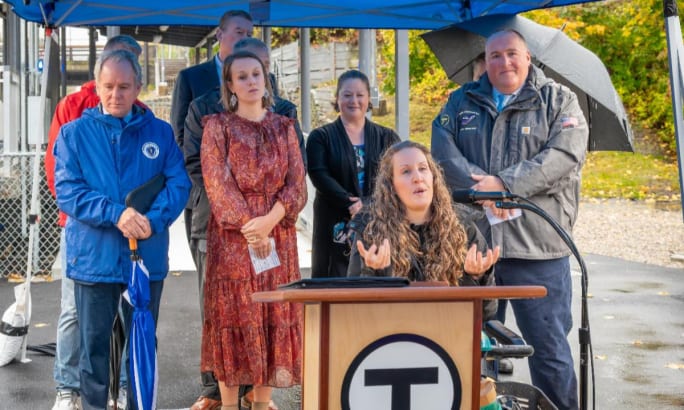
Franklin Commission on Disability Chairperson Ali Rheaume speaks during the ribbon-cutting event at Franklin Station.
Photo: MBTA
"In line with the vision of the MBTA Communities Law and HLC's mission, these improvements to the Franklin Commuter Rail station increase accessibility, livability, and the possibility of building transit-oriented housing that can accommodate the Massachusetts residents who need it," said Ed Augustus, secretary of the Executive Office of Housing and Livable Communities.
"I moved to this community because of access to two train stations," said State Representative Jeffrey Roy. "One was here when I moved here, and the second was on its way. We very much embrace it."
To achieve stair-free, level boarding, the MBTA pursued an innovative solution by designing and installing a freestanding mini-high platform on top of the original infrastructure.
More Management

Surface Transportation Extension Averts Shutdown, Leaves Transit Funding Gap
The stopgap keeps federal transportation programs moving, but missing advance funding could complicate the transit and rail projects agencies are planning next.
Read More →
Bus Tech Talk: Keeping Transit Technicians Ahead of the Technology Curve
LA Metro’s Obed Mejia discusses technician training, evolving maintenance technology, fleet replacement, and strategies for getting the most out of today’s transit fleets.
Read More →
Why Simulating Pedestrian Movement Has Become Essential for Modern Rail Stations
Pedestrian microsimulation is helping rail planners identify bottlenecks, test station designs, and prepare complex transit hubs for growing passenger volumes.
Read More →

People Movement: Holly Arnold Joins Transdev and More
In this edition, we also cover recent appointments and announcements at Pace, CamTran, MCI, and more, showcasing the individuals helping to shape the future of transportation.
Read More →
NITA Launches New Era of Regional Transit in Chicago
The new authority replaces the RTA and brings CTA, Metra, and Pace under a strengthened regional framework for funding, planning, fares, safety, and service coordination.
Read More →
How World Cup Mobility Put Transit and Motorcoaches to the Test
Behind the seamless trips were months of planning, multimodal partnerships, and lessons agencies and operators can carry into the next mega-event.
Read More →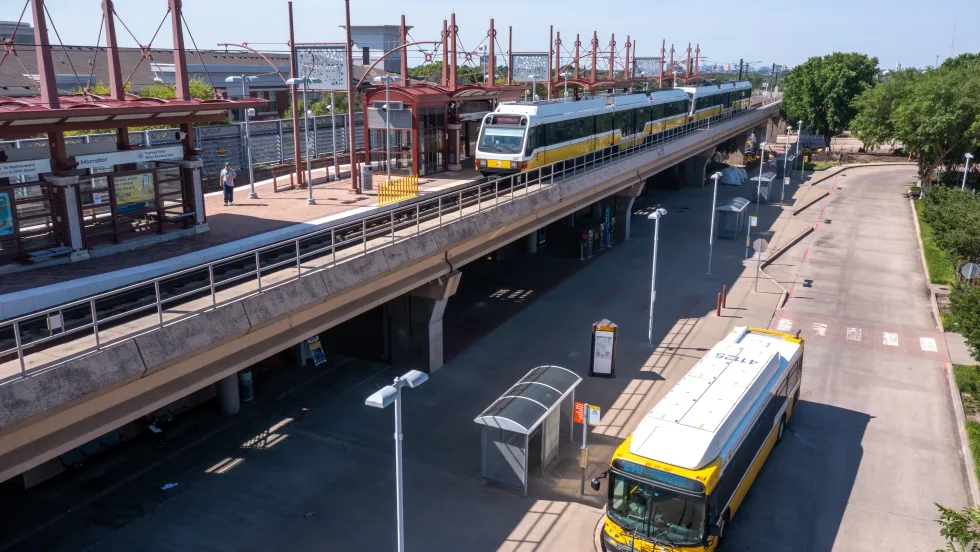
DART Introduces Dashboard to Track Ridership Data
The initial release represents the first phase of DART’s efforts to expand access to ridership information. Additional dashboard features, data, and functionality will be introduced in future phases.
Read More →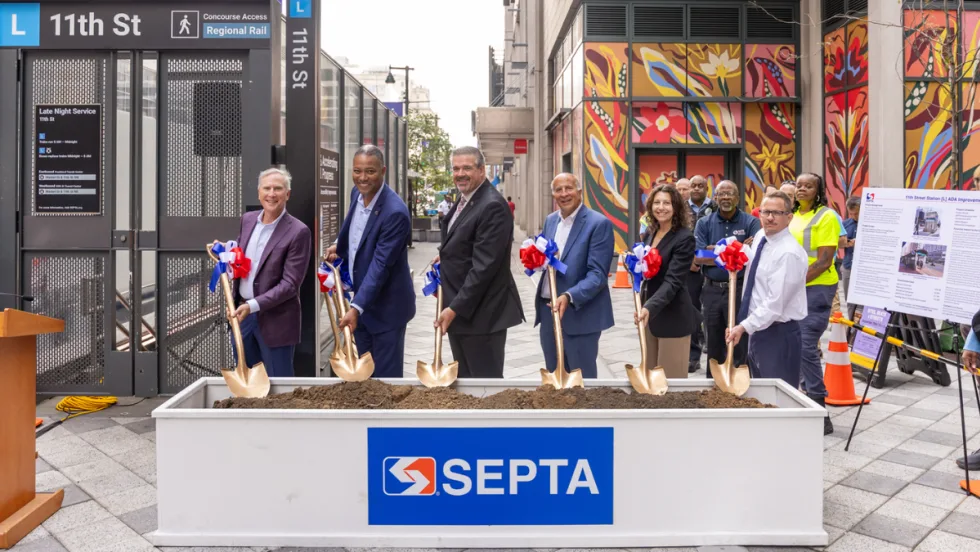
SEPTA Breaks Ground on $44M Accessibility Upgrade at 11th Street Station
The project will add elevators and other upgrades to make the busy L station fully ADA accessible, with a yearlong closure expected to accelerate construction and save up to $3 million.
Read More →
Sponsored•August 28, 2026
FTA Opens $610M for Transit Fleet Modernization
Propane autogas gives transit agencies a reliable, funding-eligible option for fleet upgrades.
Read More →
NJ TRANSIT Explores Unified Real-Time Customer Communications Platform
The agency is gathering industry input on AI, real-time data, and integrated communications technology as it prepares to procure a system that delivers faster, more consistent transit updates across every customer channel.
Read More →