



2015 Innovative Operators: Astro Travel and Tours
Top-line equipment, passenger amenities contribute to the overall experience for the Tallahassee, Fla. operator.
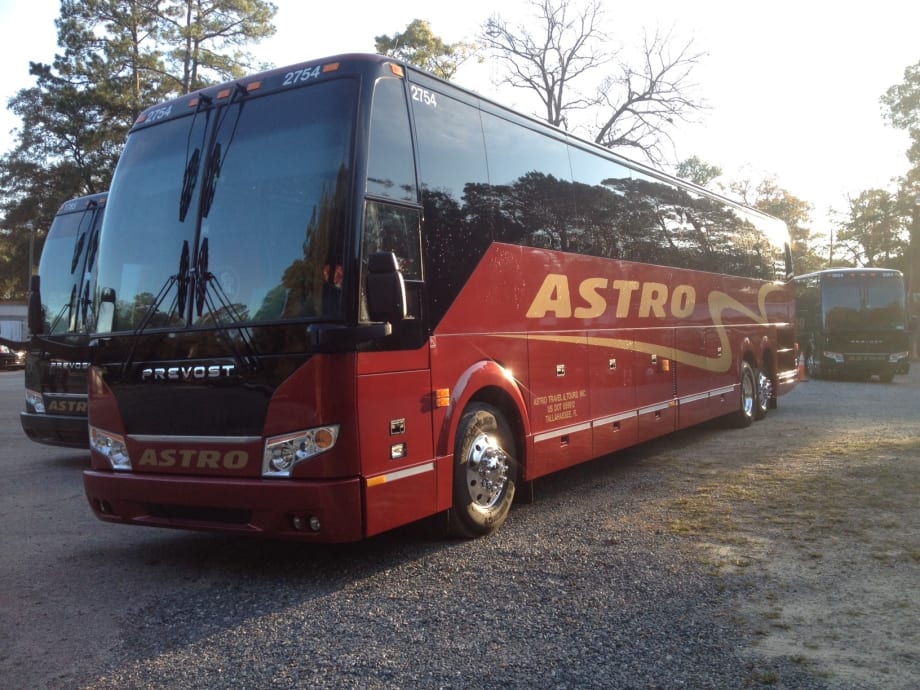
Astro Travel and Tours focuses on providing the latest amenities to their customers, which currently includes power outlets at every seat, live television and individual climate control.
Astro Travel and Tours focuses on providing the latest amenities to their customers, which currently includes power outlets at every seat, live television and individual climate control.
Tallahassee, Fla.-based Astro Travel and Tours began in 1970 as a full-service travel agency. However, as the Internet started to boom in the mid-1990’s causing the industry to take a hit, Astro purchased its first motorcoach. The goal was to supplement business by doing local shuttle work. However by 2000, Astro decided to disband its agency and continue on as a charter and tour company. Business is now comprised of 90% charter and 10% tour.
A major component of Astro Travel and Tours’ longstanding success, despite the economic odds, is their methodical and directed business strategy.
“We want to motor along and focus really intently on our geographical area to be the best we can be in that space,” says Matt Brown, Astro’s GM. “We’re not going to rush to guarantee growth or jump into another market and spread ourselves too thin. We hope to steadily do better every year.”
Regionally, senior citizens make up a key demographic, and Brown has found motorcoaches to be a preferred mode of travel.
“Not only are motorcoaches more comfortable, but a four-hour bus ride might be faster than a shorter plane ride, plus security and wait time,” Brown says. “With a bus, the journey and scenery along the way are part of the experience, not just the destination, and there’s the luxury of stopping along the way.”
As well, the company focuses on providing the latest amenities to their customers every year. This includes power outlets at every seat, live television and individual climate control. The oldest buses in its fleet are 2012 models and Astro operates strictly Prevost and Temsa vehicles.
“Other companies buy every year but still retain old motorcoaches,” Brown says. “I can’t disagree from a profit perspective, but our customers and clientele just come to expect newness from Astro, and therefore, it’s part of our business model.”
Astro’s driver retention is high, with some driving with the company since 1970. Brown connects this statistic with equipment status.
“They take so much pride in the type of equipment we put on the road,” Brown says. “That’s their product and their livelihood.”
In 2015, one of the company’s biggest efforts will be a renewed focus on driver training. The management team plans to spend more time detailing expectations and also monitoring on-board vehicles.
This past fall, Astro has implemented Quality Control Riders (QCR).
“QCRs are a group of drivers who really understand what it means to be a motorcoach operator,” Brown says. “In order to properly train our drivers, a QCR goes on the bus with a driver and monitors to make sure they’re doing things the Astro way.”
According to Brown, the idea is that if the company drivers collectively improve, the overall customer service experience will enhance as well.
“I would say we are in the beginning stages of our QCR experiment,” Brown says. “We fully anticipate that this program will have a positive impact on the way our drivers operate within our system.”
More Motorcoach

METRO Opens Submissions for 2026 Motorcoach Awards
Nominations are now being accepted for METRO Magazine’s Operator of the Year and Innovative Operator of the Year awards.
Read More →
Biz Briefs: Alstom Lands Canadian Contract, LYT to Supply California TSP, and More
In METRO's latest installment, we take a look at recent news from Complete Coach Works, Beep, FlixBus, and more partnerships making headlines across the transportation sector.
Read More →
Biz Briefs: RIPTA Unveils New Frontrunners, Clevland RTA Adds New Siemens, and More
In METRO's latest installment, we take a look at recent news from Siemens, Prevost, Dodge, and more partnerships making headlines across the transportation sector.
Read More →
People Movement: Holly Arnold Joins Transdev and More
In this edition, we also cover recent appointments and announcements at Pace, CamTran, MCI, and more, showcasing the individuals helping to shape the future of transportation.
Read More →
ABA Report: Motorcoach Travel Generates $161.6B Economic Impact
The 2025 analysis finds motorcoach travel supported nearly 900,000 jobs and generated $28 billion in federal, state, and local taxes.
Read More →
CharterUP’s Armir Harris on Technology, AI, and the Future of Group Mobility
In a recent episode of METROspectives, CharterUP Founder/CEO Armir Harris discussed the company’s evolution from an online charter bus marketplace into a technology platform supporting public- and private-sector mobility and much more.
Read More →
People Movement: ABC Names John Walsh as Chief Commercial Officer
In this edition, METRO also covers recent appointments and announcements at the DART, STV, and more, showcasing the individuals helping to shape the future of transportation.
Read More →
From Surviving to Thriving: Building Stronger Transportation Organizations
Bus Business Consultants founder Brian Dickson shares lessons on leadership, organizational health, and creating options for long-term success in a changing transportation industry.
Read More →
Biz Briefs: Luminator Marks Milestone and More
From manufacturers and suppliers to transit agencies and motorcoach operators, these updates offer a snapshot of the projects, partnerships and business moves driving the industry forward.
Read More →
ABAF Study Reveals Growing Insurance Crisis for Motorcoach Operators
Preliminary findings show 98% of operators faced premium increases over the past five years, while shrinking insurer participation is putting added pressure on businesses and customers.
Read More →