



5 Qs with Beep's Joe Moye on the Mayo Clinic AV project
On March 30, autonomous shuttles were used to transport medical supplies and COVID-19 tests for the first time in the U.S.

The JTA has actively tested AV technology since 2017 to prepare for a conversion and expansion of its Skyway automated people mover in Downtown Jacksonville into a network powered by autonomous vehicles.
Beep
On March 30, autonomous shuttles were used to transport medical supplies and COVID-19 tests for the first time in the U.S. The autonomous vehicles launched in full autonomous mode without an attendant onboard at the Mayo Clinic in Florida.
Joe Moye, CEO of Beep answers five questions on what it took to have a successful deployment in this new capacity.
Beep is primarily in the business of transportingpassengers. Did you ever think the service and technology you deploy would be used in this capacity to transport COVID-19 tests?
Certainly, the idea of multiple use cases for our autonomous vehicles is something we think about a lot. Leveraging the same assets to move people and goods is a great value proposition. That being said, we did not necessarily think about the need to move sensitive materials, as represented here with the COVID-19 tests, without human intervention.
The situation the world finds itself in today with the need to minimize human interaction in almost everything we do is a new reality, hopefully a very short-term one. Being able to partner with Mayo Clinic and the Jacksonville Transportation Authority in implementing this innovative use of autonomous platforms to support such an important cause, will only help us advance driverless mobility solutions for many important services.
Currently, Beep’s operations consist of an attendant onboard. What part of Beep’s operations and planning did you have to change to operate theCOVID-19route infull autonomous mode without an attendant onboard?
In our autonomous shuttle deployments across multiple communities today, the vehicles operate in complete autonomous mode a very large percentage of the time, over 90% even with attendants onboard.
We have safety measures for minimal manual intervention in certain scenarios such as complex intersections or other road conditions. The technology has tested well in these controlled speed, geofenced use cases. The primary changes for a full autonomous mode deployment without an attendant onboard were operational to allow for a mobile control center to monitor all video and performance measures and a remote start/stop capability for the vehicle. We have also taken steps to eliminate pedestrian and traffic interactions as an additional safety measure in these deployments.
This process with Mayo Clinic was a good exercise for our company and team because we are already planning to advance to full autonomous mode without an attendant onboard as the autonomous platforms continue to advance in capability.

Joe Moye
Beep
How was Beep, in concert with the Jacksonville Transportation Authority, NAVYA, and Bestmile, able to create, map, and deploy a routewith shuttles operatinginfull autonomous mode without an attendant onboardso quickly?
The keys with any successful deployment, and certainly with one as challenging as this in true full autonomous mode without an attendant onboard, are partnership and planning.
This is a prime example of how public/private partnerships can be a recipe for success. The Jacksonville Transportation Authority brings to the table a level of forward thinking and experience with their Ultimate Urban Circulator program where they are testing a proving out the effective use of autonomous vehicles. NAVYA and Bestmile are the shuttle and technology partners that give us the tools to make it happen. When you bring these together with Beep’s ability to provide our services and experience in designing safe routes, deploying industry leading safety practices, and delivering AV testing programs with a well architected plan, successes is possible.
With a successful deploymentofshuttles operating in full autonomous mode without attendants onboard, what changes need to be made to allow Beep and others in the autonomous vehicle industry to operate vehicles infull autonomousmode on both public and private roads?
Advancements still need to happen on multiple fronts before full autonomous mode without an attendant onboard can be achieved and deployed safely on low-speed public and private roads with the live interaction of traffic, vehicles, pedestrians, and other situations we face on our roadways every day.
From Beep’s perspective, technology needs to further mature so AVs can perceive their environment and not just react to it. What that means is giving an AV more information than a human could have in a traffic situation and having it process the information instantaneously to arrive at the right decision. The sensors and cameras of today are very good at this, but we need to continue to grow the technology. The use of external signaling and cameras will provide expanded views to detect hidden pedestrians or predict someone running a red light.
Ultimately autonomous vehicles will be much safer than driven vehicles, because they will be able to see, process, and react to information better than humans and they are never distracted or impaired, which is the root cause of 94% of traffic accidents in our country today.
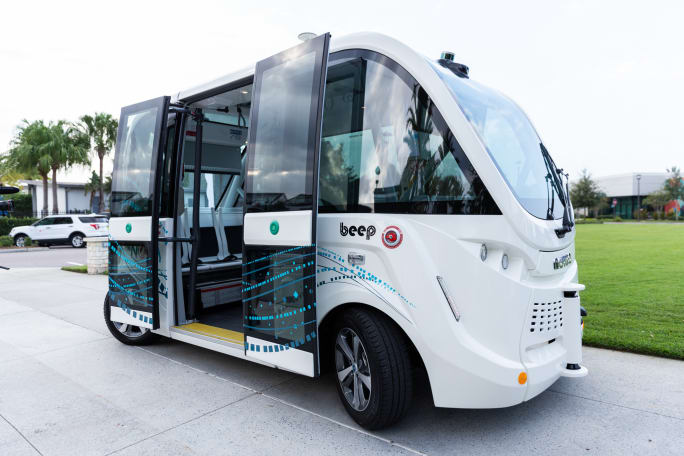
The JTA, Beep, NAVYA, and Bestmile teams partnered to create, test, and deploy the routes for the autonomous vehicles at Mayo Clinic in Florida to address the fluid developments of the COVID-19 pandemic.
Beep
What was the one thing about this deployment and process you want to share with others in the AV industry?
I would simply say that placing safety first as the guiding principal for all deployments is critical in our industry. Autonomous platforms represent one of the most explosive areas of growth in technology today and it will only come at us faster and faster.
Even in the case of rapid deployments such as this one, developing routes and operational plans that are safe and executable is an important key to escalate the momentum of this important transformation in the autonomous vehicle industry.
More New Mobility

From Hardware to Digital Partner: Luminator Charts Its Next Chapter
CEO Magnus Friberg discusses Luminator’s shift toward becoming a digital partner, the growing importance of software and interoperability, and how AI can help agencies improve operations and passenger experience.
Read More →
Biz Briefs: Alstom Lands Canadian Contract, LYT to Supply California TSP, and More
In METRO's latest installment, we take a look at recent news from Complete Coach Works, Beep, FlixBus, and more partnerships making headlines across the transportation sector.
Read More →
CharterUP’s Armir Harris on Technology, AI, and the Future of Group Mobility
In a recent episode of METROspectives, CharterUP Founder/CEO Armir Harris discussed the company’s evolution from an online charter bus marketplace into a technology platform supporting public- and private-sector mobility and much more.
Read More →
Jacksonville’s NAVI Project Charts a New Course for Autonomous Public Transportation
Through its NAVI program, JTA is showing how autonomous vehicles, intelligent infrastructure, and coordinated operations can work together to deliver everyday public transportation.
Read More →
Biz Briefs: Luminator Marks Milestone and More
From manufacturers and suppliers to transit agencies and motorcoach operators, these updates offer a snapshot of the projects, partnerships and business moves driving the industry forward.
Read More →
New Tricks for Old Bureaucracies: Joshua Schank on Making Transit Innovation Stick
Former LA Metro Chief Innovation Officer Joshua Schank discusses why good ideas aren't enough, how transit agencies can overcome resistance to change, and why today's challenges demand more innovation.
Read More →
How DART's GoPass Is Redefining Regional Mobility
Serving 14 transit agencies, GoPass simplifies multimodal travel by allowing riders to plan, pay for, and manage an entire trip through one app.
Read More →
Biz Briefs: OCTA Taps Clean Energy for Hydrogen Station, Stadler to Supply Via Rail Vehicles, and More
From manufacturers and suppliers to transit agencies and motorcoach operators, these updates offer a snapshot of the projects, partnerships and business moves driving the industry forward.
Read More →CharterUP Expands Into New Mobility and Autonomous Transportation
Vice President of New Mobility Stephen Joos discusses how CharterUP is leveraging its nationwide transportation network, technology platform, and autonomous vehicle partnerships to expand into workforce mobility, campus shuttles, and transit solutions.
Read More →
METRO Magazine Announces 2026 Innovative Solutions Awards Winners
Projects Recognized for Advancing Mobility Through Technology, Accessibility, Workforce Innovation, and Operational Excellence
Read More →