



Arizona Rail Extension Opens Early to Connect Urban Growth
Valley Metro Rail’s 3.1-mile Central Mesa light rail extension, which includes four new stations along Main Street, was added to the rail line to meet the growing transit demands in the city’s East Valley section.
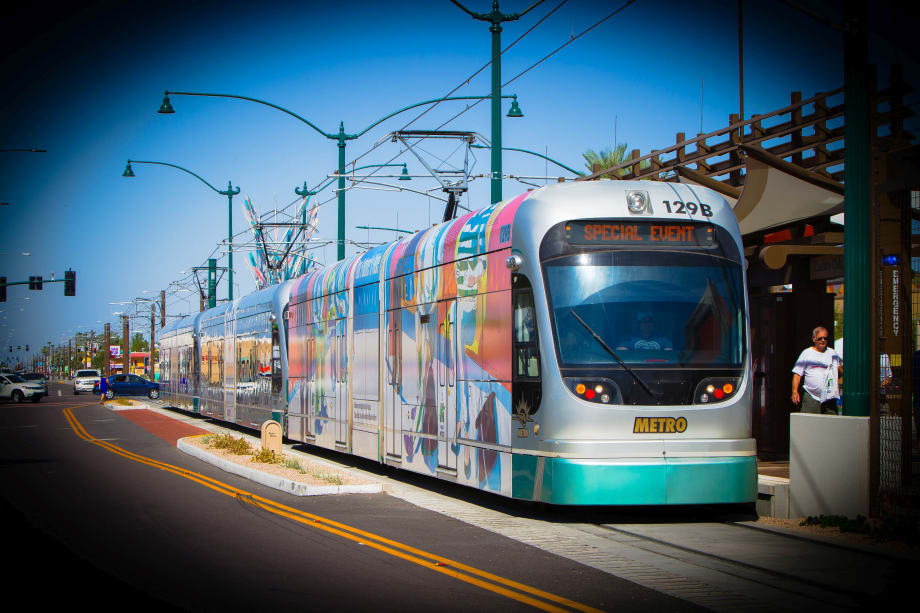
The Valley Metro light rail extension in Mesa, Ariz., opened seven months early, bringing a much-needed public transit option to the city’s growing downtown area.
The 3.1-mile, $200 million Central Mesa extension provides public transit access to destinations including the downtown business district, educational institutions, Mesa Arts Center, and Mesa City Plaza, and extends the line from the Sycamore Street/Main Street station, to connect to a larger system of light rail that serves downtown centers in nearby Tempe and Phoenix.
The extension, which is expected to add about 5,000 daily riders to the Valley Metro light rail system, opened for service on Aug. 22 with a celebration attended by federal and local officials.
“Additional light rail miles into Mesa translates into a benefit for the entire region,” says Steve Banta, Valley Metro CEO. “There is greater regional access for at least 5,000 daily riders going to school, work and entertainment, which also results in an economic boost for Main Street businesses.”
“Light rail has generated an $8.2 billion investment along the first 20 miles into Phoenix, Tempe and Mesa, and with this extension, we know that investment is only going to grow,” adds Phoenix Mayor Greg Stanton.
Funding of the extension was provided by a $75 million grant from the Federal Transit Administration, as well as $71 million in countywide transportation tax funds and $53 million in federal air quality funds.
Challenging Time Schedule
WSP | Parsons Brinckerhoff led a joint venture with PGH Wong Engineering that performed program and construction management of the Central Mesa light rail extension. Responsibilities included schedule reviews, cost reviews, inspection services, and design reviews on behalf of Valley Metro Rail and the City of Mesa.
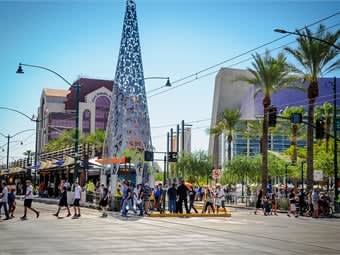
On opening day, each of the four new stations hosted events related to the city in some form, such as history or education.
Before the extension line’s groundbreaking on May 30, 2012, a careful two-year environmental assessment of the land ensured that its impact would be minimized and that it met Valley Metro’s eco-friendly requirements. Design work was conducted from 2010 to 2012.
During construction, the biggest hurdle faced by the project team was a moratorium on downtown construction that prohibited work for seven months out of the year. But, foresight and careful planning kept the project on track.
“Through working with the contractor, we were able to assist in phasing the project and scheduling work in a manner that mitigated the impact to the downtown businesses throughout construction,” says John Taylor, project manager from WSP | Parsons Brinckerhoff.
The construction team was also required to keep traffic flowing in both directions downtown during construction. With the limited available right-of-way, this required additional construction phasing and scheduling efforts to deliver the associated work within the contract time frame.
Ultimately, the project was completed seven months ahead of schedule. Taylor attributed much of the success to WSP | Parsons Brinckerhoff’s strong teamwork with PGH Wong Engineering.
“Availability of resources, key personnel, technical knowledge and a history of managing major construction projects created a winning combination that contributed to the overall success of this project,” he says.
Public Support
Creating a light rail line integrated into the city without significant disruption of vehicle traffic was also an important consideration.
“The guideway was constructed through downtown Mesa with only a rumble strip, which helped maintain a clean/streamlined view of the downtown district,” says Jake Wolff, resident engineer. “Through the use of screen walls and landscaping, six urban sites along the project were also designed to fit in with the environment and create an appealing façade to soften the impact to the City of Mesa.”
He adds that many of these sites were designed to be dual purpose, serving infrastructure needs for the light rail and doubling as an urban park. The visual appeal has enhanced the already strong public acceptance of the new light rail line.
“It is a gratifying feeling to be part of a project that is integral in delivering mass transportation to the public and allowing access to a downtown district that was previously accessible only via bus or vehicle,” says Wolff.
The majority of the remaining work along the extension revolves around the completion of urban parks at the signal building and traction power substation sites. Other minor items include completion of the operator’s facility at the park-and-ride, landscaping and work on various bus shelters. Final completion of the Central Mesa extension is projected for November 2015.
Expansion Continues
In addition to the Central Mesa Extension, WSP | Parsons Brinckerhoff is currently performing the program and construction management on a three-mile extension in Phoenix. Next, the engineering firm will be working with Valley Metro Rail on an additional two-mile extension in Mesa scheduled to open in 2018.
The extension added approximately
5,000 new riders and attracted additional development to downtown Mesa.
A total of six Valley Metro light rail extensions are either planned or under construction, which is expected to create a comprehensive 66-mile system for commuters by 2034.
Previously, WSP | Parsons Brinckerhoff served as general engineering consultant to Valley Metro for the initial 20-mile, 28-station light rail connecting Phoenix, Tempe and Mesa, which opened in December 2008. The firm’s role on the Valley Metro Rail system dates to 1998, when it supported feasibility studies, an alternatives analysis, and preliminary environmental studies to identify the best corridor for a regional transit system.
“In the Valley, we have come to realize the support and demand for building a total transit network,” says Banta. “With our next generation of workers wanting to live and work near transit, it fuels that opportunity to invest in a transit system that keeps us competitive and sustainable as a region.”
Valley Metro provides public transit options to residents of greater Phoenix and Maricopa County including the planning and operations of a regional bus system and the development and operations of 23 miles of light rail. In 2015, 71 million passengers used the Valley Metro transit system.
Richard Reitz is editor, U.S. Communications for WSP | Parsons Brinckerhoff.
More New Mobility

From Hardware to Digital Partner: Luminator Charts Its Next Chapter
CEO Magnus Friberg discusses Luminator’s shift toward becoming a digital partner, the growing importance of software and interoperability, and how AI can help agencies improve operations and passenger experience.
Read More →
Biz Briefs: Alstom Lands Canadian Contract, LYT to Supply California TSP, and More
In METRO's latest installment, we take a look at recent news from Complete Coach Works, Beep, FlixBus, and more partnerships making headlines across the transportation sector.
Read More →
CharterUP’s Armir Harris on Technology, AI, and the Future of Group Mobility
In a recent episode of METROspectives, CharterUP Founder/CEO Armir Harris discussed the company’s evolution from an online charter bus marketplace into a technology platform supporting public- and private-sector mobility and much more.
Read More →
Jacksonville’s NAVI Project Charts a New Course for Autonomous Public Transportation
Through its NAVI program, JTA is showing how autonomous vehicles, intelligent infrastructure, and coordinated operations can work together to deliver everyday public transportation.
Read More →
Biz Briefs: Luminator Marks Milestone and More
From manufacturers and suppliers to transit agencies and motorcoach operators, these updates offer a snapshot of the projects, partnerships and business moves driving the industry forward.
Read More →
New Tricks for Old Bureaucracies: Joshua Schank on Making Transit Innovation Stick
Former LA Metro Chief Innovation Officer Joshua Schank discusses why good ideas aren't enough, how transit agencies can overcome resistance to change, and why today's challenges demand more innovation.
Read More →
How DART's GoPass Is Redefining Regional Mobility
Serving 14 transit agencies, GoPass simplifies multimodal travel by allowing riders to plan, pay for, and manage an entire trip through one app.
Read More →
Biz Briefs: OCTA Taps Clean Energy for Hydrogen Station, Stadler to Supply Via Rail Vehicles, and More
From manufacturers and suppliers to transit agencies and motorcoach operators, these updates offer a snapshot of the projects, partnerships and business moves driving the industry forward.
Read More →CharterUP Expands Into New Mobility and Autonomous Transportation
Vice President of New Mobility Stephen Joos discusses how CharterUP is leveraging its nationwide transportation network, technology platform, and autonomous vehicle partnerships to expand into workforce mobility, campus shuttles, and transit solutions.
Read More →
METRO Magazine Announces 2026 Innovative Solutions Awards Winners
Projects Recognized for Advancing Mobility Through Technology, Accessibility, Workforce Innovation, and Operational Excellence
Read More →