



Bringing Bus Fire Incidents to the Forefront
Because there is no centralized database to record the number of bus fires annually in the U.S., many incidents go unreported and the transit industry misses an opportunity to create best practices and preventive measures.
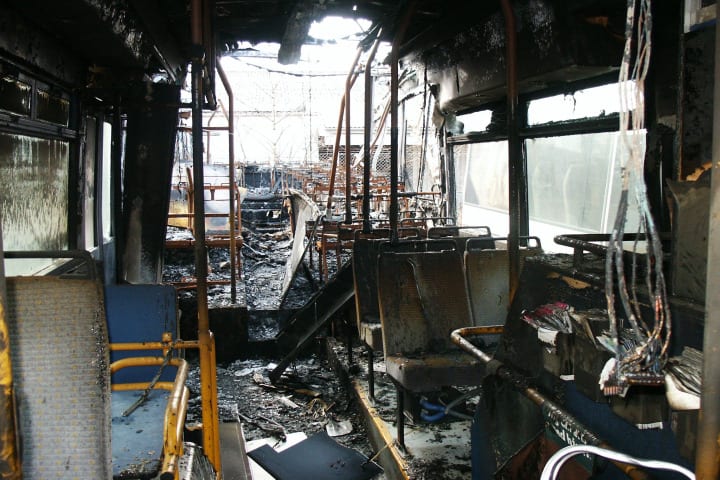
[IMAGE]MET11fires-.jpg[/IMAGE]Are bus fire incidents on the rise or waning in frequency? This question is difficult to answer because of the lack of a centralized reporting system at the national level to compile an accurate annual count.
The U.S. Fire Administration collects data from fire departments through its National Fire Incident Reporting System (NFIRS), but state participation is voluntary - different states have different reporting requirements, and the data obviously does not include fire incidents that went unreported or to which fire departments did not respond.
The National Fire Protection Association (NFPA) compiles fire data analysis, investigates major fire incidents and reports on vehicle fires, but does not separately track transit bus fire data. However, available on the agency's Website is its 2006 report (www.nfpa.org/assets/files//PDF/OS.Buses.pdf), "Vehicle Fires Involving Buses and School Buses," compiled with NFIRS data in the aftermath of the 2005 Texas motorcoach fire that claimed the lives of 23 senior citizens fleeing Hurricane Rita.
According to the report, "During the five-year period of 1999-2003, U.S. fire departments responded to an estimated average of 2,210 bus or school bus fires per year. These fires caused an estimated annual average of three civilian deaths, 30 civilian injuries and $24.2 million in direct property damage per year."
Reported bus and school bus fires appear to be flat, having peaked in 1980-81 but remaining steady since then, the NFPA finds. The report also shows that many of these fire incidents occur on non-road properties, equipment or other heat source failures caused three-fifths of the fires, mechanical failures and malfunctions were leading contributing factors, and 1999 model year vehicles were the most common in 2003 fire incidents.
"With all of the stimulus money that's going into the transit industry now, I'm sure there are more buses on the road so, in turn, you're going to have more bus fire incidents or incidents of any kind," says Angela Krcmar, marketing development manager for Firetrace International, a fire suppression system manufacturer. "Just about every fixed-route vehicle has fire suppression [systems] on it. They don't put it on there if there's not a problem."
Common causes of fires
Transit consultant Halsey King, of Carlsbad, Calif.-based Halsey King & Associates, identifies two areas on a bus that are typically the location of fires: the engine compartment and at the rear axle. "Turbochargers give the engine more power and efficiency, but they also run hot," he says. "They heat up the engine compartment and that exothermic heat buildup can't get out until you open the door."
At the rear axle, brakes and tires produce heat, which can only escape by tunneling up through the back wall of the bus, underneath passenger seating and the engine compartment. The muffler is also a heat source, King says.
Under the hood, several flammable fluids - such as engine oil, power steering fluid, windshield washer fluid, antifreeze and coolant - provide a medium that, in the hot environment of the engine compartment, could lead to a fire.
"Those products could start to spray from a small hole, which wouldn't be unusual at all, and hit something hot inside the bus engine compartment," King explains. "Eventually, dry goods like rubber hoses, sound deadening material and plastic parts will also start to smoke and burn."
The use of fuels other than diesel should also be taken into consideration, as some produce flammable vapors or run hotter, King adds.
Centralized database
To gather data, share knowledge, and standardize reporting and procedures, King proposes the formation of an industry summit on the issue of bus fires and a centralized database that would provide the basis for research into fire incident prevention.
"It would need to include all stakeholders: Departments of Transportation, state agencies, spec writers and end users who've experienced bus fires," he says. The group could develop consensus standards, outline definitions and plans to improve bus safety, standardize training for drivers and maintenance staff, and set standardized preventive measures for operations to follow nationwide.
Manufacturers should also have involvement in the process, particularly because training should follow what the manufacturer dictates, King says.
[PAGEBREAK]
Preventive measures
As part of the standardization process, King sees the development of preventive measures for bus maintenance staff as a key element in addressing the issue.
Federal and state regulations already require that transit agencies steam clean the bus chassis, engine and transmission. Additionally, King suggests that all leaks be repaired immediately, any leaked oil steam cleaned from the interior parts and mechanics should look at wiring as a potential source of electrical fires.
The amount of technology now incorporated into transit bus designs, and thus, opportunities for electrical fire catalysts, King says have dramatically increased in the years between 1999 and 2001. "The industry came to SAE (Society of Automotive Engineers) and we developed safety standards for people working on the high-voltage and high-amperage systems on gas-electric and diesel-electric buses," he says.
SAE asked specialists at the Massachusetts Institute of Technology to formulate a safety issues working group, one result of which was to designate high-powered cables to be orange colored. "In the engine compartment of a gasoline-electric bus, you'll see these big orange cables about as big around as your thumb," King says. "We tell [technicians], if you don't understand electricity, be aware, because they'll not just shock you, they'll stop your heart."
King recommends that transit bus technicians take extensive electrical training to be properly aware of maintenance concerns and fire hazards connected with electrical systems on buses. "We need to make sure that maintenance people, in their inspection, service and repair of the bus, understand how the system works, what the inspection criteria is and how to test that system," he says.
King also sees the need for drivers to be trained in fire extinguisher and fire suppression system deployment. "A lot of times [at the investigation scene], the fire extinguisher is untouched and the fire suppression system is not discharged," King says. "We need to have remedial training programs to ensure the drivers know how to set the systems off and what they need to do in an emergency on the bus.
"They get so excited to get the people off, and that serves the best purpose of all, no doubt about it. But we expect the fire suppression system to discharge and reduce the collateral damage."
Government resources
During National Transportation Safety Board (NTSB) hearings in the wake of the 2005 Texas bus fire, officials said these incidents appeared to be underreported. With more than 400,000 school buses, at least 100,000 charter buses, about 75,000 transit buses and 100,000 paratransit vehicles on the road each day, King says that the estimated total of 800,000 buses operating in the country, daily, provides a significant pool of vehicles that could experience thermal events. NTSB estimates that more than 2,500 bus fires occur each year, but without a formal data gathering mechanism in place, there is no way to verify that figure.
"Government and industry don't have a way yet to provide us with resources to get that information back to them, so they can help us," King says. "We have the NTSB; the state fire marshalls; state police and state highway patrols; and federal and state DOTs that collect this information and could funnel it into what I'm proposing - a bus fire database."
Resources currently available from industry groups include a best practices document developed by an American Public Transportation Association working group on bus fire safety. "Recommended Practice for Transit Bus Fire Safety Shutdown" was drafted and approved in 2005 and is available at, www.aptastandards.com. The document provides guidelines for vehicle systems shut down in case of detected fire.
The Florida Department of Transportation also developed a guide to bus fire incident investigations, available at www3.cutr.usf.edu/bussafety/documents/incident_bro_final3.pdf.
Investigation process
In investigating a bus fire incident, King follows procedures set out by the NFPA in their manual, "NFPA 921: Guide for Fire and Explosion Investigations."
King says that although the manual does not provide specific guidance for transit bus operators, the process is applicable across the board. According to King, NFPA's investigation guidelines include (1) recognizing the problem and determining whether it's a fire or an explosion; (2) defining the problem and determining an initial hypothesis as to the origin and cause; (3) data collection at the site of the incident and remains of the vehicle; (4) data analysis; (5) the development of a hypothesis; and (6) testing that hypothesis.
In analyzing data, King often calls on universities and other experts for testing. "I go to the University of Missouri for metallurgy," he says. "I might send a piece of material to them and have them look at it under an electron microscope, and then I'll speak to the scientists they have on staff." Labs can also help identify liquids or provide other materials testing.
King also assumes that his initial hypothesis will change during the course of the investigation. His first assessment, he says, is typically based on fire patterns and markings left by smoke.
Lastly, testing the hypothesis is a necessary step, particularly when representatives from the operation's insurance provider, the manufacturer or a legal agency may step in to challenge it. "Through that process, we try to protect the equipment from what we call spoliation," King explains. "[People come to look at the bus,] they start breaking things as they step over stuff, moving things, taking pictures, and then they take samples and maybe they take some of the very parts that started the fire. So, part of the investigator's charge needs to be to protect the evidence from spoliation, because you've got to allow full and equal access to the other investigators."
More Bus

From Surviving to Thriving: Building Stronger Transportation Organizations
Bus Business Consultants founder Brian Dickson shares lessons on leadership, organizational health, and creating options for long-term success in a changing transportation industry.
Read More →
Everett Transit, Community Transit Outline Consolidation Agreement
The proposed agreement calls for a 50% increase in bus service in Everett, a new microtransit zone, continued paratransit service, and the transfer of Everett Transit operations to Community Transit.
Read More →
SEPTA Details Accelerate Vision for Transit System
The plan outlines investments in trolley modernization, new Metro and Regional Rail vehicles, accessible stations, and more frequent bus and rail service.
Read More →
Report: Transit Bus Manufacturing Supports 34,100 Jobs, $5.1B in GDP
The “Buses Mean Business” report examines the transit bus manufacturing industry’s economic footprint, supply chain, and rising demand for vehicle replacements.
Read More →
Biz Briefs: New Flyer Delivers in Columbus, Houston, Beep and Freebee Merge, and More
In this edition of Biz Briefs, we spotlight the latest developments shaping the future of mobility.
Read More →
People Movement: Dan Dipert Coaches Adds Third-Generation Leader, Keolis Names New Valley Metro VP/GM, and More
In this edition, we also cover recent appointments and announcements at the Wabtec, SilverRide, HNTB, and more, showcasing the individuals helping to shape the future of transportation.
Read More →
New York MTA Plans Largest Bus Fleet Upgrade in More Than a Decade
The agency is seeking manufacturers for 650 new CNG buses to replace aging vehicles, improve reliability, and advance its broader fleet modernization strategy.
Read More →
Building a Flexible Path to Transit Electrification
John Hroncich discusses BAE Systems’ modular and scalable approach, lessons learned from decades of real-world operations, and how agencies can identify electrification strategies that fit their fleets.
Read More →
Bus Tech Talk: Keeping Transit Technicians Ahead of the Technology Curve
LA Metro’s Obed Mejia discusses technician training, evolving maintenance technology, fleet replacement, and strategies for getting the most out of today’s transit fleets.
Read More →
Biz Briefs: RIPTA Unveils New Frontrunners, Clevland RTA Adds New Siemens, and More
In METRO's latest installment, we take a look at recent news from Siemens, Prevost, Dodge, and more partnerships making headlines across the transportation sector.
Read More →