



BRT Survey: Funding Levels Higher, Yet Still a Concern
Cited as the top challenge experienced by one-fifth of participating operators. Coming in second was land use coordination, at 17%, down by slightly more than 10% from last year, when it was listed as the top challenge.

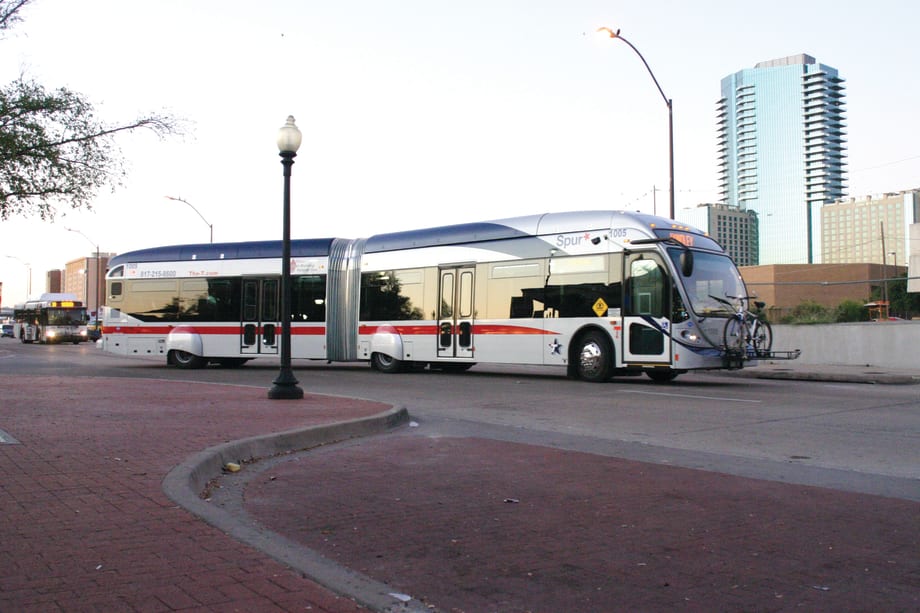
Nearly all survey respondents selected a low-floor vehicle style, and nearly three-quarters went with enhanced aesthetics. Two-thirds chose an articulated bus style. Slightly more than one-half cited passenger amenities.
Nearly all survey respondents selected a low-floor vehicle style, and nearly three-quarters went with enhanced aesthetics. Two-thirds chose an articulated bus style. Slightly more than one-half cited passenger amenities.
METRO's bus rapid transit (BRT) survey results for 2012 include 43 projects, 39 of which are located in the U.S. with four in Canada. As with last year, we are offering some in-depth profiles of projects that are opening this year, as well as one that opened last year.
In the news over the past few months, we have seen BRT grow into an increasingly popular choice in the U.S., with high-profile stories highlighting light rail plans being rejected in favor of BRT, due to cost and rider convenience. In December, Detroit Mayor Dave Bing, Michigan Gov. Rick Snyder and U.S. Transportation Secretary Ray LaHood scrapped the city's $528 million light rail project in favor of a regional BRT system.
Economics was the major factor. Additionally, a study in Nashville by Parsons Brinckerhoff found that a BRT system will cost one-half as much to build as streetcars but still attract the same number of riders, cost significantly less, be faster to construct and likely will be eligible for more federal funding.
Our survey results show project opening dates ranging from as early as 1983 (Ottawa-based OC Transpo's The TransitWay) to the 11 lines that are slated for completion between 2014 and 2020 (Minneapolis' Metro Transit's Rapid Bus).
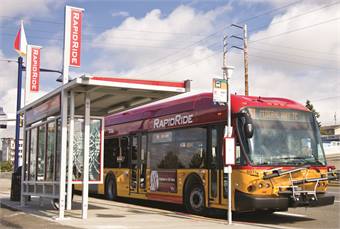
RapidRide buses will feature low floors, three doors, bike racks, wheelchair ramps, security cameras, Wi-Fi and three levels of passenger stop amenities.
This year will see only one less project opening (five) than last year (six), based on survey responses. Two of these projects are located in Seattle: King County Metro Transit's RapidRide C Line and D Line. The other three are from Stockton, Calif.'s San Joaquin Regional Transit District; Winnipeg, Manitoba-based Winnipeg Transit's Southwest Rapid Transit Corridor; and San Antonio-based VIA Metropolitan Transit Authority's VIA Primo.
The region producing the highest number of BRT systems was, unsurprisingly, the West Coast, featuring more than one-half of the lines listed, with California in the lead, opening two-thirds of those projects. Projects in this region combined for a total of $1.7 billion, about one-half of last year's $3.6 billion total.
Federal funding included FTA's Very Small Starts and the Urbanized Area Formula Funding Program (5307), Congestion Mitigation and Air Quality Improvement Program (CMAQ), ARRA and the Federal Highway Administration's Urban Partnership Agreement. These comprised 80% of financial support. Approximately 80% of the projects received some form of local funding, and state backing contributed to about 50% of project support. These numbers have all made a noticeable increase from last year's, with federal support up by slightly more than 10%, local seeing a 60% increase and state funds doubling, a possible indicator of the economy finally regaining strength. Only one project reported no dedicated funding at this point.
Despite what appears to be an increase in financing this year, funding came in as the top challenge experienced by one-fifth of participating operators. Coming in second was land use coordination, at 17%, down by slightly more than 10% from last year, when it was listed as the top challenge among operators. Another popular difficulty was community opposition to certain elements of projects, such as the "loss of several parking spaces, reduced turning movements at one intersection" and "opposition to transit lanes" as with San Diego Association of Governments Mid-City Rapid project, set to open in 2013. Other obstacles listed included construction and balancing speed and access.[PAGEBREAK]
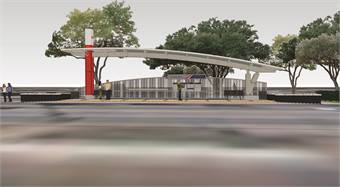
The VIA Primo, slated to open in December 2012, will feature real-time bus arrival info at boarding platforms (rendering shown).
Project benefits, however, seemed to greatly outweigh any challenges. About 30% of respondents said their BRT systems streamlined their transit network and reduced travel times, while nearly one-fifth cited the ability to improve onboard amenities, such as offering free Wi-Fi. Slightly more than one-tenth of respondents said that the lines offer more connections to major employment centers and transfer points and increased ridership.
Transit agencies have plans to buy 267 vehicles in 2012, only slightly fewer compared with last year. On average, this comes to six buses per project listed.
Slightly more than one-half of operators plan to use hybrid-electric propulsion for their buses, running about the same as last year's figure. Clean diesel was the second-most popular choice again this year, at 30%, with CNG coming in third, at 28%. Signal manipulation and passenger information tied as the most popular ITS options.
For charts, graphs, profiles and more, click here.
More Bus

New York MTA Plans Largest Bus Fleet Upgrade in More Than a Decade
The agency is seeking manufacturers for 650 new CNG buses to replace aging vehicles, improve reliability, and advance its broader fleet modernization strategy.
Read More →
Building a Flexible Path to Transit Electrification
John Hroncich discusses BAE Systems’ modular and scalable approach, lessons learned from decades of real-world operations, and how agencies can identify electrification strategies that fit their fleets.
Read More →
Bus Tech Talk: Keeping Transit Technicians Ahead of the Technology Curve
LA Metro’s Obed Mejia discusses technician training, evolving maintenance technology, fleet replacement, and strategies for getting the most out of today’s transit fleets.
Read More →
Biz Briefs: RIPTA Unveils New Frontrunners, Clevland RTA Adds New Siemens, and More
In METRO's latest installment, we take a look at recent news from Siemens, Prevost, Dodge, and more partnerships making headlines across the transportation sector.
Read More →
People Movement: Holly Arnold Joins Transdev and More
In this edition, we also cover recent appointments and announcements at Pace, CamTran, MCI, and more, showcasing the individuals helping to shape the future of transportation.
Read More →
The High Cost of Transit Buses: Industry Leaders Look to Procurement Reform
Transit leaders and policymakers examine how standardized bus designs, streamlined procurement, and predictable funding could help agencies stretch budgets and deliver better service.
Read More →
The Business Voice Behind Public Transportation
As chair of APTA’s Business Members Board of Governors, Ray Melleady explains how more than 850 business members are partnering with transit agencies to advance funding, innovation, and industry-wide collaboration.
Read More →
From Surviving to Thriving: Building Stronger Transportation Organizations
Bus Business Consultants founder Brian Dickson shares lessons on leadership, organizational health, and creating options for long-term success in a changing transportation industry.
Read More →
Finding the ‘Happy Medium’: Optimizing Maintenance Without Sacrificing Reliability
The key to maintenance optimization isn’t doing less work—it’s doing the right work at the right time on the right assets.
Read More →
LA Metro, City of West Hollywood, and Partners Advance Smarter Bus Lane Enforcement
The award-winning partnership combines AI-powered detection with human oversight to improve bus reliability, accessibility, and enforcement efficiency.
Read More →