



High-Floor Buses Worth Another Look
Routine inspections and maintenance are the basis for any successful operation. Putting off repairs or cutting back on shop staff in a misguided effort to save money, are risky practices.
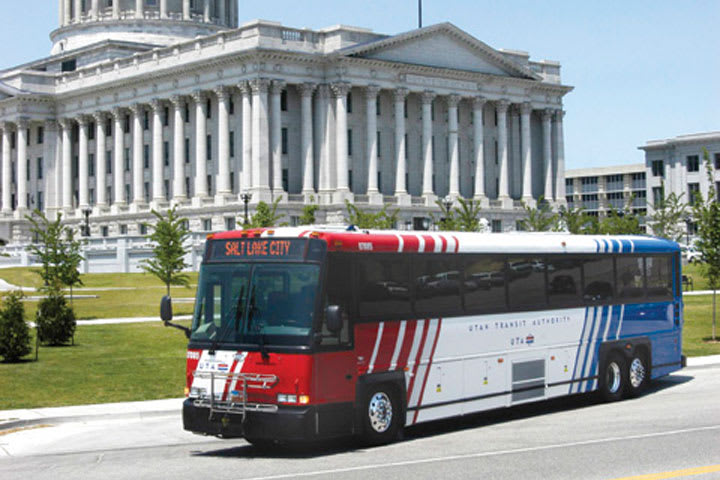
[IMAGE]MET8p56large.jpg[/IMAGE] The U.S. transit industry has essentially converted to low-floor transit buses for most new orders. Much of the rationale for choosing these designs is based on two primary arguments: customer convenience and more cost-effective compliance with accessibility regulations.
As was the case first in Europe, and later in many cities worldwide, low-floor transit buses have virtually completed their conquest of the North American marketplace. Indeed, no manufacturer now offers a standard-floor vehicle (i.e., a higher floor with steps at the doors). Low-floor design advantages include faster boarding and alighting for the majority of passengers, as well as elimination of the traditional wheelchair lift, which has been one of the biggest sources of maintenance-related road calls since accessible buses began to be mandated in the U.S.
However, there are applications where these benefits may be trumped by those of standard-floor buses, including the accommodation of the preference of many riders who would rather sit higher above the roadway, as well as higher capacity in vehicles of comparable size.
To bus engineers, every design decision represents a trade-off, with advantages in certain areas inevitably creating disadvantages in others, and the choice of floor design is no exception. Given the growing, near universal enthusiasm over low-floor buses among today’s public transit fleets, could some of their disadvantages be overlooked?
Passenger considerations
Standard-floor designs may be worth another look for two considerations, the first of which is that many passengers prefer a higher seated position. This is particularly true of passengers on higher-speed commuter routes. Several bus manufacturer executives have noted that the first areas of a stepped low-floor bus to fill up with passengers tends to be the higher-floor sections. Whether it is a perceived safety consideration or preference for looking out the windows at a higher level, many passengers do prefer seating in those sections — even if they prefer the lower floor at entry and exit.
This is particularly true at higher speeds. They report that in express routes, for example, riding in the lower floor section at higher speeds feels to some customers like “riding in a bathtub.” Perhaps this explains why many people prefer SUVs and trucks over regular passenger car designs, capacity issues aside.
It is also important to note that wheelchair lifts have substantially improved in reliability during the past two decades. The present generation of wheelchair lifts, now in wide use on paratransit and other fleets, are far more reliable.
Further, in some applications, longer dwell times may not be as important to fleet productivity or customer convenience as the rest of regular-route transit service. One such example is commuter or express service. The additional dwell time needed for wheelchair lift deployment to assist boarding and alighting of mobility-impaired patrons is not as important an issue in these applications as comfort, speed and capacity.
Moreover, wheelchair ramps are still designed with actuator, linkages, safety gates and other components. Although certainly less complex overall than a conventional lift, these ramps also present maintenance challenges — they require the drivers to leave their seats to deploy the ramps and assist passengers with their securement systems. Thus it is not clear how much dwell time or maintenance-related savings are being achieved.
Operating cost advantages?
The second reason why transit agencies may want to reconsider using low-floor buses in all applications in their service areas is the inherent disadvantage in low-floor buses of standard floor design with fewer seats per coach. This could help explain some rising operating costs in recent years.
According to National Transit Database (www.ntdprogram.gov) statistics, per-passenger operating costs have actually risen in recent years, from $2.15 in 1995 — when low-floor buses really began to be delivered to agencies in large volumes — to $2.54 in 2002, the most recent year studied. This represents a rise of 18 percent, at a time when the average fleet age was actually decreasing, due to record levels of funding that allowed transit agencies to replace their aging vehicles. It was also at a time when ridership continued to climb at levels not seen since the 1950s. Could low-floor buses be part of the reason?
There could be a number of explanations for rising operating costs, including higher driver and maintenance technician wages, additional high-tech equipment, poorer fuel economy of alternative fuels and costs associated with more stringent emission controls, among other factors.
These rising costs, however, could be exacerbated by the trend toward low-floor bus procurements for the following reasons:
[PAGEBREAK]
Familiarization issues.
Although not as much of an issue in the decade of their introduction, low-floor buses in North America were developmentally young when compared to existing standard-floor transit bus designs. This suggests greater probability of infantile developmental problems compared with more mature standard-floor vehicles. For example, some operators may recall the “teething problems” experienced by early operators of advanced design buses (ADBs) more than three decades ago, when ADBs were as developmentally immature as low-floor buses were in the 1990s. This is particularly true when one realizes that some of the nation’s largest fleets did not begin their conversion to low-floor units until recently.
Maintainability issues.
Low-floor designs necessarily displace the equipment otherwise located under the floor in standard-floor designs. This equipment must, therefore, be relocated to unconventional, less accessible and/or less convenient locations, such as within the roof structure (typically between the ceiling panels and the roof skins), or added to an already overcrowded engine compartment (or both). Such equipment typically consists of air reservoirs, pneumatic valves, air dryers, plumbing, pumps, water heaters and the like. Relocating such equipment inconveniences maintenance personnel, which at best marginally increases labor time for these activities and at worst could increase the risk of accidents working on scaffoldings for roof access to these systems.
Operational limits.
Because under-floor space is at such a premium, some low-floor models may not be able to provide 125 gallons of useable fuel capacity presently deemed minimally acceptable by most operators. Although step-floor designs, which are the common such design in the industry, have ameliorated this concern by leaving valuable underfloor space aft of the rear door, it is worth mentioning, as many agencies contemplate 100 percent low-floor designs for urban bus rapid transit (BRT) service.
Capacity disadvantages & increased life-cycle costs.
Using typical seating layouts, plus two ADA-required wheelchair spaces, standard-floor buses are able to accommodate approximately 44 passenger seats. Comparable stepped low-floor buses contain approximately 38 seats. Thus, the standard-floor bus is able to seat approximately 16 percent more passengers than the stepped low-floor bus, and a greater percentage over non-stepped low-floor designs. (Typically, standee space is also proportionally less with the low-floor approach.) This seating disparity leads to the following considerations, based upon a 100-unit fleet of 40-foot buses in a hypothetical case study:
• 116 40-foot low-floor buses would be needed to provide the same level of service as 100 standard-floor buses, requiring approximately $6.4 million in capital funds over and above that needed to procure the 100 standard-floor buses that would provide the same ridership capacity.
• The 16 percent additional low-floor buses needed to replace their standard-floor counterparts would require 16 percent more operating costs for fuel, oil, brakes and other consumables.
• These same 16 additional buses would also require a 16 percent increase in maintenance and driver labor — including benefits — to operate them. The annual cost would then have to be multiplied by the expected 12-year design life of such buses to determine the overall operating cost impact.
• Whatever an operator’s tire mileage costs will be for a fleet of 100 standard-floor buses, it would certainly be greater for 116 low-floor buses. Obviously, this increased vehicle quantity will increase annual tire mileage cost for this fleet by 16 percent over their 12-year design life. However, low-floor buses utilize unique, low-profile tires, which may raise costs further through higher per-mile lease rates.
Thus, when consideration is given to life-cycle costs, the standard-floor bus is clearly superior. As a practical rule of thumb, operators should look upon the 40-foot low-floor bus as the service equivalent of the 35-foot standard-floor bus.
Moreover, some of the advantages of low-floor buses narrow depending on route application. For example, studies have shown that if dwell times are on average within a traffic signal cycle length there is minimal system impact and, thus, minimal advantage in terms of the travel time savings for the route. Powered ramps can also be complicated systems, while wheelchair lifts have become substantially more reliable in recent years as the supply chain has stabilized and matured in the marketplace.
Rising operating costs in the industry should be researched further, to determine whether the choice of low-floor designs has resulted in greater need for public sector investment than otherwise would have been the case. Accordingly, transit agencies should perform more thorough needs-based assessments to help make the final purchase decision. Critical to this assessment are the types of applications that vehicle decisions will ultimately serve.
Michael Melaniphy is the vice president, public sector for Motor Coach Industries Inc. (MCI).
Cliff Henke, a contributing editor to METRO, is senior analyst at PB.
More Management

Utilimarc Launches SmartReplace to Optimize Fleet Replacement Decisions
AI-powered SmartReplace helps fleets prioritize vehicle replacements, model budget scenarios, and build more defensible long-term strategies.
Read More →
APTA Honors 2026 Award Winners, Hall of Fame Inductees at TRANSform & EXPO
Innovations in autonomous and zero-emission transportation, standout transit systems, and industry leadership took center stage among this year's honorees.
Read More →
7 Ways to Build a Better Transit Internship Program
Lessons from DRPA/PATCO’s approach to creating a meaningful internship experience—and developing the next generation of transportation professionals.
Read More →
Scenes from APTA TRANSform & EXPO 2026
Transit leaders, manufacturers, and industry professionals gathered in Chicago to explore new technologies, share ideas, and discuss the future of public transportation.
Read More →
Building Stronger Leaders, More Resilient Transit Teams
Dr. Carol Parker Walsh discusses leadership development, employee retention, workplace culture, and preparing transit’s workforce for AI and automation.
Read More →
APTA 2026 TRANSform & EXPO Kicks Off in Chicago
After 45 years, APTA returns to Chicago with a focus on next-generation fleets, AI, connected transit networks, and the funding strategies shaping public transportation’s future.
Read More →
New York MTA Warns Federal Tariffs Could Add $1 Billion to Rolling Stock Costs
The agency said tariffs on specialized imported components could reduce the purchasing power of its $23 billion investment in new subway cars, railcars, and buses.
Read More →
From the Show Floor: What Happened at APTA TRANSform & EXPO 2026
See the latest product launches, partnerships, technology updates, and transit industry announcements from APTA TRANSform & EXPO in Chicago.
Read More →
How Valley Metro Is Balancing Transit Growth With the Rider Experience
The APTA award-winning agency is pairing rapid system expansion with investments in workforce, safety, technology, and the fundamentals of transit service.
Read More →
Bus Tech Talk: Keeping Transit Technicians Ahead of the Technology Curve
In this episode of Bus Tech Talk, Complete Coach Works’ Business Development Manager Mark Hollenbeck and METRO’s Executive Editor Alex Roman sit down with Obed Mejia, Senior Technical Trainer for Bus Maintenance, at LA Metro to discuss how rapidly evolving bus technology is changing the maintenance shop — and the skills technicians need to keep pace.
Read More →