



New York Unveils Sweeping Plan to Modernize City Bus Service
Next Stop: Fast Buses, Better Service identifies 50 priority bus corridors for improvements across the five boroughs and launches the City’s next generation of rapid bus service along five key routes.

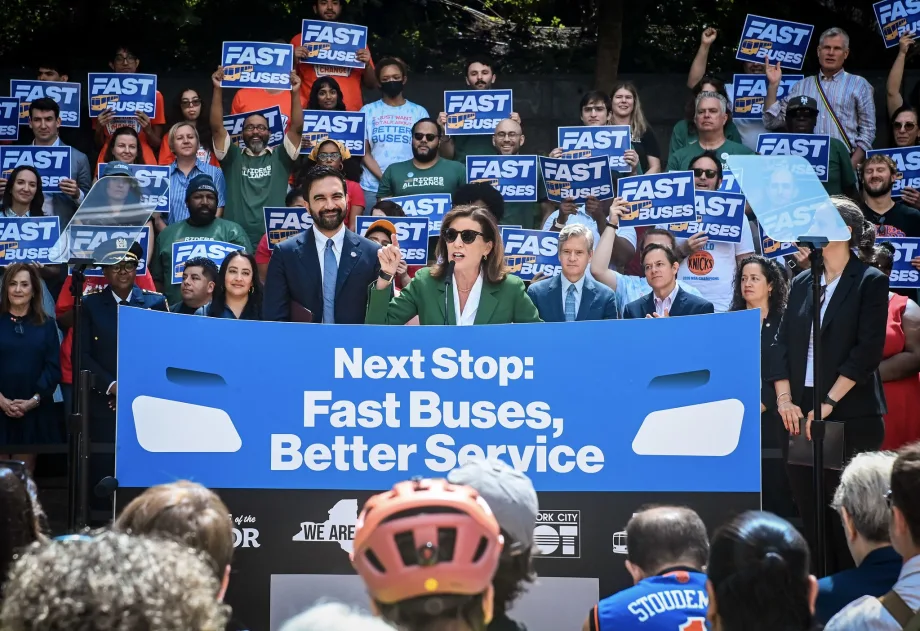
Together, the Governor and Mayor of New York said these investments will shorten commutes, improve reliability, expand accessibility, and create a bus system worthy of the city that depends on it.
Marc A. Hermann
- New York City has introduced a comprehensive plan named "Next Stop: Fast Buses, Better Service" to modernize its bus system.
- The plan highlights 50 priority bus corridors across all five boroughs slated for enhancements.
- A new generation of rapid bus service is set to launch along five key routes as part of the initiative.
*Summarized by AI
Governor Kathy Hochul and Mayor Zohran Kwame Mamdani unveiled “Next Stop: Fast Buses, Better Service,” a sweeping bus action plan to build the next generation of bus service in New York City.
The plan marks a historic partnership between the New York City Department of Transportation (NYC DOT) and the Metropolitan Transportation Authority (MTA) to transform how New Yorkers experience the city’s buses — with investments that will make service faster, more accessible, and more comfortable from curb to destination, according to officials.
Next Stop…
Next Stop: Fast Buses, Better Service identifies 50 priority bus corridors for improvements across the five boroughs and launches the City’s next generation of rapid bus service along five key routes.
Together, the Governor and Mayor of New York said these investments will shorten commutes, improve reliability, expand accessibility, and create a bus system worthy of the city that depends on it.
“Every day, millions of New Yorkers rely on buses to get around this city, but for far too long, making their journeys faster and their lives easier has seemed out of reach. That all changes today,” Governor Hochul said. “New York is in the midst of a transit renaissance, with historic investments being made to improve the lifeblood of our city.”
New Yorkers take 2.75 million trips on New York City buses each day, making the system the busiest in the nation — carrying more riders than the bus systems of Los Angeles, Chicago, San Francisco, and Philadelphia combined. But New York’s buses remain the slowest of any major U.S. city, averaging just eight miles per hour.
Improving bus service is central to Governor Hochul and Mayor Mamdani’s promise to make New York City more livable for working people. Bus riders are disproportionately working-class, women, and people of color, and are more likely than subway riders or drivers to live in households earning less than $100,000 annually.
Fast Buses, the Next Generation of Rapid Transit
Next Stop: Fast Buses, Better Service identifies 50 priority corridors where NYC DOT and the MTA will target investments to address the city’s slowest and most delay-prone bus routes. Improvements along routes will begin this year.
Five corridors in Brooklyn, Queens, and the Bronx have been selected as the first phase of New York City’s next generation of rapid bus routes. The corridors were selected because they connect New Yorkers to jobs, schools, subway service, and major destinations while supporting current and future housing and economic growth.
Beginning in 2026, NYC DOT and the MTA will advance these projects with dedicated, protected bus lanes, frequent all-day service, upgraded stations with sheltered waiting areas and public space improvements modeled after the best rapid bus systems around the world, said officials.
Bus Reliability, The Rider Experience
The MTA will work together to improve service reliability by ensuring scheduled trips are completed, modernizing depot operations, and strengthening bus maintenance.
Through the MTA’s historic $68 billion 2025-2029 Capital Program, fully funded by Governor Hochul and the state legislature in the FY26 Enacted Budget, the authority will purchase approximately 2,500 new buses, replacing 40% of its aging fleet.
The MTA will also implement all-door boarding in 2027, with a complete transition to tap-and-ride.
To make bus stops safer, more comfortable, and more accessible, NYC DOT and the MTA will:
- Expand the bus stop accessibility program to reach 65 stops per year by 2030.
- Install 300 new bus shelters by 2028.
- Add seating at 875 bus stops annually, ensuring every feasible stop has seating by 2035.
- Plant 30 trees at bus stops in 2026 and pilot shelter design improvements for mitigating extreme heat at bus stops.
- Install 90 new Real-Time Passenger Information displays in 2026 and expand to 2,900 displays citywide by 2030.
Keeping Bus Lanes Clear
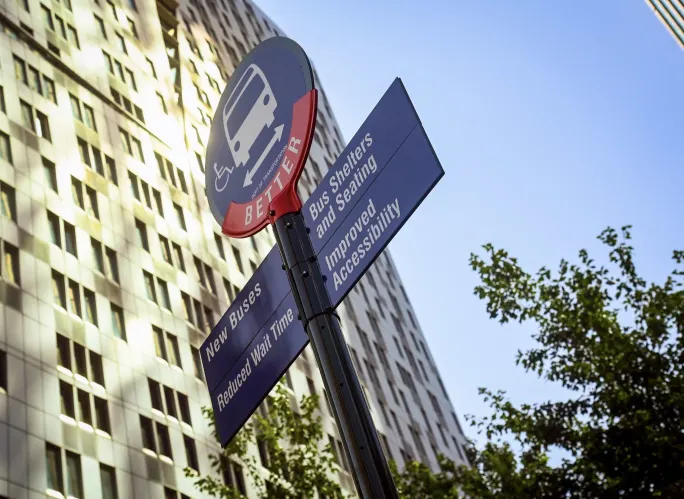
To ensure accountability, NYC DOT and the MTA will publicly release performance data within six to 12 months after projects are completed, measuring impacts on travel times, reliability, and rider experience, while identifying opportunities for further improvements.
Marc A. Hermann
Keeping buses moving requires keeping bus lanes free of illegal traffic.
Automated Camera Enforcement (ACE) has increased bus speeds by up to 30% while reducing collisions by 20%.
To build on those gains:
- NYC DOT and the MTA will expand bus-mounted ACE to 25 additional routes each year in 2026 and 2027.
- NYC DOT will install 200 additional stationary bus lane cameras by 2027, an effective program to capture vehicles illegally driving in bus lanes.
- The New York City Police Department (NYPD) will expand targeted bus lane enforcement from 14 to 20 corridors beginning in 2026.
Putting Riders Front and Center
Next Stop: Fast Buses, Better Service also establishes a more robust, rider-centered approach to community engagement.
Working alongside the Mayor’s Office of Mass Engagement (OME) and other City agencies, NYC DOT and the MTA will hold community events, conduct surveys, and partner with advocacy organizations and community groups before the projects begin. Public education campaigns will help riders understand upcoming improvements and service upgrades.
To ensure accountability, NYC DOT and the MTA will publicly release performance data within six to 12 months after projects are completed, measuring impacts on travel times, reliability, and rider experience, while identifying opportunities for further improvements.
Quick Answers
The purpose of the plan is to improve public transportation by modernizing bus services, making them faster and more efficient across New York City's five boroughs.
*Summarized by AI
More Bus

More Than a Summer Job: Building the Next Generation of Transit Talent
The Delaware River Port Authority and PATCO have transformed their internship program into a hands-on professional development experience that introduces students to the breadth of transportation careers — and creates a pipeline for future employees.
Read More →
LA Metro Board Awards 220 Battery-Electric Bus Contract to ENC
The contract, which is the largest base award of battery-electric buses by a U.S. transit agency, will be built in Southern California, sustaining good jobs as LA prepares to welcome the world in 2028
Read More →
Public Transit Conference Returning to GFX in 2027, Call for Papers Now Open
The Call for Papers is now open, allowing transit agency professionals and industry experts to help shape the PTC educational program by submitting session ideas for consideration.
Read More →
Indian River Transit’s Community-Focused Approach Earns National Recognition
Named APTA’s 2026 Outstanding Public Transportation System in its size category, Florida’s Indian River County transit system continues to grow ridership through fare-free service and a focus on evolving community needs.
Read More →
ENC Lands MATA Contract and More in Biz Briefs
In this edition of Biz Briefs, we spotlight the latest developments shaping the future of mobility.
Read More →
From Surviving to Thriving: Building Stronger Transportation Organizations
Bus Business Consultants founder Brian Dickson shares lessons on leadership, organizational health, and creating options for long-term success in a changing transportation industry.
Read More →
Everett Transit, Community Transit Outline Consolidation Agreement
The proposed agreement calls for a 50% increase in bus service in Everett, a new microtransit zone, continued paratransit service, and the transfer of Everett Transit operations to Community Transit.
Read More →
SEPTA Details Accelerate Vision for Transit System
The plan outlines investments in trolley modernization, new Metro and Regional Rail vehicles, accessible stations, and more frequent bus and rail service.
Read More →
Report: Transit Bus Manufacturing Supports 34,100 Jobs, $5.1B in GDP
The “Buses Mean Business” report examines the transit bus manufacturing industry’s economic footprint, supply chain, and rising demand for vehicle replacements.
Read More →
Biz Briefs: New Flyer Delivers in Columbus, Houston, Beep and Freebee Merge, and More
In this edition of Biz Briefs, we spotlight the latest developments shaping the future of mobility.
Read More →