



RELATED: Ways to Improve Communication with Customers Who Have Disabilities
How to Involve Seniors, People with Disabilities to Make Your Transit System More Accessible
Transportation systems are encouraged to welcome seniors and people with disabilities who want to have a role on advisory committees, who provide input into local planning activities, and who volunteer as mentors or peers to other riders.
by Rachel Beyerle
May 16, 2016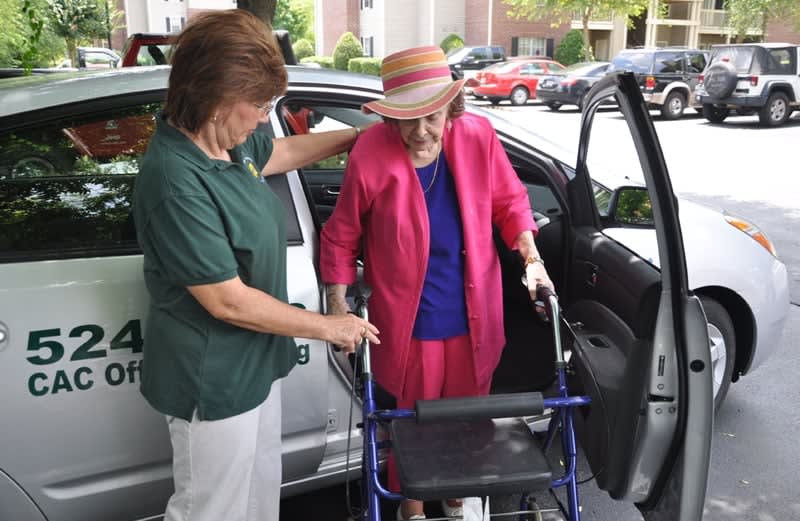
Photo: Easter Seals
4 min to read
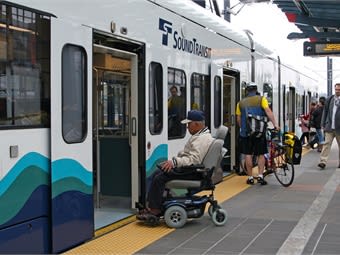
Photo: Sound Transit
May is Older Americans Month, and the 2016 OAM theme is “Blaze a Trail,” with civic engagement being one of the areas in which older adults are encouraged to get involved or take a more active role. Community service has both physical and mental benefits, according to the Administration for Community Living. Transportation systems are encouraged to welcome seniors and people with disabilities who want to have a role on advisory committees, who provide input into local planning activities, and who volunteer as mentors or peers to other riders. The National Aging and Disability Transportation Center (NADTC) recommends focusing on four areas that will help your transportation system blaze a trail to greater accessibility.
Engage
Before creating a new service or route, involve older adults and people with disabilities in program design and oversight. Ask current and potential riders about their experience with transportation services and their mobility needs. Rider input means rider buy-in. Customers who know that their input has been considered are more likely to be satisfied customers.
Photo: Easter Seals
Provide riders opportunity for feedback. Checking in with riders on their level of satisfaction is an essential component of customer service.
Mobility managers can serve as liaisons to the community, helping to explain transportation options, communicate the system’s initiatives, and engage community members in meetings and advisory committees.
Communicate
Sidewalks, streets, ramps, benches and lifts are crucial for physical accessibility; however those features make up only one part of the accessibility equation. Communication and information round out the concept of accessibility. Older adults and people with disabilities need to know the transportation choices available to them, and for aging adults, information about options can help ease fears for those no longer able to drive.
Recommended communications include:
- Brochures, flyers, websites, social media, and verbal information provided by transit operators and staff should always be offered or posted in a courteous, respectful and friendly manner. Refer to ADA guidance for alterative format requirements. When interacting with riders in-person or over the phone, invite questions and explain key features of communications. Provide a friendly reminder that information is available through a variety of media.
- Be aware of your community and rider needs — providing information in languages other than English reinforces the message that you want to provide excellent customer service and truly engage all community members.
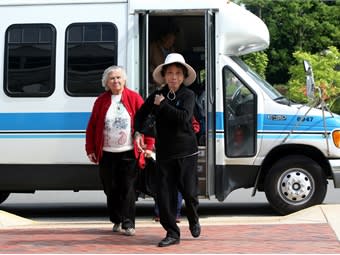
Photo: Easter Seals
Provide Excellent Service
- Offer assistance when needed or requested, especially to new riders, older adults and people with disabilities who may be experiencing physical, mental or emotional difficulties.
- Establish a travel training program provided by professionals or through a peer-to-peer or buddy program to help new or returning riders overcome concerns about using public transit. If you’re just getting started in the process of developing a travel training program for older adults, Easter Seals Project Action Consulting offers an archived webinar called “Ten Steps to Starting a Travel Training Program.” The National Association of Area Agencies on Aging (n4a) and Eldercare Locator offer resources on driver transition and mobility options for older adults.
Ensure ADA Adherance
- Coordinate with your local jurisdiction to ensure safe, unobstructed pathways to transit stops.
- Perform regular maintenance and pre-route checks to make sure that lifts, securement devices and accessibility features are kept in good working order.
- Provide verbal and/or electronic stop announcements. The ADA requires stop announcements, including transfer point announcements, on fixed-route service. No matter the type of service your system provides, verbal announcements are beneficial for all passengers.
- Accommodate service animals as permitted by U.S. Department of Transportation regulations, and hold refresher training for staff on ADA requirements and customer service policies related to service animals.
- Encourage a culture of accessible, respectful service within your agency and among your employees. Happy riders are return riders.
How to Keep Your System Age- and Ability-Friendly
- Ensure that lettering and font on signs and instructions is easily legible. Serif fonts are traditionally easier to read and typeface should be 12 point or larger whenever possible. The National Institute on Aging and AIGA are good resources for age-friendly design.
- When speaking with customers in-person or over the phone, consider tone and volume. Have a pad of paper and pen available in case you or the rider needs to communicate in writing.
- Riders of all abilities have differing familiarity with technology — including fare payment, kiosks, websites and mobile apps. Be prepared to explain how riders can use different technologies employed by your system.
- In general, older adults place more emphasis on personal contact and information dissemination methods that involve interaction (e.g., through clubs, places of worship and senior centers) than do younger customers. Coordinate with community centers and organizations to help get the word out to senior audiences or to family members and caregivers.
Interaction with the local transportation network and involvement of seniors and people with disabilities in their personal mobility decisions can make a difference in not only the success of your service, but as noted, interaction can bring about physical and mental benefits for riders and your staff.
Rachel Beyerle is communications director for the National Aging and Disability Transportation Center.
Subscribe to Our Newsletter
More New Mobility

From Hardware to Digital Partner: Luminator Charts Its Next Chapter
CEO Magnus Friberg discusses Luminator’s shift toward becoming a digital partner, the growing importance of software and interoperability, and how AI can help agencies improve operations and passenger experience.
Read More →
Biz Briefs: Alstom Lands Canadian Contract, LYT to Supply California TSP, and More
In METRO's latest installment, we take a look at recent news from Complete Coach Works, Beep, FlixBus, and more partnerships making headlines across the transportation sector.
Read More →
CharterUP’s Armir Harris on Technology, AI, and the Future of Group Mobility
In a recent episode of METROspectives, CharterUP Founder/CEO Armir Harris discussed the company’s evolution from an online charter bus marketplace into a technology platform supporting public- and private-sector mobility and much more.
Read More →
Jacksonville’s NAVI Project Charts a New Course for Autonomous Public Transportation
Through its NAVI program, JTA is showing how autonomous vehicles, intelligent infrastructure, and coordinated operations can work together to deliver everyday public transportation.
Read More →
Biz Briefs: Luminator Marks Milestone and More
From manufacturers and suppliers to transit agencies and motorcoach operators, these updates offer a snapshot of the projects, partnerships and business moves driving the industry forward.
Read More →
New Tricks for Old Bureaucracies: Joshua Schank on Making Transit Innovation Stick
Former LA Metro Chief Innovation Officer Joshua Schank discusses why good ideas aren't enough, how transit agencies can overcome resistance to change, and why today's challenges demand more innovation.
Read More →
How DART's GoPass Is Redefining Regional Mobility
Serving 14 transit agencies, GoPass simplifies multimodal travel by allowing riders to plan, pay for, and manage an entire trip through one app.
Read More →
Biz Briefs: OCTA Taps Clean Energy for Hydrogen Station, Stadler to Supply Via Rail Vehicles, and More
From manufacturers and suppliers to transit agencies and motorcoach operators, these updates offer a snapshot of the projects, partnerships and business moves driving the industry forward.
Read More →CharterUP Expands Into New Mobility and Autonomous Transportation
Vice President of New Mobility Stephen Joos discusses how CharterUP is leveraging its nationwide transportation network, technology platform, and autonomous vehicle partnerships to expand into workforce mobility, campus shuttles, and transit solutions.
Read More →
METRO Magazine Announces 2026 Innovative Solutions Awards Winners
Projects Recognized for Advancing Mobility Through Technology, Accessibility, Workforce Innovation, and Operational Excellence
Read More →