



Innovative Solutions: Operations
TheBus partnered with its CAD-provider, Trapeze, to develop a Dynamic Headway Management Module. Under dynamic headway scheduling, an entire bus route is monitored by the CAD system and total circuit times are measured in real time.
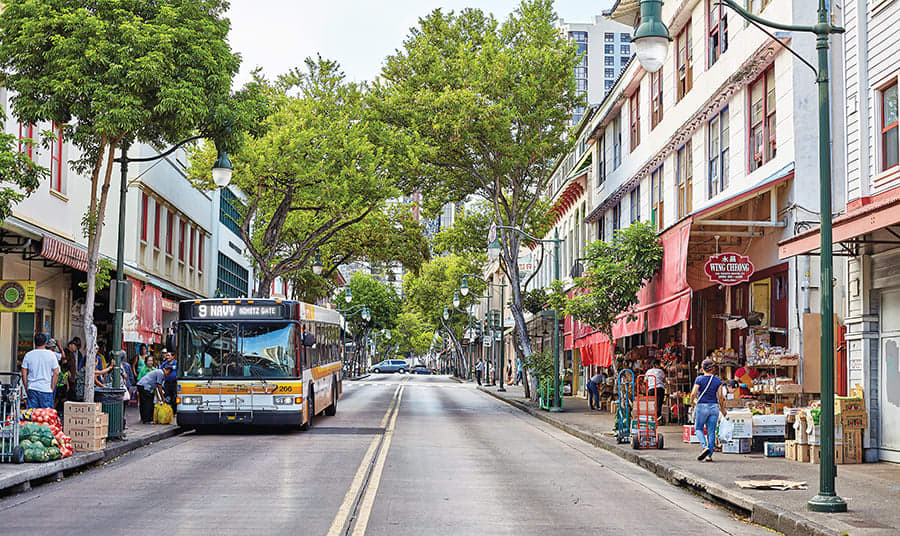
As a result of dynamic scheduling, TheBus has experienced less customer complaints about “pass-ups,” which used to be a byproduct of bus bunching.
Getty Images/JamesYetMingAu-Photography
With COVID-19 basically canceling the trade show and awards season, METRO Magazine decided to honor our 2020 Innovative Solutions Award winners here in print.Now in its sixth year, the Innovative Solutions Awards honors bus operations and their supplier partners who have implemented initiatives that helped them save money, run more efficiently, streamline operations, increase safety, improve customer satisfaction, increase ridership, and more. This year, we categorized our winners into six categories: Technology, Safety, Passenger Experience, Operations, Clean Tech, and Mobility.
In 2019, TheBus partnered with its CAD-provider, Trapeze, to develop a Dynamic Headway Management Module. Under dynamic headway scheduling, an entire bus route is monitored by the CAD system and total circuit times are measured in real time. The system automatically starts trips and maintains spacing for all buses on the route. Trapeze has developed a simple driver interface using the existing Mobile Data Terminal (MDT) in the vehicle. The MDT provides a countdown of when to start a trip and informs drivers when they are too close or too far from the front vehicle. Central radio controllers monitor headway routes, more like an air traffic controller, and intervene when necessary.
Dynamic scheduling is particularly important in Honolulu because of the intensity of the bus operation. The average passenger load (passenger miles/revenue miles) is the highest in the country. Dynamic headway scheduling was developed as a strategy to reduce or eliminate bus bunching on short headway lines. Routes that are candidates for dynamic headway scheduling provide frequent service and the public does not rely upon timetables. The public can obtain real-time location and expected arrival time for buses as these are available on the various transit apps, as well as other apps provided by third-party developers. An added value of dynamic headway scheduling is the ability to quickly add or subtract buses from a bus route, for example in case of a breakdown or accident. The dynamic headway scheduling software will quickly adapt to a variable number of buses and will space out buses in real time.
Dynamic scheduling was initially modelled on Route 8 — a short, four-mile urban circulator connecting Waikiki with the Ala Moana Shopping Center. The route carries about 5,000 daily passengers and operates on a nominal 10-minute headway between 7 a.m. and 5 p.m. About a year ago, TheBus expanded dynamic headway scheduling to Route 2 — the system’s busiest route with about 20,000 daily boardings. The route is about 10 miles long and normally has 20 articulated buses assigned to the line.
“As COVID-19 broke out, we adapted the dynamic scheduling system to help us deal with the need for greater social distancing on our busiest bus routes. While overall system ridership declined to about 60% of pre-COVID levels, our busiest bus routes still experienced trips with more than 40 people on board, rendering social distancing impossible,” explains J. Roger Morton, president and GM at TheBus. “However, with dynamic scheduling, we add more service on busy lines than even the regular full schedule. We’ve reduced headways on some routes from about every 12 minutes to about seven minutes so we can maintain a maximum passenger load of no more than 20 people on a 40-foot bus and no more than 30 people on an articulated bus.”
Morton adds TheBus can do this on the fly without the need for schedulers to develop new schedules for every change in service level. The agency has also modified its public “next-bus” system to update trip arrival predictions based on the real-time dynamic schedule.
As a result of dynamic scheduling, there have been less customer complaints about “pass-ups,” which used to be a byproduct of bus bunching. Second, because of the reduction in bus bunching, TheBus is providing more effective capacity with the same number of buses. Lastly, when the agency operates a route dynamically, it ended up with more bus trips than the static schedule because drivers operate in real traffic speeds rather than static scheduled speeds.
TheBus is expanding usage of dynamic scheduling and plans to adapt this mode of operation to special situations such as quickly established bus bridges when its rail system loses a segment.
“Partnering with experienced and talented individuals in the industry, like those at TheBus, energizes us to build innovative solutions that solve complex problems,” says Nathan Reynolds, director, ITS product management, for Trapeze. “This high level of involvement with our customers continues as we develop new features in our roadmap — to ensure that what we are building continues to solve customer challenges.”
More Technology

From Hardware to Digital Partner: Luminator Charts Its Next Chapter
CEO Magnus Friberg discusses Luminator’s shift toward becoming a digital partner, the growing importance of software and interoperability, and how AI can help agencies improve operations and passenger experience.
Read More →
Beyond the Checklist: A Structured Approach to Transit Maintenance
Reliability-Centered Maintenance helps transit agencies move beyond routine checklists to focus limited resources on the assets and failures that have the greatest impact on safety, reliability, and service.
Read More →
NJ TRANSIT Advances Bus Technology Upgrades Across Statewide Fleet
More than 1,500 buses now feature upgraded technology designed to improve arrival predictions and provide free Wi-Fi, with deployment expected to reach nearly 2,000 buses by the end of 2026.
Read More →

Building a Flexible Path to Transit Electrification
John Hroncich discusses BAE Systems’ modular and scalable approach, lessons learned from decades of real-world operations, and how agencies can identify electrification strategies that fit their fleets.
Read More →
Biz Briefs: Alstom Lands Canadian Contract, LYT to Supply California TSP, and More
In METRO's latest installment, we take a look at recent news from Complete Coach Works, Beep, FlixBus, and more partnerships making headlines across the transportation sector.
Read More →
From Legacy Silos to Conversational Intelligence
What if transit leaders could ask any operational question and get a trusted answer in seconds? Conversational AI is transforming how agencies use their data.
Read More →
USDOT Announces Rail Vehicle Replacement Grants, Chattanooga AV Shuttle Funding
More than $191 million in federal funding will help three transit agencies replace aging rail vehicles and support a new autonomous shuttle service in Chattanooga.
Read More →
Bus Tech Talk: Keeping Transit Technicians Ahead of the Technology Curve
LA Metro’s Obed Mejia discusses technician training, evolving maintenance technology, fleet replacement, and strategies for getting the most out of today’s transit fleets.
Read More →
Biz Briefs: RIPTA Unveils New Frontrunners, Clevland RTA Adds New Siemens, and More
In METRO's latest installment, we take a look at recent news from Siemens, Prevost, Dodge, and more partnerships making headlines across the transportation sector.
Read More →
Why Simulating Pedestrian Movement Has Become Essential for Modern Rail Stations
Pedestrian microsimulation is helping rail planners identify bottlenecks, test station designs, and prepare complex transit hubs for growing passenger volumes.
Read More →