



Kentucky proposes transit safety bill
Would reclassify and upgrade some crimes from Class B to Class A misdemeanors.

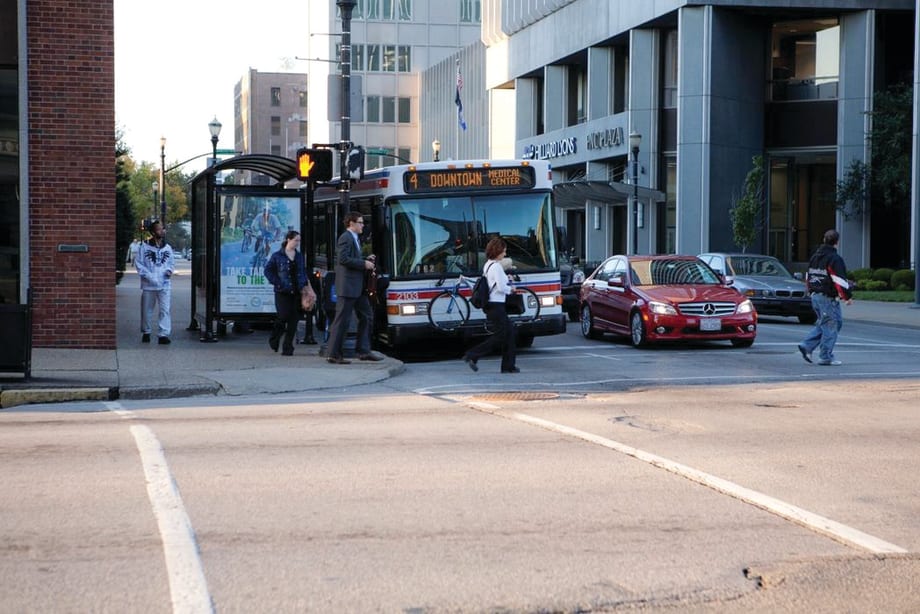
Kentucky may soon join several other states — including California, Colorado and Illinois — in adopting tougher laws against those who commit violent acts against transit workers and passengers as incidents continue to increase nationwide.
State representative Joni L. Jenkins resubmitted a bill, initially proposed by the Amalgamated Transit Union (ATU) five years ago, to curb violence on public transportation by stiffening penalties for those who commit acts of violence on public buses and taxis.
The problem was highlighted this past July, when two men boarded a Lexington, Ky.-based Transit Authority of River City (TARC) bus during the day and shot and killed a 17-year-old.
The legislation puts penalties for assaulting bus drivers and passengers on par with police and firefighters, said Barry Barker, executive director of TARC, which supports the bill.
“It’s one grade more severe,” he explained. “We want it to be a deterrent. It’s an ongoing struggle because you have drivers in all parts of the community at all times. Essentially, we have to open doors to let people on and off. We do what we can to protect [drivers].”
The proposed legislation would reclassify and upgrade some crimes from Class B to Class A misdemeanors. While a Class B misdemeanor is punishable by up to 90 days in jail and a $250 fine, a Class A misdemeanor is punishable for up to one year in jail and a $500 fine.
Also under the proposal, a person would be guilty of assault in the third degree if he or she “recklessly, with a deadly weapon or dangerous instrument, or intentionally causes or attempts to cause physical injury” to an operator or passenger of a taxi, bus or other passenger vehicle for hire.
Assault in the third degree is a Class D felony, with penalties of one year to five years in prison and fines of $1,000 to $10,000.
“It’s just one of a number of things we’re concerned about in improving safety for our operators and passengers,” Barker explained.
TARC had also installed five cameras on each of its buses, which enabled it to successfully push for prosecution in the July shooting, because it recorded the incident.
“The police had an indictment within two days,” Barker added.
Other measures taken by TARC to prevent violent situations include training drivers how to de-escalate situations and use self-defense from a seated position; working with community groups to enhance the relationship between drivers and teenagers; renovating bus stops, sidewalks and lighting; adding a new bus-tracking GPS system; acquiring a smart card fare system to cut down on fare evasion; and employing off-duty police to ride or follow buses if a driver complains of an incident.
While Barker acknowledges that the legislation isn’t going to fix everything, he believes it can be one more tool to make it safer to operate and ride on public transportation.
“[The question always is] how safe is safe? It’s never safe [or] secure enough. You’ve got to keep figuring out the next improvement,” he said.
TARC expects to hear about the legislation in April.
Larry Hanley, international president, ATU, said that there has been a steadily increasing number of assaults since the recession began, primarily, brought on by the combination of service cuts and raised fares by nearly every system in the country.
“They then send the only curbside tax collector in the country — the bus driver — into neighborhoods where people are the victims of the bad economy, who have lost their jobs, and are struggling every day to make a living and waiting longer for buses. When the bus finally arrives, [they find out] the fare has gone up,” he explained.
Hanley pointed out that in states that have strict penalties on assaulting transit operators, some crime has likely been prevented, but there has been no measurable decline because most attacks are crimes of passion and attackers aren’t considering the consequences.
“Sometimes I think people are embarrassed. They’re mad at the society that has kicked them to the side of the road,” he said. “I think there are times when bus drivers would have been assaulted except for the fact that there [are] stiffer penalties, but I don’t think it’s a huge driving force.”
What will prevent drivers from being assaulted, according to Hanley, is building enclosures around them — as is being done in New York and New Jersey — and adding exit doors on the driver’s left side so they can escape an attack.
“Bus drivers in a seat with no exit are cornered and attacked from the side or the rear. It’s almost impossible to defend yourself in that situation,” Hanley said. “We don’t have [left-side doors] in the states and we should. Many European buses have [them].”
More Bus

People Movement: Dan Dipert Coaches Adds Third-Generation Leader, Keolis Names New Valley Metro VP/GM, and More
In this edition, we also cover recent appointments and announcements at the Wabtec, SilverRide, HNTB, and more, showcasing the individuals helping to shape the future of transportation.
Read More →
New York MTA Plans Largest Bus Fleet Upgrade in More Than a Decade
The agency is seeking manufacturers for 650 new CNG buses to replace aging vehicles, improve reliability, and advance its broader fleet modernization strategy.
Read More →
Building a Flexible Path to Transit Electrification
John Hroncich discusses BAE Systems’ modular and scalable approach, lessons learned from decades of real-world operations, and how agencies can identify electrification strategies that fit their fleets.
Read More →
Bus Tech Talk: Keeping Transit Technicians Ahead of the Technology Curve
LA Metro’s Obed Mejia discusses technician training, evolving maintenance technology, fleet replacement, and strategies for getting the most out of today’s transit fleets.
Read More →
Biz Briefs: RIPTA Unveils New Frontrunners, Clevland RTA Adds New Siemens, and More
In METRO's latest installment, we take a look at recent news from Siemens, Prevost, Dodge, and more partnerships making headlines across the transportation sector.
Read More →
People Movement: Holly Arnold Joins Transdev and More
In this edition, we also cover recent appointments and announcements at Pace, CamTran, MCI, and more, showcasing the individuals helping to shape the future of transportation.
Read More →
The High Cost of Transit Buses: Industry Leaders Look to Procurement Reform
Transit leaders and policymakers examine how standardized bus designs, streamlined procurement, and predictable funding could help agencies stretch budgets and deliver better service.
Read More →
The Business Voice Behind Public Transportation
As chair of APTA’s Business Members Board of Governors, Ray Melleady explains how more than 850 business members are partnering with transit agencies to advance funding, innovation, and industry-wide collaboration.
Read More →
From Surviving to Thriving: Building Stronger Transportation Organizations
Bus Business Consultants founder Brian Dickson shares lessons on leadership, organizational health, and creating options for long-term success in a changing transportation industry.
Read More →
Finding the ‘Happy Medium’: Optimizing Maintenance Without Sacrificing Reliability
The key to maintenance optimization isn’t doing less work—it’s doing the right work at the right time on the right assets.
Read More →