



London congestion pricing scheme set to begin in February
The congestion charging zone will comprise central London, which 1 million people enter every day.

Though London has a population similar to that of New York (about 7 million), it has half of the density over twice the area. That means a lot of commuting into the city. And the population in London is expected to increase 700,000 by 2016. To help solve the associated transportation problems, the city is instituting congestion charging, which is a process similar to collecting tolls but a little more high-tech. “London is a world city, but our transport system is not entirely fit for the 21st century,” Derek Turner, managing director of street management for Transport for London, told attendees at a Washington, D.C., symposium held by the Eno Transportation Foundation. “The transport system has been starved for decades, and we don’t have the space to increase it.” That has led to a decrease in performance and capacity, causing increased costs, harming business efficiency and worsening the quality of life. People and businesses are losing about $6.40 to $10 per week. For most commuters, 50% of their time is spent in traffic queues with an average speed of less than 11 mph, Turner said. The transport strategy determined by London Mayor Ken Livingstone as part of his political strategy includes improving bus service in the short term and tube and rail in the long term. There will be a 40% increase in the capacity of buses and trains serving the capital by 2011 and in new traffic links to improve access development in east London. Finally, his intent is to reduce congestion, primarily accomplished by congestion charging. The idea of congestion charging has been discussed in London since at least 1960. In 1999 the government finally gave Livingston power to introduce the scheme. After 18 months of public consultation, the scheme will be introduced on Feb. 17, 2003. The congestion charging zone will comprise central London, which 1 million people enter every day. “We’re talking about changing the habits of a relatively small number of people,” Turner said. “The economic impacts won’t be seen for five years.” Commuters will be charged a flat fee of $8 per day, Monday through Friday, 7 a.m. to 6:30 p.m. “Five pounds a day won’t have a business impact since parking in the retail area is £5 an hour,” Turner said. “The impact will be on people driving through.” Drivers will be able to pay the fare by mail, telephone, retail outlets or the Internet. The fee has to be paid on the same day, but late payments are accepted up to midnight, primarily for travelers and those unfamiliar with the system. After 10 p.m., the charge becomes $16. The payment is only collected once, when the vehicle passes into the boundary. Vehicles entering and exiting the central London area will be monitored by camera to make sure they have paid. Once vehicle data is recorded by a camera, the image is scanned and added to a database. That image is then matched to payment based on the vehicle’s registration number. “Little people will escape, but it’s an enforcement issue,” Turner said. “Because it’s an enforcing system, it is very flexible.” If no matching payment is found, meaning a commuter did not pay the fare, a penalty charge is issued. If no payment is then received, a warrant may be issued and the vehicle may be clamped or removed. “We’re not doing this to raise revenue or as a taxation system,” Turner said. “Our goal is to reduce traffic ... and improve the transport system in terms of freeing up the roads.” Discounts and exemptions to the fare do apply to such vehicles as buses, coaches, alternative-fuel vehicles, emergency services and the disabled. There is also a 90% discount for residents inside the zone. Signs will be placed around the city, noting where the congestion charging zones are and their hours of effect. The congestion charging scheme aims to do several things, which will begin to be apparent six months after the program begins. It aims to decrease traffic in central London 10% to 15% by bringing fewer vehicles into the city, and to cut journey times and traffic delays by about 25%. More public transportation may also be used, resulting in less traffic inside and outside the zone. The scheme will bring $208 million in net revenue which, by law, must be invested in transportation facilities in London. The cost of starting the program is about $320 million. In the short term, that revenue will be used to improve bus operations, reduce fares on public transportation and better maintain roads and bridges. In the long term, it will be used for increased Underground and rail capacity, new Thames Gateway river crossings and improvements to London’s road systems. A major public information campaign has been underway since October to make sure all Londoners and residents of other affected boroughs know of the scheme. A call center was opened and a leaflet was distributed to every household across Greater London. Advertising has also been done on TV and radio, in newspapers and online. A Website, www.cclondon.com, was also established to answer any questions. In an opinion poll conducted by the Evening Standard in September, 46% were in favor of the charging scheme and 43% were against it, despite the fact that a January 2000 survey showed that 93% wanted action on congestion. The issues that remain include presenting the congestion charging as part of an overall strategy, improving public transport and implementing traffic management measures. “There’s a lot of work to do, but it’s not critical for day one,” Turner said. “There is no other alternative. This policy’s hour has come. If not publicly accepted, I really don’t know what we’ll do.”
More Management
People Movement: Connectpoint Expands Leadership Team, Stadler Names New Group CEO, and More
In this edition, we also spotlight recent personnel moves at Burns, UZURV, and more, highlighting the people taking on new roles across the transportation industry.
Read More →
More Than a Summer Job: Building the Next Generation of Transit Talent
The Delaware River Port Authority and PATCO have transformed their internship program into a hands-on professional development experience that introduces students to the breadth of transportation careers — and creates a pipeline for future employees.
Read More →
LA Metro Board Awards 220 Battery-Electric Bus Contract to ENC
The contract, which is the largest base award of battery-electric buses by a U.S. transit agency, will be built in Southern California, sustaining good jobs as LA prepares to welcome the world in 2028
Read More →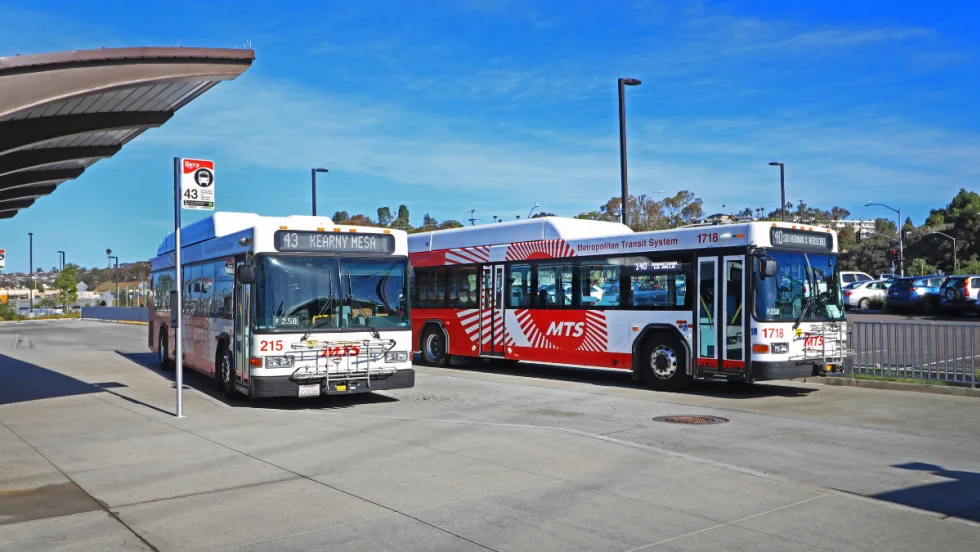
What’s Behind San Diego MTS’s Award-Winning Transit Strategy
Named one of APTA’s 2026 Outstanding Public Transportation Systems with 50 million or more annual passenger trips, California’s San Diego Metropolitan Transit System points to gains in ridership, safety, technology, and reliability as foundations of its success.
Read More →
Public Transit Conference Returning to GFX in 2027, Call for Papers Now Open
The Call for Papers is now open, allowing transit agency professionals and industry experts to help shape the PTC educational program by submitting session ideas for consideration.
Read More →
Indian River Transit’s Community-Focused Approach Earns National Recognition
Named APTA’s 2026 Outstanding Public Transportation System in its size category, Florida’s Indian River County transit system continues to grow ridership through fare-free service and a focus on evolving community needs.
Read More →
ENC Lands MATA Contract and More in Biz Briefs
In this edition of Biz Briefs, we spotlight the latest developments shaping the future of mobility.
Read More →
From Surviving to Thriving: Building Stronger Transportation Organizations
Bus Business Consultants founder Brian Dickson shares lessons on leadership, organizational health, and creating options for long-term success in a changing transportation industry.
Read More →
Everett Transit, Community Transit Outline Consolidation Agreement
The proposed agreement calls for a 50% increase in bus service in Everett, a new microtransit zone, continued paratransit service, and the transfer of Everett Transit operations to Community Transit.
Read More →
Strada360’s Steve Lassey on Turning Transit Data Into Better Decisions
From breaking down data silos to preparing for AI, Strada360 CEO Steve Lassey discusses how transit agencies can use technology to improve operations, customer information, and long-term decision-making.
Read More →