



Modeling Future Mobility: New Challenges Demand a Broader Scope
Connected and autonomous vehicles could represent a breakthrough in surface transportation with potentially profound implications for land use, travel behavior, transportation investments, safety, and economic productivity.


Historical travel patterns and transit ridership are on the verge of being disrupted by emerging technologies, changing demographics, shifting attitudes, and preferences. Millennials are comfortable using a wider array of options to address their activities and are eschewing or delaying automobile ownership at a time when an aging Baby Boomer population also looks for transportation alternatives. The ubiquitous internet (e.g. teleworking, telecommuting, online schooling, shopping, banking, and entertainment) expands the ability to accomplish the same tasks that used to require trips. At the same time, ridesourcing modes (e.g. Uber, Lyft) facilitated by smartphones increase mobility options that both complement and compete with transit services.
Of major interest, connected and autonomous vehicles (C/AVs) could represent a breakthrough in surface transportation with potentially profound implications for land use, travel behavior, transportation investments, safety, and economic productivity. Their impact on transit will be complex. Analyzing scenarios related to these issues requires a powerful and flexible modeling framework. Models based only on existing travel behavior without sensitivity to underlying factors and aggregate market segments are limited in their usefulness to explore the impacts of future mobility. Activity-based models implemented in a flexible platform can be extended to represent these scenarios and provide insight to how future mobility may impact transportation.
Future mobility implications
There has always been a degree of uncertainty in travel demand forecasting, however new developments in travel behavior and emerging technologies add several dimensions to possible future scenarios. This is the case for travel demand in general and public transit in particular, which has seen an increasing trend in ridership over the last few decades. It is unclear how these ridership trends will evolve and how the interactions between public transit, new transportation services, and emerging automation technology will play out. Yet, they are important to watch over time.
There has been a marked increase in transit and active mode usage by the millennial generation along with a decrease in auto usage and ownership compared to older generations. There has also been an increase in non-auto usage by young and middle-aged adults and an increase in telecommuting by older working adults in the last decade (Figure 1). These trends, possibly due to changing economic factors and/or environmental, health, or quality of life concerns, are likely to continue and perhaps increase in the future. The potential for these trends to continue, or even reverse, implies the likelihood of substantially different transportation futures.
Ridesourcing has the potential to impact how travelers view their travel options and how their transit services will be delivered. These services provide a convenient transportation option with a level of service competitive with transit and private vehicles in many areas. Ridesourcing providers also offer a shared-ride service that reduces the fare in exchange for a less direct and private trip. Furthermore, pilot programs are testing the use of existing ridesourcing services to provide paratransit and overnight service. These services may be complementary to existing trunk-line transit routes connecting origins and destinations that are not well served by transit and would help address the “first/last mile problem.” The development of these services may induce travelers to reduce their auto ownership, which is correlated to greater transit and non-auto mode usage. Lower auto ownership implies that less parking is needed and higher density neighborhoods may be developed.
Autonomous vehicles have become the hot topic in transportation today with much discussion and debate centering on the deployment timeframe (if/when/how/and to what degree). There is no shortage of other difficult questions that must be resolved such as cost and policies of usage. For example, should empty vehicles be permitted to patrol city streets awaiting an owner, a passenger or perhaps a package to deliver? More importantly, will travelers change their behavior in response to this new mode of travel? It is also unclear what the impact of autonomous vehicles ridesourcing services might be. In contrast to the virtuous cycle described above where more people use non-auto modes, autonomous vehicles may lead people to live farther from their workplaces and travel greater distances by private vehicle, thus making public transit less viable for daily travel. (See Virtuous/Vicious cycle Figure 2)
Models help plan For future mobility
Faced with uncertainty about future transportation conditions, a natural response could be “wait and see” before dealing with developments. The reactionary approach is risky because of the cost and lifespan of transportation investments, for example widening an existing freeway. Moreover, the transportation system plan should be consistent with future operational conditions to best assess policy decisions and evaluate potential regulations. Regulation of new technologies will be more difficult once practices, such as empty vehicle operation, become entrenched into personal and business practices. While travel demand models have not incorporated sensitivity to the types of future mobility scenarios described in this article, they are well suited as tools to gain insight and explore the range of potential futures. Activity-based travel demand models can be a more useful tool because they represent the population and travel behavior in much more detail than traditional four-step models and can test a wider array of policy questions.
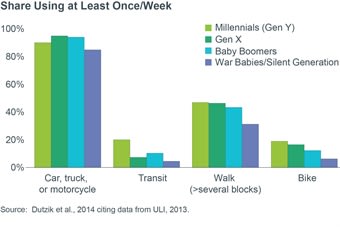
Figure 1 – Part A: Vehicle sharing is popular amongst many generations, where transit use is vastly more popular with Millennials.
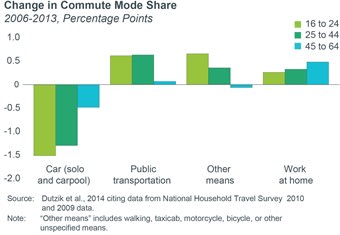
Figure 1 – Part B: Millennials currently use transit and non-motorized modes to a greater degree than other generations (Part A) and at increasing levels (part B) There has been also been a trend towards telecommuting by older working adults in the last decade.
Activity-based models (ABMs) are structured to represent the demand for activities on a person-by-person basis. These models simulate a full day of travel for each person in the region. They may include intra-household dependencies (e.g. the correlation between specific child and adult travel patterns on a given day), sensitivity to time-of-day policies and have a greater level of traveler detail (income, gender, age, worker-status, student-status) than is possible from aggregate trip-based models. The increased complexity of ABMs support more subtle policy testing and can provide insight into the interactions between multiple inputs.
Use of an ABM or any model to explore future mobility requires leveraging and extending the existing model structures. New models reflecting experience with future mobility options cannot be estimated because there are no available observations, but existing model structures can help planners and modelers gain insight into the range and scope of future mobility’s impact of travel. It is important to incorporate the actual uncertainty into the parameter definitions and interactions, and to explore many variations informed by the observed interactions of the model. Model forecasts have always incorporated a level of uncertainty, but it is easily overlooked when only a single point prediction is used for planning analysis. The potential variations in travel behavior and emerging technologies call for a more comprehensive and exploratory approach to modeling future mobility.
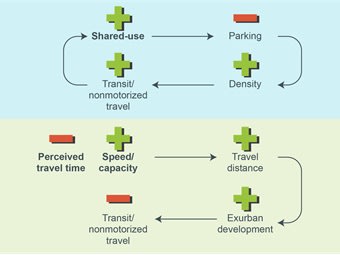
Figure 2: Autonomous ridesourcing services may create a “virtuous cycle” of decreased auto ownership and increased density and transit. Alternatively, the improved level of service with autonomous vehicles may cause a “vicious cycle” whereby developed sprawls, personal vehicle usage increases, and transit and non-motorized modes are less viable.
The Florida Department of Transportation (FDOT) District Four is using an ABM to conduct research on the impacts of future mobility. “My experience has been to try to understand what the model indicates and use it as a tool to create a scenario from it,” says Shi-Chiang Li, policy and systems planning manager with 27 years of FDOT experience. Li calls activity-based models “fundamental tools” for long-range transit planning. The key to overcoming modeling challenges, he says, is to “understand model structure, the statistics, and the uncertainty of the future (despite) so many variables that are put in the model.”
The potential to forecast future mobility is enhanced through activity-based modeling approaches. Moreover, a model practice that explicitly defines and explores varied scenarios can offer insight to the scope of impacts across possible futures. That is why it is important for transportation agencies to incorporate activity-based modeling tools and scenario practices into their planning process to more effectively forecast future travel demand and conduct policy analysis.
Martin Milkovits is senior associate and travel demand modeler with Cambridge Systematics Inc. (www.camsys.com).
More New Mobility

From Hardware to Digital Partner: Luminator Charts Its Next Chapter
CEO Magnus Friberg discusses Luminator’s shift toward becoming a digital partner, the growing importance of software and interoperability, and how AI can help agencies improve operations and passenger experience.
Read More →
Biz Briefs: Alstom Lands Canadian Contract, LYT to Supply California TSP, and More
In METRO's latest installment, we take a look at recent news from Complete Coach Works, Beep, FlixBus, and more partnerships making headlines across the transportation sector.
Read More →
CharterUP’s Armir Harris on Technology, AI, and the Future of Group Mobility
In a recent episode of METROspectives, CharterUP Founder/CEO Armir Harris discussed the company’s evolution from an online charter bus marketplace into a technology platform supporting public- and private-sector mobility and much more.
Read More →
Jacksonville’s NAVI Project Charts a New Course for Autonomous Public Transportation
Through its NAVI program, JTA is showing how autonomous vehicles, intelligent infrastructure, and coordinated operations can work together to deliver everyday public transportation.
Read More →
Biz Briefs: Luminator Marks Milestone and More
From manufacturers and suppliers to transit agencies and motorcoach operators, these updates offer a snapshot of the projects, partnerships and business moves driving the industry forward.
Read More →
New Tricks for Old Bureaucracies: Joshua Schank on Making Transit Innovation Stick
Former LA Metro Chief Innovation Officer Joshua Schank discusses why good ideas aren't enough, how transit agencies can overcome resistance to change, and why today's challenges demand more innovation.
Read More →
How DART's GoPass Is Redefining Regional Mobility
Serving 14 transit agencies, GoPass simplifies multimodal travel by allowing riders to plan, pay for, and manage an entire trip through one app.
Read More →
Biz Briefs: OCTA Taps Clean Energy for Hydrogen Station, Stadler to Supply Via Rail Vehicles, and More
From manufacturers and suppliers to transit agencies and motorcoach operators, these updates offer a snapshot of the projects, partnerships and business moves driving the industry forward.
Read More →CharterUP Expands Into New Mobility and Autonomous Transportation
Vice President of New Mobility Stephen Joos discusses how CharterUP is leveraging its nationwide transportation network, technology platform, and autonomous vehicle partnerships to expand into workforce mobility, campus shuttles, and transit solutions.
Read More →
METRO Magazine Announces 2026 Innovative Solutions Awards Winners
Projects Recognized for Advancing Mobility Through Technology, Accessibility, Workforce Innovation, and Operational Excellence
Read More →