



New Rail Projects Continue in Climate of Fiscal Restraint
Despite the growing demand for new rail investments, the strength of federal support will depend on new revenues. Meanwhile, strong local funding continues and private interest increases.

Toll road concessions, public-private partnerships, and state infrastructure banks were some of the innovative financing tools and credit instruments identified at a recent Brookings Institute forum.
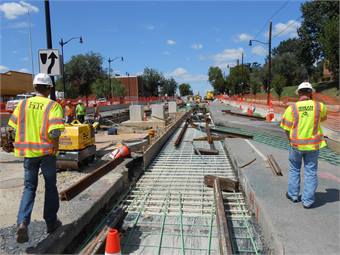
Courtesy DC Streetcar
The strong demand for additional rail investments in cities throughout the country continues unabated, despite the fact that following the sunset of Moving Ahead for Progress in the 21st Century Act (MAP-21) next September, the Mass Transit Account of the Highway Trust Fund is projected by the Congressional Budget Office (CBO) to have very little if not a negative balance by FY 2015 (beginning Oct. 1, 2014), when any reauthorization of MAP-21 would begin.
Meanwhile, regulatory implementation of this law is ongoing, and the final rule governing the New Starts and Small Starts programs that partly fund the majority of U.S. public transportation infrastructure projects was only recently released. This article will cover those recent developments as well as new and upcoming projects in the federal “pipeline” of funding requests. We’ll also take a look at how the next federal law may be funded and what cities are doing to address this fiscal climate.
New Starts rule finalized
The Federal Transit Administration (FTA) released its new policy guidance in August, which replaces all previous policy guidance documents published by FTA relating to the New and Small Starts programs. It revises the evaluation measures and methods for calculating a project’s justification and how FTA will evaluate a project’s local financial commitment, as required by MAP-21 and implemented in the final rule published this past January.
The FTA also released reporting instructions that describe what project sponsors need to submit to the agency and the new forms that must be completed. These documents can be found on FTA’s website at http://www.fta.dot.gov/12304.html.
Of course, the guidance and January regulation cover only the New and Small Starts evaluation process; many other implementing rules of new MAP-21 programs will follow in the next 18 months, including the core capacity improvement program evaluation and rating process; the program of interrelated projects evaluation and rating process; the pilot program for expedited project delivery; the measures and breakpoints for ratings for the congestion relief criterion; and the process for an expedited technical capacity review for project sponsors that have recently, and successfully, completed at least one new fixed guideway or core capacity project.
In addition, more specific explanation of how these steps in the New and Small Starts process will be implemented by FTA are expected in future interim policy guidance. In short, a considerable amount of the current federal law governing public transportation programs has yet to be implemented — for a law that is scheduled to expire in the last quarter of next year.
Considerable controversy
The August New and Small Starts guidance says the FTA will rate the six-project justification criteria equally, including mobility improvements, environmental benefits, congestion relief, economic development effects, land use and cost effectiveness. This will form the project justification rating, which is half of the overall project rating law. The other half will comprise the rating of local financial commitment, which in turn will look at three sub-criteria: availability of reasonable contingency amounts; availability of “stable and dependable” capital and operating funding sources; and availability of local resources to maintain and operate the overall existing and proposed public transportation system without requiring a reduction in existing services. Each of these criteria will be rated on a five-point scale, from low to high.
Considerable controversy was generated in how some of the project justification ratings would be applied between New and Small Starts. While the FTA tried to apply the same evaluations to both categories of projects, some, such as the cost-effectiveness rating, do have different break points for the five-point scale.
The final policy guidance specifies that FTA will assign a 25% weight to the current financial condition of the project sponsor, 25% weight to the firmness of the local funding commitment and fully 50% of the financial rating to the “reasonableness” of the financial plan submitted by the project sponsor. The requested New or Small Starts share of the total project capital cost, and the level of local match, will be also be strongly considered; this can potentially raise the local financial commitment sub-rating one level. [PAGEBREAK]
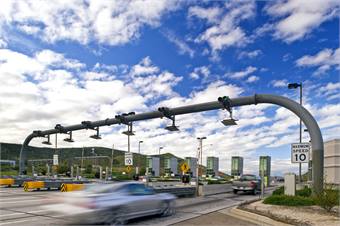
Toll road concessions, public-private partnerships, and state infrastructure banks were some of the innovative financing tools and
instruments identified at a recent Brookings Institute forum.
A post-MAP 21 world
While the two tax writing committees in Congress wrestle with how to make the Highway Trust Fund and Mass Transit Accounts sufficiently solvent both to write a successor bill to MAP-21 and provide stable long-term funding for the surface transportation programs, a growing number of states and regions are increasing their responsibilities in their infrastructure agendas.
The AASHTO Center for Excellence in Project Finance lists at least 30 states currently debating or having already passed measures aimed at increasing funding for transportation. For example, Virginia completely revised its transportation financing by converting its 17.5-cents-per-gallon gas tax into a state sales tax increase of 5.3%. Maryland has also passed several gas tax increases, totaling an additional 12.5 cents per gallon over several years to fund major transportation projects, and is looking at public-private partnerships (PPP) to help fund and deliver some of its major projects, such as the Purple Line light rail, and possibly, the bus rapid transit (BRT) network being planned for Montgomery County.
Oregon has adopted a voluntary pilot vehicle miles traveled fee, allowing up to 5,000 registered car owners to pay 1.5 cents per mile instead of paying the state gas tax at the pump. The pilot may be the first step toward the nation’s first VMT program. And of course, for more than a decade now, the average annual win rate for local and statewide ballot initiatives for surface transportation, including those with tax increases attached to them, continues to be more than 70%, even in more challenging economic times.
A July 12 Brookings Institution-sponsored forum, entitled “Can-Do States: A New Era for Infrastructure Investment,” shined a spotlight on another revenue-raising approach states are using to fund infrastructure. This includes a variety of innovative financing tools and credit instruments, such as PPPs, state infrastructure banks, toll road concessions, and availability payments to private consortia based on tax and debt sources of funding.
Although most of these new approaches have been in new highway programs, several public transportation programs are worth mentioning, including the Eagle P3 commuter rail project in Denver and the use of Transportation Infrastructure Finance Investment Act (TIFIA) loans for the Crenshaw light rail in Los Angeles, among others. This program was expanded roughly six-fold in MAP-21; so many more such awards are expected. In addition, at press time a PPP tender was underway for the Washington, D.C., streetcar program using availability payments to incentivize a private consortium.[PAGEBREAK]

Oregon has adopted a voluntary pilot vehicle miles-travelled fee, allowing up to 5,000 registered car owners to pay 1.5 cents per mile instead of paying the state gas tax at the pump.
Interesting bellwether
Another example of how urban rail projects will be funded and financed in a post-MAP-21 future might be found in Los Angeles. Several voter-approved sales tax increases over the past three decades, most recently Measure R in 2008, have allowed the Los Angeles County Metropolitan Transportation Authority (Metro) to provide a stable funding stream to match federal New Starts and leverage TIFIA dollars. Indeed, Los Angeles is currently in the midst of a rail transit construction boom, with three major rail projects slated to begin construction within the coming year.
One of the projects prioritized through 2008’s Measure R, and included in Metro’s long-range plans, is a potential transit and/or highway improvement project through the perennially congested Sepulveda Pass.
The Sepulveda Pass provides an important transportation link across the Santa Monica Mountains between the household-dense San Fernando Valley and major employment and activity centers in Los Angeles County’s Westside. The I-405 Freeway is one of the most traveled urban highways in the U.S., according to the Federal Highway Administration (FHWA) with an average annual daily traffic of 374,000 vehicles in 2010.
In late 2012, Metro completed the Sepulveda Pass Corridor Systems Planning Study, an initial study that evaluated potential transit and/or highway capacity improvements beyond those currently being constructed as a part of the I-405 Sepulveda Pass Improvements Project. This study evaluated six broad level concepts — from BRT, light rail (LRT) and heavy rail transit (HRT) to highway improvements, including High Occupancy Toll (HOT) lanes and tolled tunnels, and at-grade and above and/or below grade-separated rail alignments. Development of these concepts took into account travel markets, engineering constraints and environmental issues.
Even with Measure R funding, a transit or highway project over the Sepulveda Pass may require additional funding and financing to accelerate construction. To this end, the Metro board has recommended further study of a PPP to implement toll lanes and expedite funding and construction of one of the concepts. Under this funding scenario, a private development consortium would provide funding to construct a project through the Sepulveda Pass and Metro would grant the consortium a franchise to possibly operate and maintain the new facility for a number of years to recover their capital investment.
Although no individual concept has been chosen as the preferred alternative to date, several of the concepts being contemplated have potential for PPP application. Aside from its initial study and the recommendation by its board to further study a PPP as a potential funding and project acceleration strategy, Metro has not moved forward with any other plans or decisions related to a potential highway and/or transit project through the Sepulveda Pass.
Short, long-term implications
How all three levels of government will respond to both the growing demand for public transport infrastructure to meet the challenge of a changing economy as well as the growing interest in PPPs to help fund this demand will shape the future of public transportation infrastructure funding. More state and local revenue and PPP approaches could lessen the pressure for Congress to come up with increased resources to fund the next reauthorization. The CBO estimated that to finance a six-year program at current spending levels would require roughly $320 billion ($53 billion/year), but projected revenues in the Highway Trust Fund would leave an unfunded gap of $80 billion.
However, others argue that greater federal involvement than the currently provided is being demanded more than ever to meet the national international challenges of climate change, global economic competitiveness and other forces of economic and social change in America. The American Public Transportation Association will ask for a six-year authorization of $100 billion, which assumes that federal share of capital projects remains at the recent history of 40%. Any less would reduce the federal share of public transportation investment to levels not seen in many decades.
Cliff Henke is a senior analyst and assistant VP at Parsons Brinckerhoff.
Ivan Gonzalez is a transportation planner at Parsons Brinckerhoff.
Both are based in Los Angeles.
More Management

METRO Opens Submissions for 2026 Motorcoach Awards
Nominations are now being accepted for METRO Magazine’s Operator of the Year and Innovative Operator of the Year awards.
Read More →
New York MTA Advances Final Contract for Second Avenue Subway Expansion
Contract Four is the largest in the Second Avenue Subway Phase 2 project and includes construction of station infrastructure, tracks, and signals for the subway expansion, MTA officials said. Work on Contract Four will begin in 2027.
Read More →
Transit Agencies Highlight Safety Gains at National Summit
Leaders from 15 major transit systems shared crime-reduction results and safety initiatives while discussing the role of continued federal support.
Read More →

NITA Names New Leadership, Expands Reduced-Fare Program at First Board Meeting
The new regional transit authority appointed its first board chair and interim executive director while extending reduced fares across CTA, Metra, and Pace for eligible riders.
Read More →
Beyond the Checklist: A Structured Approach to Transit Maintenance
Reliability-Centered Maintenance helps transit agencies move beyond routine checklists to focus limited resources on the assets and failures that have the greatest impact on safety, reliability, and service.
Read More →
APTA 2026 Nominating Committee Selects Leadership Slate, Names Chair and Vice Chair Nominees
Leadership changes will help shape the association’s priorities and its representation of the transportation industry during the 2026–2027 term.
Read More →
DART Launches Major Security, Fare Enforcement Initiative
The 90-day demonstration will deploy coordinated security teams at five light rail stations while testing controlled access and gathering data to guide future investments.
Read More →
Advancing Fare Collection Through Technology and Innovation
Learn about delivering 1300 gates at 91 stations while managing fare evasion. Explore the large scale deployment, solution customization and real-world results that affect the region. Prepare for deployment in your region now.
Read More →
Game Day in Motion: Moving Millions During the 2026 World Cup
Between packed transit stations and team motorcoaches, see how agencies and operators across North America tackled the transportation demands of the 2026 FIFA World Cup.
Read More →
Surface Transportation Extension Averts Shutdown, Leaves Transit Funding Gap
The stopgap keeps federal transportation programs moving, but missing advance funding could complicate the transit and rail projects agencies are planning next.
Read More →