



Public-private partnership to fund Denver rail expansion
The East Corridor rail line is part of the Denver Regional Transportation District's $2.3 billion Eagle P3 project to be funded by a public-private partnership. Electric multiple-unit commuter rail trains will carry passengers from downtown Denver to the Denver International Airport.
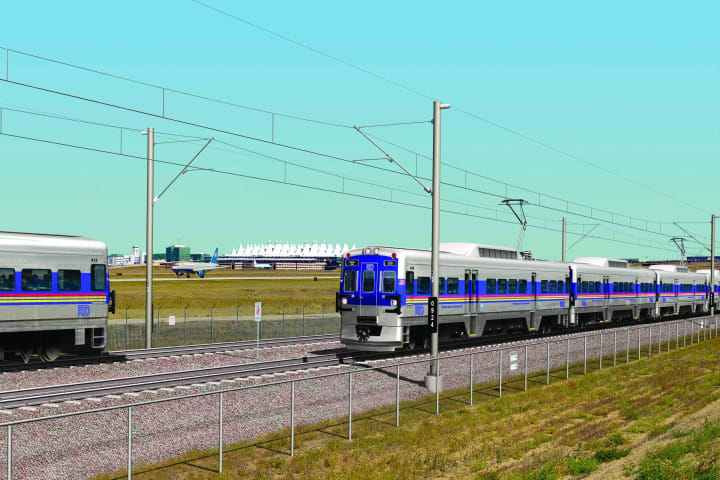
[IMAGE]RTD.jpg[/IMAGE]The Denver Regional Transportation District (RTD) will fund construction of 36 miles of commuter rail lines and a maintenance facility as well as the procurement of rail vehicles through a public-private partnership. The $2.3 billion Eagle P3 project, as RTD calls it, is part of the agency's larger expansion program, FasTracks.
Final proposals from the two investment consortia bidding on the project - which includes divisions of Macquarie Group Ltd. and Siemens AG — were due May 14, and the winning bidder will be announced June 15. As reported by Nasdaq.com, the investment groups are being asked to provide about $1.2 billion up front, with federal grants covering about $1 billion and local money making up the remainder. RTD will retain ownership of the project and pay back investors over a 40-year term.
"The public sector would take advantage of the private equity that this team would come to the table with to help get the capital project up and running," FasTracks Public Information Manager Pauletta Tonilas said.
RTD's FasTracks transit expansion program includes extensions of three rail lines and a bus rapid transit corridor. In developing the Eagle P3 project, Tonilas said, "We looked at the various projects, and we took a couple of them that are identified to receive federal funds through the New Starts program at the Federal Transit Administration (FTA) and we bundled those together." The project will include construction on two rail lines, plus a short segment of a third. Construction of a commuter rail maintenance facility and procurement of the electrified rail vehicles will also be covered in the deal.
RTD conducts an annual program evaluation to assess the costs, schedule and revenue projections associated with the FasTracks program. "About three years ago, we started to realize the magnitude of the financial challenge we were having because of how things had changed since the plan had initially been put together," Tonilas said. Not only had the cost of construction materials skyrocketed, but sales tax revenues used to fund rail expansion projects were on a decline due to the recession, she said.
The agency then began formulating other strategies for funding construction and applied to take part in FTA's Public-Private Partnership Pilot Program (Penta-P). "They made an incentive to agencies to consider utilizing a public-private partnership to lower the risk on both the agency and the FTA for federally funded projects," Tonilas said.
RTD sent out a request for qualifications, then shortlisted three investment groups that responded to the request. Those three then received RTD's request for proposals; one team has since dropped out of the running. The remaining two teams submitted technical proposals April 14. The final proposals due in May contained complete financial details.
Construction on the East Corridor portion of the Eagle P3 project, a rail line that will connect downtown Denver with the Denver International Airport, is slated to break ground in August.
Although this type of transit funding partnership is used frequently in Europe and South America, Tonilas said, it is rare in the U.S. However, in current economic conditions, she sees it becoming more commonplace. "Entities that are very reliant on sales tax revenues have been hit hard through this recession, and it's tough playing catch-up," she said. "It'll take entities years and years to build their coffers back up from what we've been experiencing."
Tonilas thinks such public infrastructure as highway projects, toll roads, hospitals, jails and city buildings could increasingly be funded through public-private partnerships in future years. "Long-term, it's a solid investment," she said.
More Rail

New York MTA Advances Final Contract for Second Avenue Subway Expansion
Contract Four is the largest in the Second Avenue Subway Phase 2 project and includes construction of station infrastructure, tracks, and signals for the subway expansion, MTA officials said. Work on Contract Four will begin in 2027.
Read More →
San Diego MTS Breaks Monthly Trolley Ridership Record
Agency officials said July’s ridership indicates MTS’s continued recovery from the pandemic.
Read More →
Report Examines NJ TRANSIT Reliability, Funding Challenges
The Garden State Initiative analysis examines the roles of Amtrak infrastructure, fleet management, and agency operations while recommending a more performance-based approach to improving reliability.
Read More →
Stadler, CapMetro Sign Long-Term Rail Fleet Support Agreement
Beginning in 2027, Stadler will provide on-site technical expertise, spare parts support, training, and obsolescence management to help extend the reliability and longevity of CapMetro’s GTW fleet.
Read More →
Biz Briefs: Alstom Lands Canadian Contract, LYT to Supply California TSP, and More
In METRO's latest installment, we take a look at recent news from Complete Coach Works, Beep, FlixBus, and more partnerships making headlines across the transportation sector.
Read More →
CATS Gold Line Marks 5 Years of Service, 2.8M Passenger Trips
With a six-mile expansion planned, the Charlotte streetcar is positioned to connect more neighborhoods and major transit hubs across the region.
Read More →
Why Simulating Pedestrian Movement Has Become Essential for Modern Rail Stations
Pedestrian microsimulation is helping rail planners identify bottlenecks, test station designs, and prepare complex transit hubs for growing passenger volumes.
Read More →
Amtrak Begins Major Construction at New York’s Sunnyside Yard
The new maintenance facility will support Amtrak’s Airo trainsets while improving maintenance efficiency and turnaround times in New York.
Read More →
Chicago Leaders Unveil Plans for O’Hare Airport Express Train
The privately developed project would offer a 15-minute trip between downtown and O’Hare’s Terminal 2, with trains operating every 15 minutes on a dedicated track. The service would use battery-electric trains and three existing freight rail rights-of-way.
Read More →
OCTA Maps Out 30-Year Strategy to Protect Coastal Rail Corridor
The draft feasibility report identifies strategies to protect the coastal rail line for decades as the agency continues near-term stabilization and sand placement efforts.
Read More →