



New York MTA Seeks Bids for 2,390 Subway Cars in Record-Breaking Order
The new cars, model R262, will be funded by the MTA’s 2025-29 Capital Plan, which received a historic $68 billion in funding from Governor Hochul and the State Legislature in the FY26 Enacted State Budget.

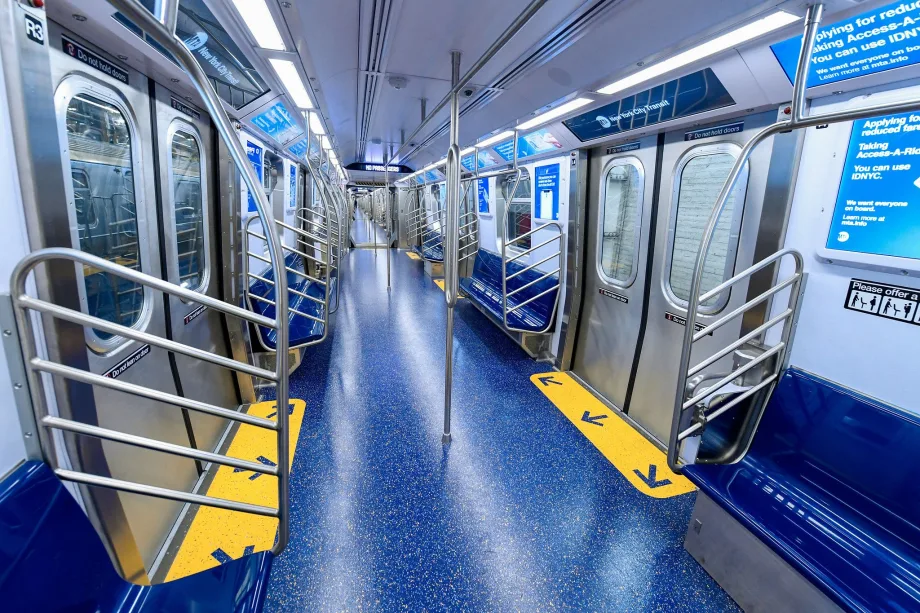
The RFP states that the future order will include a to-be-determined number of open gangway cars, which would be a first for the A-Division, the numbered lines.
Marc A. Hermann
- The New York MTA is seeking bids to purchase 2,390 new subway cars, designated as model R262.
- Funding for the new subway cars is part of the MTA’s 2025-29 Capital Plan.
- The plan received a historic $68 billion in funding from Governor Hochul and the State Legislature in the FY26 Enacted State Budget.
*Summarized by AI
The New York Metropolitan Transportation Authority (MTA) is seeking proposals from railcar manufacturers for its largest subway car contract in history with a base order of 1,140 subway cars to replace the R62 and R62A fleets operating on the 1, 3, 6 lines, and if an option to purchase the additional 1,250 cars is exercised, to replace the R142 and R142A cars on the 2, 4, 5 lines.
"Thanks to Governor Hochul, the MTA has a historic $68 billion 2025-2029 Capital Plan, and New Yorkers are seeing a Golden Age of transit investment,” said MTA Chair/CEO Janno Lieber. “So much of our capital investment goes unseen, but this next subway car order — our largest ever — is a major step to visibly delivering the modern transit system New Yorkers deserve."
MTA’s Railcar RFP
In total, the contract includes 2,390 new subway cars — more cars than the Chicago Transit Authority subway fleet and Massachusetts Bay Transit Authority’s combined, said MTA officials.
The new cars, model R262, will be funded by the MTA’s 2025-29 Capital Plan, which received a historic $68 billion in funding from Governor Hochul and the State Legislature in the FY26 Enacted State Budget. This Capital Plan represents the largest investment in new rolling stock in the MTA's history.
The purchase also includes funds made available through the 2020-2024 Capital Plan, which is supported by congestion pricing revenues.
New Contracting Methods
With a new Rolling Stock Program in place, the MTA has approached this contract differently, modernizing the terms and conditions and encouraging innovation by giving manufacturers greater flexibility to propose new ideas, according to officials.
More than 60% of the technical specifications are now also performance-based rather than design-driven, and for the first time, the terms request that proposers submit total cost of ownership projections. These efforts result in a streamlined contract that balances the current challenges contractors face with the authority's need to retain the tools necessary to deliver the quality car riders deserve on time.
The historic car contract could replace up to 36.4% of the subway’s entire fleet — 17.3% with just the base order alone. The subway’s entire fleet consists of 6,574 cars.
The new cars will significantly improve reliability, with a higher mean distance between failures (MDBF) — a measure of how long a car can operate without issues, repairs, or maintenance. The R262 has an MDBF requirement of 200,000 miles, compared to the R62/R62A’s average of 89,000 miles. This upgrade will reduce the number of problems customers experience en route and decrease the amount of time cars are taken out of service.
The Request for Proposals (RFP) outlines additional technical specifications designed to enhance efficiency, security, performance, and the customer experience. These include higher-quality announcement systems and assistive listening devices that allow deaf passengers to connect to personal devices, such as hearing aids.
In addition, the RFP states that the future order will include a to-be-determined number of open gangway cars, which would be a first for the A-Division, the numbered lines. Efficiency upgrades include installing an automatic passenger counting (APC) system and an electric braking control to achieve savings by using fewer parts.
Meanwhile, security specifications include onboard cameras, such as those currently installed on the existing subway fleet, and platform-edge CCTV, along with an electronic lock to prevent unauthorized cab access.
Proposals are due September 8, and a contract is expected to be awarded by early 2028.
Quick Answers
The model of the new subway cars is R262.
*Summarized by AI
More Rail

ENC Lands MATA Contract and More in Biz Briefs
In this edition of Biz Briefs, we spotlight the latest developments shaping the future of mobility.
Read More →
Strada360’s Steve Lassey on Turning Transit Data Into Better Decisions
From breaking down data silos to preparing for AI, Strada360 CEO Steve Lassey discusses how transit agencies can use technology to improve operations, customer information, and long-term decision-making.
Read More →
SEPTA Details Accelerate Vision for Transit System
The plan outlines investments in trolley modernization, new Metro and Regional Rail vehicles, accessible stations, and more frequent bus and rail service.
Read More →
FTA Ends Direct Oversight of MBTA Safety Actions
The federal agency closed its remaining special directive to the Massachusetts Department of Public Utilities following a safety review that began in 2022.
Read More →
Amtrak, CN Reach Agreements to Strengthen Passenger Rail Service, Safety
The agreement resolves a more than decade-long proceeding before the Surface Transportation Board concerning the terms and conditions for Amtrak services, such as the City of New Orleans, Illini/Saluki, and Wolverine.
Read More →
New York MTA Advances Final Contract for Second Avenue Subway Expansion
Contract Four is the largest in the Second Avenue Subway Phase 2 project and includes construction of station infrastructure, tracks, and signals for the subway expansion, MTA officials said. Work on Contract Four will begin in 2027.
Read More →
San Diego MTS Breaks Monthly Trolley Ridership Record
Agency officials said July’s ridership indicates MTS’s continued recovery from the pandemic.
Read More →
Report Examines NJ TRANSIT Reliability, Funding Challenges
The Garden State Initiative analysis examines the roles of Amtrak infrastructure, fleet management, and agency operations while recommending a more performance-based approach to improving reliability.
Read More →
Stadler, CapMetro Sign Long-Term Rail Fleet Support Agreement
Beginning in 2027, Stadler will provide on-site technical expertise, spare parts support, training, and obsolescence management to help extend the reliability and longevity of CapMetro’s GTW fleet.
Read More →
Biz Briefs: Alstom Lands Canadian Contract, LYT to Supply California TSP, and More
In METRO's latest installment, we take a look at recent news from Complete Coach Works, Beep, FlixBus, and more partnerships making headlines across the transportation sector.
Read More →