



Renewable Propane Reduces Emissions, Provides Cost Savings
Ideal for paratransit and on-demand transit fleets, the non-fossil fuel is produced from 100% raw materials, and when paired with an ultra-low NOx engine, brings emission levels to near-zero.


The average propane-fueled bus saves up to $3,000 per year, which allows the agency to provide an even greater level of service to the communities they support.
ROUSH CleanTech
We’re seeing more transit fleets leap toward a greener future. Highway and airport buses and city transit are just a few of the fleets switching to electrification. Electric transit is great for cities because it’s quieter and has no emissions. But electrification is not the only green alternative for powering public transit.
The path to zero emissions is also fueled by propane. And the best part — there is a renewable option. In addition, with the help of tax credits, it’s more attainable than ever.
Powering Transit Fleets with Propane
ROUSH CleanTech designs and develops advanced clean transportation solutions. And it’s one of the companies helping fuel transit fleets with renewable propane.
In fact, it was the first company to use an ultra-low NOx engine for renewable propane that brings emission levels to near-zero as defined by California Air Resources Board.
“We have seen a lot of success in the paratransit and on-demand market,” says Todd Mouw, executive VP, sales and marketing, for ROUSH CleanTech. “These vehicles go out on a route each day and return to a central location at night, which is ideal for propane because fueling infrastructure can be installed right on a transit agency’s property.”
Compared to traditional gas, propane provides a significant reduction in cost as well as emissions.
ROUSH CleanTech has more than 1,200 paratransit buses running in agencies all over the U.S.
The average bus saves up to $3,000 per year, which allows the agency to provide an even greater level of service to the communities they support.
Why Use Renewable Propane?
Out of all the alternative fleet fuels, propane is the most reliable and versatile. It’s a byproduct of natural gas processing, and it’s also known as liquid petroleum. Although it’s a fossil fuel, it has no toxicity and doesn’t harm the environment.
There is also an abundance of supply. According to propane.com, the U.S. produces more than enough propane to meet current demand and became a net exporter of propane in 2011.
In comparison, renewable propane (or biopropane) is a non-fossil fuel produced from 100% raw materials. It’s commonly produced from feedstock such as animal fat, wood waste, and cooking oil.
Renewable propane can also be a byproduct of renewable diesel. Most of the available volumes today come from sustainable aviation fuel production.
Regarding renewable propane as an alternative fuel for fleets, Mouw states, “Renewable propane is clean and economical for fleets to use. It has a carbon intensity four times lower than conventional propane and five times lower than diesel.”
Renewable propane’s chemical structure and physical properties are the same as propane. So that means it can be used as a drop-in for all the same fleet vehicle applications. Plus, no hardware, software, or modifications are necessary when switching to fueling transit fleets to propane or renewable propane.
It is even less expensive than traditional gas. According to the U.S. Energy Information Administration, the price of natural gas in June of 2022 averaged $9.66 per 1,000 cubic feet, while the price of propane in March of 2022 averaged about $5.13 per gallon.
And propane is even less expensive than diesel, at 50% less per gallon.
“Transit fleet operators across the nation report saving both time and money due to reduced maintenance costs and fewer service requirements compared to diesel buses,” Mouw says. “Propane autogas buses also don’t have cold-start issues and warm up quickly, which saves both time and money on equipment and staff.”
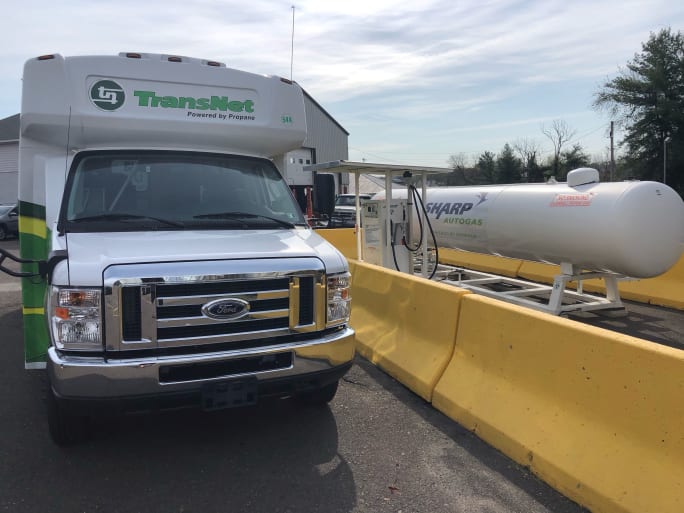
Compared to traditional gas, propane provides a significant reduction in cost as well as emissions.
ROUSH CleanTech
Room for Growth
Propane still has a long way to go. As of December 2021, 79% of transit buses operate on diesel. But that means there is more opportunity to grow. There are a plethora of initiatives taking place to move toward a renewable propane world. The more propane is used for other items, such as appliances and equipment, the more widely used and available it will be to fuel fleets as well.
Federal and state governments have their own incentives that make switching to propane worthwhile:
Incentives for California propane customers who purchase a new propane vehicle (including school buses) that meet both California Air Resources Board and EPA certification.
The Propane Education & Research Council pays up to $1,000 for each new home or remodel completed in 2022 if it includes qualifying propane appliances.
ERC offers up to $5,000 in financial incentives toward the purchase of new, propane-powered farm equipment.
California Parking Incentive Programs: preferential spaces, reduced fees, and fueling infrastructure.
Energy tax credits: $0.50 per gasoline gallon equivalent of propane, which equates to approximately $0.37 per gallon of propane.
So, when will propane take over America? “Over the next five to seven years, I believe we will see significant adoption of renewable propane, especially as more states adopt a low-carbon fuel standard,” Mouw says.
Propane as an alternate fuel for bus fleets is a no-brainer. It delivers significant reductions in cost and harmful emissions. It’s growing in popularity with fleets as a no-compromise solution.
“We believe in all of the alternative fuels, but propane is a perfect fit for ‘on-demand’ service that does not have a predetermined route requiring a significant amount of range,” says Mouw.
More Technology

From Hardware to Digital Partner: Luminator Charts Its Next Chapter
CEO Magnus Friberg discusses Luminator’s shift toward becoming a digital partner, the growing importance of software and interoperability, and how AI can help agencies improve operations and passenger experience.
Read More →
Beyond the Checklist: A Structured Approach to Transit Maintenance
Reliability-Centered Maintenance helps transit agencies move beyond routine checklists to focus limited resources on the assets and failures that have the greatest impact on safety, reliability, and service.
Read More →
NJ TRANSIT Advances Bus Technology Upgrades Across Statewide Fleet
More than 1,500 buses now feature upgraded technology designed to improve arrival predictions and provide free Wi-Fi, with deployment expected to reach nearly 2,000 buses by the end of 2026.
Read More →

Building a Flexible Path to Transit Electrification
John Hroncich discusses BAE Systems’ modular and scalable approach, lessons learned from decades of real-world operations, and how agencies can identify electrification strategies that fit their fleets.
Read More →
Biz Briefs: Alstom Lands Canadian Contract, LYT to Supply California TSP, and More
In METRO's latest installment, we take a look at recent news from Complete Coach Works, Beep, FlixBus, and more partnerships making headlines across the transportation sector.
Read More →
From Legacy Silos to Conversational Intelligence
What if transit leaders could ask any operational question and get a trusted answer in seconds? Conversational AI is transforming how agencies use their data.
Read More →
USDOT Announces Rail Vehicle Replacement Grants, Chattanooga AV Shuttle Funding
More than $191 million in federal funding will help three transit agencies replace aging rail vehicles and support a new autonomous shuttle service in Chattanooga.
Read More →
Bus Tech Talk: Keeping Transit Technicians Ahead of the Technology Curve
LA Metro’s Obed Mejia discusses technician training, evolving maintenance technology, fleet replacement, and strategies for getting the most out of today’s transit fleets.
Read More →
Biz Briefs: RIPTA Unveils New Frontrunners, Clevland RTA Adds New Siemens, and More
In METRO's latest installment, we take a look at recent news from Siemens, Prevost, Dodge, and more partnerships making headlines across the transportation sector.
Read More →
Why Simulating Pedestrian Movement Has Become Essential for Modern Rail Stations
Pedestrian microsimulation is helping rail planners identify bottlenecks, test station designs, and prepare complex transit hubs for growing passenger volumes.
Read More →