



Revised ad policies helping transit agencies
Within the past year, several U.S. transit agencies have revamped their advertising policies in an attempt to generate more non-farebox revenue.
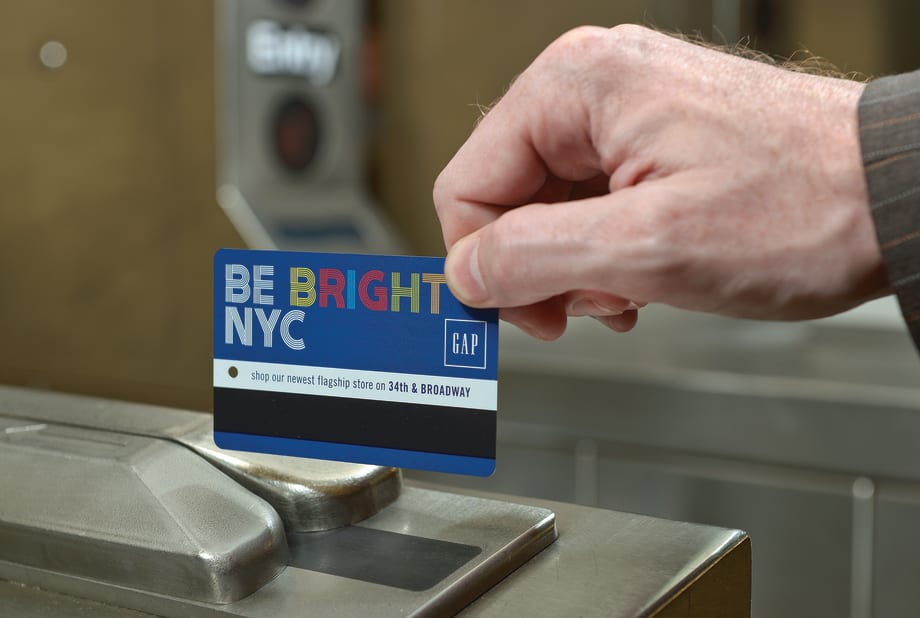
Courtesy New York MTA
Courtesy New York MTA
Within the past year, several U.S. transit agencies have revamped their advertising policies in an attempt to generate more non-farebox revenue. For many, this means allowing alcohol-related advertisements and turning any thinkable vehicle or station into a space for ads.
“Transportation systems have been hurting financially as a result of the economy, and advertising is a big source of income that folks are turning to,” said Aaron Donovan, media liaison for New York’s Metropolitan Transportation Authority (MTA).
The MTA expanded to new platforms of advertisements, both on-vehicle and in-station, and has nearly doubled its revenue by doing so. Print, digital and moving advertisements can be found on stair steps, columns and turnstile arms scattered throughout the system.
There are also ads on the backs of MetroCards and wrapped around select rail trains. Swiss watch brand Swatch fully wrapped six trains in March of 2011. The ads feature giant eye-catching watch images against a striped background. MTA called it a “novel form of advertising.”
Outside companies can also purchase a “station domination,” in which an entire station becomes an ad.
“Now we have ads where you’ve never seen ads before,” said Donovan. “We’ve done a lot to welcome advertising into the system and make it more prominent. That’s the overall reason why our ad revenue is up.”
In general, MTA’s ridership and community members have been in support of the endeavor, reported Donovan, as it allows them to hold on to the change in their pockets. “Every dollar we receive from advertising revenue relieves pressure on our budgets from fares, tolls and taxes,” said Donovan.
At the end of 2012, MTA is expecting to calculate approximately $120 million in revenue from advertisements, which supports about 1% of its operating budget overall.
MTA also changed a non-commercial advertising policy after a federal court decision determined its “no demeaning standard” to be unconstitutional. In response, MTA requires a similar disclaimer, removing it from viewpoints expressed on the ad.
In a similar financial pursuit, the Chicago Transit Authority (CTA), in March of 2012, lifted its 15-year ban on accepting advertising for alcoholic beverages. Beer, wine and liquor ads are now featured on railcars and at certain rail stations.
The agency’s advertisement program was already expansive, generating $25 million annually. With the new inclusion of alcohol ads, an additional $1.2 million in revenue is expected to be pumped into the system by the end of 2013, said Eric Reese, CTA’s chief of process management.
CTA did, however, enforce regulations designed to keep the controversial advertisement out of school children’s sight. Alcohol ads are not posted on stations where more than 7.5% of riders are between the ages of 12 and 18.
As well, these ads, which must feature a standard disclaimer, are only allowed within the business district of the city and at the stations serving the U.S. Cellular Field and Wrigley Field baseball stadiums. CTA will continue to ban alcohol advertisement on any city buses.
“We changed the policy with very careful consideration, which has limited any sort of negative feedback,” said Lambrini Lukidis, media relations representative with CTA. “The process was pretty robust — first we had to come up with the areas where we thought it would be appropriate to allow the ads, and then from there, we worked with our broker on a final strategy.”
After approving the change in March, “drink responsibly” ads and other safety posters went up in May, with the first actual alcohol ads displayed in June.
In another change, CTA is requiring political or public service ads by nonprofits and government agencies to disclose who is sponsoring them.
More Bus
Biz Briefs: New Flyer Delivers in Columbus, Houston, Beep and Freebee Merge, and More
In this edition of Biz Briefs, we spotlight the latest developments shaping the future of mobility.
Read More →
People Movement: Dan Dipert Coaches Adds Third-Generation Leader, Keolis Names New Valley Metro VP/GM, and More
In this edition, we also cover recent appointments and announcements at the Wabtec, SilverRide, HNTB, and more, showcasing the individuals helping to shape the future of transportation.
Read More →
New York MTA Plans Largest Bus Fleet Upgrade in More Than a Decade
The agency is seeking manufacturers for 650 new CNG buses to replace aging vehicles, improve reliability, and advance its broader fleet modernization strategy.
Read More →
Building a Flexible Path to Transit Electrification
John Hroncich discusses BAE Systems’ modular and scalable approach, lessons learned from decades of real-world operations, and how agencies can identify electrification strategies that fit their fleets.
Read More →
Bus Tech Talk: Keeping Transit Technicians Ahead of the Technology Curve
LA Metro’s Obed Mejia discusses technician training, evolving maintenance technology, fleet replacement, and strategies for getting the most out of today’s transit fleets.
Read More →
Biz Briefs: RIPTA Unveils New Frontrunners, Clevland RTA Adds New Siemens, and More
In METRO's latest installment, we take a look at recent news from Siemens, Prevost, Dodge, and more partnerships making headlines across the transportation sector.
Read More →
People Movement: Holly Arnold Joins Transdev and More
In this edition, we also cover recent appointments and announcements at Pace, CamTran, MCI, and more, showcasing the individuals helping to shape the future of transportation.
Read More →
The High Cost of Transit Buses: Industry Leaders Look to Procurement Reform
Transit leaders and policymakers examine how standardized bus designs, streamlined procurement, and predictable funding could help agencies stretch budgets and deliver better service.
Read More →
The Business Voice Behind Public Transportation
As chair of APTA’s Business Members Board of Governors, Ray Melleady explains how more than 850 business members are partnering with transit agencies to advance funding, innovation, and industry-wide collaboration.
Read More →
From Surviving to Thriving: Building Stronger Transportation Organizations
Bus Business Consultants founder Brian Dickson shares lessons on leadership, organizational health, and creating options for long-term success in a changing transportation industry.
Read More →