



School Charter Crashes Prompt Closer Look at Key Safety Concerns
Two recent school charter crashes, both involving motorcoach operators, have spurred federal regulators to action. Motorcoach officials warn schools against selecting charter operators based only on price.
In late April four children from a middle school in Newton, Mass., were killed in a motorcoach accident while taking an overnight trip to a music festival in Canada. The causes of the accident were still under investigation at press time, so are not at issue here. However, one result of the tragedy is an increased national scrutiny of overnight school charters and a search for ways to maximize their safety. This scrutiny is understandable. Three weeks before the aforementioned fatal crash in Sussex, New Brunswick, a motorcoach transporting a group of North Carolina high school students on an overnight trip to Florida crashed near Kingsland, Ga. Twenty-two students were injured in that crash, two critically. The weight of those two crashes prompted the Federal Motor Carrier Safety Administration (FMCSA) to launch a program to help school districts select bus companies with superior safety records. "We will provide access to our data systems so they can identify which bus operators have the best safety records," Julie Anna Cirillo, acting deputy administrator of the FMCSA, told a House subcommittee in early May. A month later, an interagency task force in North Carolina released a set of recommendations to school districts on how to select a motorcoach company for school charter assignments. These precautions might suggest that there are exceptional problems with the safety of motorcoach charters, especially school-related trips, but that would be inaccurate. "Bus transportation is the safest form of travel there is," says Phil Hanley, acting chief of the commercial passenger carrier safety division of the FMCSA. "It's got a better record than the airlines. But, like an air crash, a bus fatality, especially involving children, makes news, and tends to make people skeptical." Although remarkably safe, motorcoach transportation of children raises some concerns. "An issue that we've identified over the years, and are just starting to address, is that the sole criterion for schools choosing a bus company is, in many cases, price," Hanley says. "I've talked to several people around the country and, rather than service or the safety of the children, what the schools are looking for is the best price." Michele Janis, vice president of communications/marketing at the American Bus Association (ABA), agrees, noting there is a general lack of awareness by the schools on seeking motorcoach service. "Although we don't know the details regarding the Newton trip, the contours of this kind of trip are of great concern to the ABA," Janis says. "There does not seem to be a high level of education or awareness within the school system on how to procure outside transportation." "The heart of the matter, as I see it, is that most school trips operate on what I call a bake sale budget," she says. "You have to sell a lot of brownies to book a hotel room or hire an extra driver." Janis says that the choice of the bus company usually falls to the band leader, PTA member, parent or even administrator, none of whom have any particular awareness of what schools should consider when choosing a bus company. Improving safety at the federal level To address the situation, both the ABA and FMCSA are preparing initiatives to help educate the schools. The ABA is currently preparing a brochure in concert with the U.S. Department of Transportation. The FMCSA is also preparing a brochure and presentations to both school districts and bus companies, and will have a Website addressing the topic up in the fall. Hanley says the Website will allow schools to get a snapshot of a motor carrier. Information will include the number of vehicles inspected, buses registered with the agency and the number out of service, numbers of violations and proper levels of insurance. It will also provide information on drivers that includes training, medical qualifications, drug testing and commercial driving license status. Janis suggests that someone at the school should be specifically trained and given responsibility for doing the appropriate investigations and asking the right questions. For instance, if a bus company itself contracts out to another company, it should be known up front that that second company should be questioned as well. The driver's logbook should be checked, and it should be verified that the driver is rested and working within regulations. A second driver should, ideally, be sent ahead to be met at a motel part way on a long trip so he can be really rested. A second driver riding in a bus with 50 children is not in an environment conducive to sleep. Janis says that there is nothing wrong with overnight trips per se. "Statistics show that at night there is less traffic and fewer accidents, so it is actually safer," Janis says. "And children can fall asleep on buses." In some cases, she adds, depending on the trip length, the nature of the activity at the end of the ride and the timing, it might be better to schedule in an overnight stop at a motel. In terms of a basic message to be sent to bus companies, Hanley says that talking to the established ones "is like talking to the choir. They have properly qualified and certified drivers and well-maintained vehicles. They already know the rules." The question then arises: Why should consumers have to educate themselves on how to choose a good carrier, if the carriers are basically doing a good job? "There are many smaller, fly-by-night companies that are getting by on a shoe string," Hanley says. "They have a tendency to cut corners. They make a low bid to get a contract, but the drivers may not be qualified and may be pushed to work longer hours." Janis suggests there may be another reason why even reputable bus companies may, however unwittingly, contribute to less than optimal conditions for a trip. "If a school representative asks can you get me from here to there at this price, the bus company representative's tendency is to say, sure," she says. "For that's customer service. But the better question to ask is: what's the best way to make this trip? The bus company representative is then more likely to say something along the lines of, well, you could take the red eye special, but you might have a lot of cranky kids for your event. In this situation, maybe stopping at a motel overnight would be better." Michael Palmer, executive director of the Student and Youth Travel Association of North America, suggests that the trend is moving from parent or school-arranged to professional tour provider-arranged trips, and that trend should continue. The reason, Palmer says, is that the tour provider doesn't have a motivation to either sell on price or overlook anything that shouldn't be overlooked. "Tour professionals tend to place considerable scrutiny on bus companies they work with," Palmer says. "They know they expose themselves to either headaches or liability if they work with unreliable operators whose buses break down, don't have qualified drivers or don't show up on time." Palmer says that his association's research shows that student travel has grown at the rate of at least 20% during the past 10 to 12 years, and that bus travel takes on the lion's share of the transportation. "This growth will continue to put even more pressure on bus companies to accommodate increased business at the same time as maintaining their safety standards," he says. ******************************************* Dealing With School Trips A bus carrying children can be involved in an accident due to any one of a number of causes: other drivers, oil slicks, the weather, mechanical failure, poor judgments on the part of drivers, bus drivers or school officials. But a bus full of unruly, undisciplined children can also create conditions for disaster. Victor Parra, CEO of the United Motorcoach Association, offers the following: "Rules For Schools" as a way bus companies can deal with that issue: 1. All decisions pertaining to the operation of the motorcoach will be made by the driver based on legal requirements and company policy. 2. It is the driver's determination when and where fuel stops shall be made in accordance with the company's policy. 3. The driver will determine where the bus may be safely stopped during emergencies on the road and where it may be parked at other times. 4. Allowing food and drinks inside the bus is a privilege granted by the motorcoach operator and may be rescinded at the discretion of the driver. Should the driver determine that this privilege is being abused, all food and drink will be placed in the baggage area and passengers will have access during stops as needed. A clean-up and damage fee will be assessed if necessary. 5. Chaperones are responsible to see that students put trash in containers provided by the driver and, if necessary, pick up any food and drink left by the students. 6. Deviation from the itinerary that was presented to the operator may result in extra costs. Once the trip is in progress, additional itinerary charges may result in greater mileage costs or determined to be impossible if it conflicts with the legal duty time required by the driver. 7. Student behavior on the bus is the responsibility of the chaperones. Legal and safety requirements determine that all passengers must be seated when the bus is in motion, and it is the responsibility of the chaperones to see that this rule is enforced. If the chaperones cannot enforce this rule, the driver will park the bus and remain parked until it is enforced. 8. Commercial bus drivers are strictly regulated to driving hours in order to comply with the legal requirements for safety. That requires close cooperation between the commercial bus company and the activity group to ensure compliance. The U.S. Department of Transportation's regulation 395 restricts a driver's duty time. The rule has three components:
10-hour rule: A driver cannot drive more than 10 hours following eight consecutive hours off-duty (adverse driving conditions and verifiable emergency situations are excepted).
15-hour rule: After 15 hours on-duty (this includes driving and on-duty, not driving time) a driver cannot continue driving until completion of eight consecutive hours off-duty. (On-duty not driving includes time for pre-trip inspection and delays.)
70-hour rule: On-duty time cannot exceed 70 hours for any period of eight consecutive days.
More Management

Bus Tech Talk: Keeping Transit Technicians Ahead of the Technology Curve
In this episode of Bus Tech Talk, Complete Coach Works’ Business Development Manager Mark Hollenbeck and METRO’s Executive Editor Alex Roman sit down with Obed Mejia, Senior Technical Trainer for Bus Maintenance, at LA Metro to discuss how rapidly evolving bus technology is changing the maintenance shop — and the skills technicians need to keep pace.
Read More →
Michael Schneider Joins Paslay Group to Expand Transportation Practice
The longtime transportation executive will help Paslay Group grow its advisory and program management work across transit, highway, and other infrastructure sectors.
Read More →
People Movement: Connectpoint Expands Leadership Team, Stadler Names New Group CEO, and More
In this edition, we also spotlight recent personnel moves at Burns, UZURV, and more, highlighting the people taking on new roles across the transportation industry.
Read More →
More Than a Summer Job: Building the Next Generation of Transit Talent
The Delaware River Port Authority and PATCO have transformed their internship program into a hands-on professional development experience that introduces students to the breadth of transportation careers — and creates a pipeline for future employees.
Read More →
LA Metro Board Awards 220 Battery-Electric Bus Contract to ENC
The contract, which is the largest base award of battery-electric buses by a U.S. transit agency, will be built in Southern California, sustaining good jobs as LA prepares to welcome the world in 2028
Read More →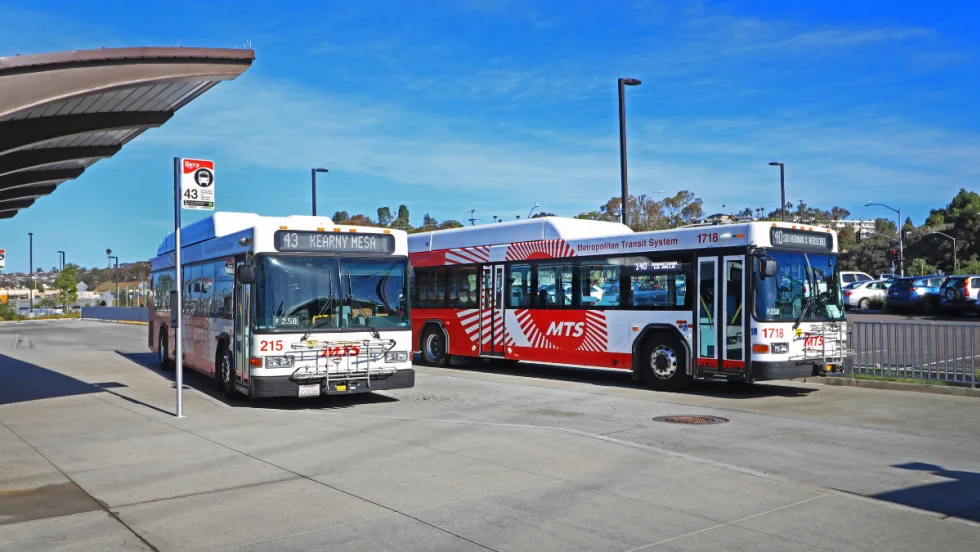
What’s Behind San Diego MTS’s Award-Winning Transit Strategy
Named one of APTA’s 2026 Outstanding Public Transportation Systems with 50 million or more annual passenger trips, California’s San Diego Metropolitan Transit System points to gains in ridership, safety, technology, and reliability as foundations of its success.
Read More →
Public Transit Conference Returning to GFX in 2027, Call for Papers Now Open
The Call for Papers is now open, allowing transit agency professionals and industry experts to help shape the PTC educational program by submitting session ideas for consideration.
Read More →
Indian River Transit’s Community-Focused Approach Earns National Recognition
Named APTA’s 2026 Outstanding Public Transportation System in its size category, Florida’s Indian River County transit system continues to grow ridership through fare-free service and a focus on evolving community needs.
Read More →
ENC Lands MATA Contract and More in Biz Briefs
In this edition of Biz Briefs, we spotlight the latest developments shaping the future of mobility.
Read More →From Surviving to Thriving: Building Stronger Transportation Organizations
Bus Business Consultants founder Brian Dickson shares lessons on leadership, organizational health, and creating options for long-term success in a changing transportation industry.
Read More →