




Can Better Branding Grow Ridership? Bloomington Transit Bets on a Unified Mobility Experience
Microtransit Fare Hikes May Hurt More Than Help, Study Finds
New research suggests raising microtransit fares may drive away the riders agencies need most.
June 29, 2026
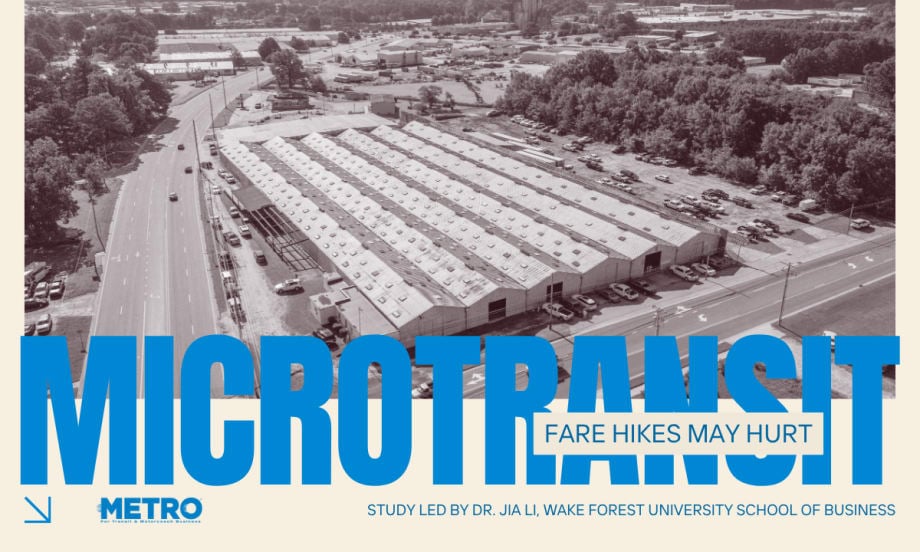
In Wilson, North Carolina, overall ridership appeared stable following the fare increase. But underneath the surface, existing riders were reducing their trips while new riders replaced them.
Credit:
Mark Stebnicki/METRO
4 min to read
- A recent study indicates that increasing fares for microtransit services could lead to a decline in ridership among crucial user groups.
- The research highlights that fare hikes may disproportionately impact individuals who rely heavily on microtransit for daily transportation.
- Agencies might inadvertently reduce accessibility for those who benefit most from affordable transit options if fares are raised.
*Summarized by AI
As agencies across the country look to microtransit to expand mobility in underserved areas while searching for ways to sustain the service amid shrinking federal support and rising operating costs, new research suggests that simply raising fares may do more harm than good.
A study led by Dr. Jia Li, associate professor at Wake Forest University School of Business, found that across-the-board fare increases in microtransit systems can significantly reduce ridership among occasional users while generating only modest revenue gains.
The research published in Transportation Research Part A: Policy and Practice, titled “Heterogeneous Fare Sensitivity in Microtransit: Evidence From a Natural Experiment,” examined Wilson, North Carolina’s, citywide on-demand microtransit service operated by Via, but locally marketed as RIDE, which replaced the city’s fixed-route bus network in 2020.
The study used rider-level panel data to evaluate how different groups of microtransit users responded to fare changes over time.
Wilson has become one of the most closely watched microtransit case studies in the country, with ridership surging after the transition to on-demand service. But as agencies look to microtransit to serve low-density and underserved areas, Li said many may be misunderstanding how riders respond to pricing changes.
“What our study shows is that the typical ‘one-price-for-everyone’ approach is fundamentally misaligned with how people actually use microtransit,” Li said.
Study Reveals Sharp Divide Between Rider Types
Using detailed rider-level trip data tied to a natural experiment in Wilson, the study analyzed the impact of a fare increase from $1.50 to $2.50 implemented in 2022. Because no major service changes occurred at the same time, researchers were able to isolate the effects of pricing on rider behavior.
The results revealed a sharp divide between rider types. Frequent riders, many likely commuting to work, showed relatively little change in usage after fares increased. Occasional riders, however, substantially reduced their use of the service.
Researchers found that riders with established travel routines demonstrated substantially lower fare elasticity than infrequent users, suggesting commute-driven demand remained stable even after prices rose. However, this group is small relative to the overall user base.
“The majority are occasional users, and they’re highly price sensitive,” Li said. “When you raise fares uniformly, you don’t get much more revenue from frequent riders, but you do lose a lot of occasional trips.”
Even large fare increases produced limited financial upside. Simulation modeling in the study showed that revenue gains flattened quickly. According to the study’s simulation model, a hypothetical 40% fare increase would boost total revenue by only about 7%, largely because ridership losses offset much of the additional fare collection.
“It means fare increases are not going to solve the funding problem, at least not on their own,” Li said.
The findings arrive as many transit agencies reevaluate service models developed during or after the pandemic. Although smaller cities and suburban systems have turned to microtransit to improve geographic coverage and reduce long waits associated with fixed-route operations.
The paper notes that microtransit systems operate differently from traditional fixed-route transit because rider demand is more behaviorally responsive to pricing, convenience, and service uncertainty.
Wilson’s system, for example, allows riders to request trips through an app, website, or call center for curb-to-curb service throughout the city. A good chunk of these trips is estimated to be work commutes. Li believes those commuting patterns point toward one potential funding strategy: employer partnerships.
“Many of the least price-sensitive riders are likely commuting to work, and employers have a clear interest in reliable transportation for their workforce,” he said.
Li recommended that major employers, such as hospitals and manufacturing plants, consider the benefits of reliable employee transportation and subsidize passes. This would shift part of the subsidy burden from the city to private partners, he added.
How Targeted Pricing and Employer Partnerships Help
Rather than broad fare hikes, the study also recommends more targeted pricing strategies, including off-peak discounts, income-based fares, and loyalty incentives designed to encourage occasional riders to become more consistent users.
“One illustrative example is a threshold-based incentive, for instance, ‘take three rides this week and get the fourth at a discount,’” Li explained.
The research also raises caution flags for agencies considering replacing low-performing fixed routes with microtransit.
“Microtransit looks like a flexible upgrade, but it asks more from riders, such as booking a trip, waiting, adjusting to variable pickup times,” Li said. “Fixed routes are simple and predictable. Not everyone makes that transition. Some riders don’t switch; they just disappear.”
Perhaps the biggest takeaway for transit leaders, Li said, is that aggregate ridership figures may hide deeper instability within a system.
“One way to think about it is that a stable system can still be a fragile system,” Li said.
In Wilson, overall ridership appeared stable following the fare increase. But underneath the surface, existing riders were reducing their trips while new riders replaced them, masking underlying churn in the rider base.
“The broader lesson is that microtransit is a behavioral system, not just an operational one,” Li said. “If you only look at averages such as total ridership, you will miss the underlying dynamics that actually drive performance. The real question is not just how many people are riding, but who is riding, how their behavior is changing, and how the rider base is evolving over time.”
Subscribe to Our Newsletter
More Management

ENC Lands MATA Contract and More in Biz Briefs
In this edition of Biz Briefs, we spotlight the latest developments shaping the future of mobility.
Read More →
From Surviving to Thriving: Building Stronger Transportation Organizations
Bus Business Consultants founder Brian Dickson shares lessons on leadership, organizational health, and creating options for long-term success in a changing transportation industry.
Read More →
Everett Transit, Community Transit Outline Consolidation Agreement
The proposed agreement calls for a 50% increase in bus service in Everett, a new microtransit zone, continued paratransit service, and the transfer of Everett Transit operations to Community Transit.
Read More →

Strada360’s Steve Lassey on Turning Transit Data Into Better Decisions
From breaking down data silos to preparing for AI, Strada360 CEO Steve Lassey discusses how transit agencies can use technology to improve operations, customer information, and long-term decision-making.
Read More →
People Movement: Phil Washington Joins HNTB, Denver RTD Launches CEO Search, and More
In this edition, we also spotlight recent personnel moves at STV, the Eno Center for Transportation, and more, highlighting the people taking on new roles across the transportation industry.
Read More →
SEPTA Details Accelerate Vision for Transit System
The plan outlines investments in trolley modernization, new Metro and Regional Rail vehicles, accessible stations, and more frequent bus and rail service.
Read More →
FTA Ends Direct Oversight of MBTA Safety Actions
The federal agency closed its remaining special directive to the Massachusetts Department of Public Utilities following a safety review that began in 2022.
Read More →
Report: Transit Bus Manufacturing Supports 34,100 Jobs, $5.1B in GDP
The “Buses Mean Business” report examines the transit bus manufacturing industry’s economic footprint, supply chain, and rising demand for vehicle replacements.
Read More →
LIT Marks 10-Year Milestone at Annual Summit
Hosted by the COTA from September 10 to 13, the Summit carried the theme “Celebrating 10 Years of Excellence, Leadership, and Impact,” with every part of the program honoring the people, agencies, and partners who built LIT over its first decade.
Read More →
People Movement: Dan Dipert Coaches Adds Third-Generation Leader, Keolis Names New Valley Metro VP/GM, and More
In this edition, we also cover recent appointments and announcements at the Wabtec, SilverRide, HNTB, and more, showcasing the individuals helping to shape the future of transportation.
Read More →