



Smarter Maintenance Starts with Risk, Not Routine
As infrastructure ages and funding pressures mount, effective asset management is becoming critical to maintaining safe, reliable transportation networks.

Transportation agencies are increasingly using data analytics and lifecycle planning to optimize infrastructure investments, improve reliability and extend the useful life of critical assets.
METRO
- Effective asset management is essential for maintaining transportation networks as infrastructure ages.
- Risk-based maintenance strategies are becoming crucial in the face of limited funding.
- Shifting from routine to risk-driven maintenance can enhance safety and reliability in transportation systems.
*Summarized by AI
Agencies are being asked to do more with less. Budgets are tight. Infrastructure is aging. Riders expect safe, fast, reliable service every day. The cornerstone of effective transportation services is delivering the right level of service at the right time, driven largely by effective maintenance.
But not all maintenance work delivers equal value — and that’s where many programs fall short. Traditional approaches help close the gap, but they are no longer enough on their own.
Now, agencies can take a more targeted approach to maintenance by making better use of data, advanced analytics, and artificial intelligence (AI) for risk-based predictive maintenance.
Understanding Risk-Based Maintenance
Traditional maintenance strategies generally fall into three categories:
- Reactive Maintenance: Fixing assets after something breaks or fails.
- Planned Preventive Maintenance: Servicing assets on a set schedule, but it can lead to unnecessary or redundant work.
- Condition-Based Maintenance: Using condition data such as vibration, temperature, and wear to assess asset health and determine when maintenance is needed.
Each approach adds value, but they share a common limitation. They do not always account for the full risk of failure. As a result, agencies spend time and money on interventions that do little to reduce the most significant operational risks.
Risk-based predictive maintenance emerges as the natural next step in how agencies should approach maintenance. By combining asset condition, performance history, asset criticality, and operating context, agencies can predict which assets are most likely to fail and the consequences of that failure.
That shift matters. It allows teams to focus time and budget on the issues that will have the greatest impact on safety and service.
Risk-Based Predictive Maintenance in Action
Imagine three similar vehicles all maintained under the same fixed maintenance schedule. With traditional approaches, all three would typically be serviced at fixed intervals regardless of their individual conditions.
In reality, one asset may safely operate longer, another may require only partial intervention, and a third may pose a higher risk of failure and require urgent attention.
Risk-based predictive maintenance helps agencies distinguish between these scenarios and prioritize resources where they will have the greatest impact.
Rather than applying the same schedule to every asset or servicing only after failure, risk-based predictive maintenance helps agencies make more informed decisions in an environment where every dollar and every hour count.
The key is turning raw data into information that agencies can actually generate and use.
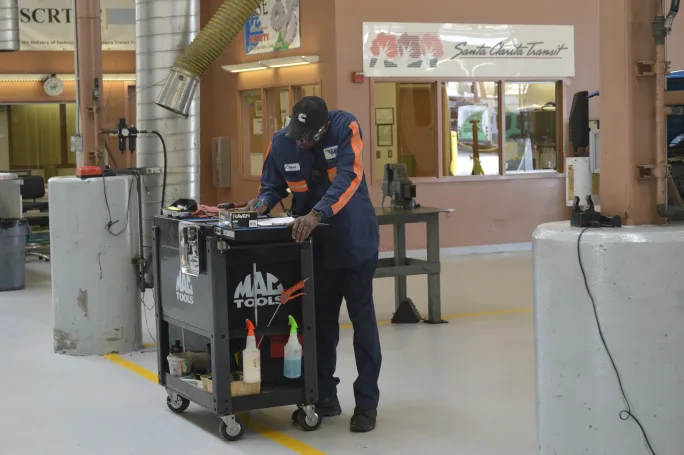
Modern asset management strategies enable agencies to monitor infrastructure performance and allocate resources more effectively across transportation networks.
METRO Magazine
Turning Data into Better Decisions
Today’s agencies have access to large volumes of data, from onboard sensors and inspection systems to environmental and operational metrics. While this data is valuable, it does not automatically translate into better decisions.
To get full value, agencies need to turn data into integrated information that provides usable insights. That remains a challenge. Data is often fragmented across systems and difficult to interpret in ways that drive action.
In practice, many agencies can start by connecting existing data and organizing it around their most important operating priorities. By weighing factors such as asset condition, operating context, likelihood of failure, and consequence, they can develop a single, risk-informed view that helps prioritize action.
For instance, a transit agency seeking to reduce service disruptions might combine data from track geometry, signaling systems, on-board sensors, and power infrastructure to assess overall risk across the network. Agencies can start small with focused proof-of-concept efforts, supported by thoughtful change management. From there, an agency might start with a single asset class, such as vehicles or infrastructure, to identify the most important maintenance priorities before expanding the approach more broadly.
This approach has already shown value in practice.
One large transit agency applied a risk-based framework across its system’s track and power assets, combining inspection data, performance history, and operational impact into a unified model. The model revealed high-risk assets that were not being prioritized under traditional schedules. By adjusting maintenance timing and focusing resources accordingly, the agency reduced unplanned disruptions and improved asset availability without increasing costs.
Risk indexes make these outcomes possible by translating complex data into clear, actionable insights. Their effectiveness, however, depends on the quality of the data and supporting technologies behind them.
Advanced Analytics, Deployable Tech, and Human Resources
Advances in sensing technologies, data processing, and artificial intelligence enable predictive, risk-informed maintenance. Most agencies don’t need additional layers of data. They need better data integration and the ability to discern patterns amid the noise.
AI can help agencies act on the data they already have by quickly synthesizing multiple inputs to identify patterns and anomalies. With near-real-time estimates of asset failure likelihood, decision-makers can pinpoint the specific interventions that will have the greatest impact on safety, reliability, performance, and return on investment.
Successful, risk-based predictive maintenance depends on quality data, whether using a basic framework or the latest AI tools. Agencies build that foundation by deploying the right tools and methods to gather information.
In many agency environments, inspection and monitoring activities offer a practical place to begin, especially when they are time-consuming, repetitive, or pose safety concerns.
Remote and automated inspection tools, such as drones or other robotic systems, reduce the need for personnel to operate in high-risk environments while improving worker safety. These technologies can also improve data quality, consistency, and coverage while speeding up inspection activities.
Integrated inspection platforms offer another advantage by capturing multiple data types in a single pass, giving agencies a richer, more comprehensive view of asset conditions.
The value goes beyond efficiency. This approach can improve confidence in asset assessments, reduce uncertainty, and, crucially, empower workers to make more informed decisions. By reducing the burden of routine inspection activities, agencies can redeploy skilled personnel toward higher-value work, including corrective maintenance that directly improves asset performance and reliability.
Maintenance backlogs and workforce shortages make it even more critical to align human effort with the tasks that matter most. When people see that their work is making a greater impact, it can strengthen employee engagement and a sense of purpose.

Metro Transit
Driving Adoption of Risk-Based Predictive Maintenance
While the benefits of risk-based predictive maintenance are clear, implementation requires thoughtful planning and stakeholder involvement.
Existing maintenance practices are often deeply embedded in organizational culture, so the goal is not to immediately replace them, but to build on what already works. A structured, collaborative transition can combine internal expertise with external assistance where needed.
Because each organization operates within its own context of resources, priorities, and maturity, adoption should be tailored to that environment. It is critical to engage influential voices within the workforce and provide the support needed to foster understanding and trust.
No single implementation path will fit every organization, but several practical steps can help agencies build momentum, validate outcomes, and accelerate adoption:
- Start with a focused pilot: Identify a high-impact asset class or corridor segment and develop a risk-based approach using available data.
- Validate results: Use pilot programs to demonstrate improvements in reliability, efficiency, or safety, and refine the model based on real-world outcomes.
- Engage frontline teams: Involve maintenance and operations staff early to ensure that new approaches are practical, credible, and aligned with operational realities.
- Scale incrementally: Expand successful approaches over time, matching the organization’s maturity rather than attempting large-scale transformation upfront.
This phased approach allows agencies to build confidence and support for broader adoption. When done well, risk-based predictive maintenance can deliver tangible benefits in a relatively short timeframe.
The Next Evolution of Asset Management
The transition toward intelligent, risk-based predictive maintenance is part of a broader evolution toward more individualized, data-driven asset management. It does not have to begin with wholesale transformation.
Agencies can start with carefully sequenced actions: integrate data, develop a risk-informed framework, and begin applying it in a manageable, high-value context.
The opportunity is to adopt new tools and approaches that build on existing strengths while improving how maintenance decisions are made. With better information, agencies can more effectively engage their people and make confident, timely decisions about their assets and operations.
The bottom line: agencies can no longer afford to treat every asset equally. Success depends on knowing where failure matters most and acting on it.
About the Author: Nilmino Roberts is Senior VP, Asset Management, at WSP in the U.S.
Quick Answers
Effective asset management is essential for maintaining safe and reliable transportation networks, particularly as infrastructure ages and funding pressures increase.
*Summarized by AI
More Management
What’s Behind San Diego MTS’s Award-Winning Transit Strategy
Named one of APTA’s 2026 Outstanding Public Transportation Systems with 50 million or more annual passenger trips, California’s San Diego Metropolitan Transit System points to gains in ridership, safety, technology, and reliability as foundations of its success.
Read More →
Public Transit Conference Returning to GFX in 2027, Call for Papers Now Open
The Call for Papers is now open, allowing transit agency professionals and industry experts to help shape the PTC educational program by submitting session ideas for consideration.
Read More →
Indian River Transit’s Community-Focused Approach Earns National Recognition
Named APTA’s 2026 Outstanding Public Transportation System in its size category, Florida’s Indian River County transit system continues to grow ridership through fare-free service and a focus on evolving community needs.
Read More →
ENC Lands MATA Contract and More in Biz Briefs
In this edition of Biz Briefs, we spotlight the latest developments shaping the future of mobility.
Read More →
From Surviving to Thriving: Building Stronger Transportation Organizations
Bus Business Consultants founder Brian Dickson shares lessons on leadership, organizational health, and creating options for long-term success in a changing transportation industry.
Read More →
Everett Transit, Community Transit Outline Consolidation Agreement
The proposed agreement calls for a 50% increase in bus service in Everett, a new microtransit zone, continued paratransit service, and the transfer of Everett Transit operations to Community Transit.
Read More →
Strada360’s Steve Lassey on Turning Transit Data Into Better Decisions
From breaking down data silos to preparing for AI, Strada360 CEO Steve Lassey discusses how transit agencies can use technology to improve operations, customer information, and long-term decision-making.
Read More →
People Movement: Phil Washington Joins HNTB, Denver RTD Launches CEO Search, and More
In this edition, we also spotlight recent personnel moves at STV, the Eno Center for Transportation, and more, highlighting the people taking on new roles across the transportation industry.
Read More →
SEPTA Details Accelerate Vision for Transit System
The plan outlines investments in trolley modernization, new Metro and Regional Rail vehicles, accessible stations, and more frequent bus and rail service.
Read More →
FTA Ends Direct Oversight of MBTA Safety Actions
The federal agency closed its remaining special directive to the Massachusetts Department of Public Utilities following a safety review that began in 2022.
Read More →