



RELATED: Capital Metro taps Luminator for passenger info displays
Tech Trends: Digital signage advances bring cost, energy savings
Solutions deliver real-time updates that are important to a rider’s journey, including rider alerts and next-bus information.
by Werner Malcherek
May 30, 2019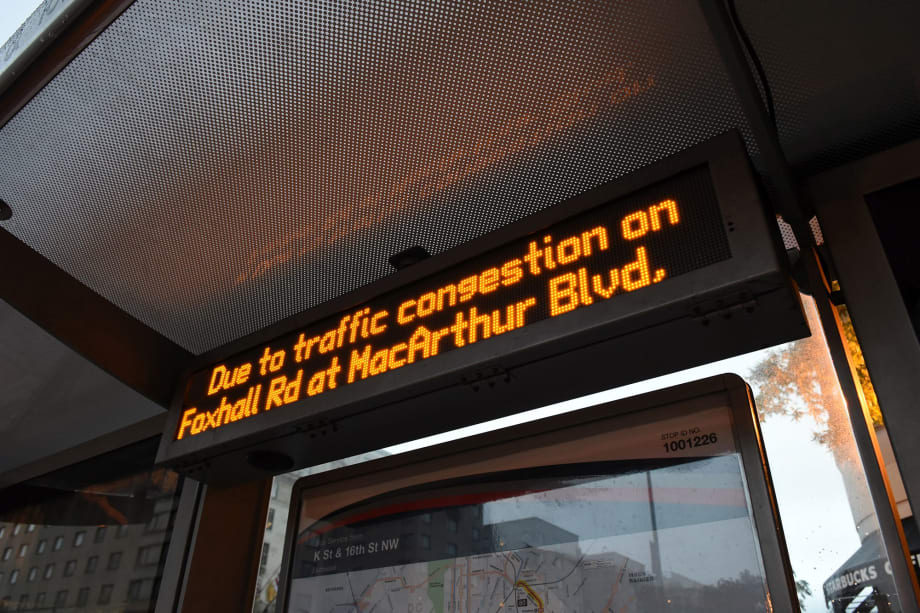
By choosing digital signs that use alternative energy, such as solar power, transit agencies can save on the operational costs needed to power the system’s display.
3 min to read
The Washington Metropolitan Area Transit Authority in Washington, D.C., understands that real-time information communication is vital for its 120 million yearly transit customers.
Photos via Luminator
Transit agencies and city officials are paying close attention to today’s innovators who are building technology solutions to increase efficiency, reduce waste, encourage sustainability, and save money. While electric buses are known to have made a significant positive impact on our environment, additional transit technologies exist that have a similar capability to save resources and reduce energy consumption, while improving the rider experience.
Agencies across the country are turning to networked digital signage solutions that are cost-effective and energy efficient. These solutions deliver real-time updates that are important to a rider’s journey, including rider alerts, next bus information, and route maps.
By choosing digital signs that use alternative energy, such as solar power, transit agencies can save on the operational costs needed to power the system’s display. Eliminating reliance on existing power grids can also save time and money on installation and allows for signage to be installed in remote locations where power is not readily available.
The power consumption of a signage system depends on its operating parameters and the display technology itself. New “e-Paper” solar-powered signs, for example, can remain fully operational under the open sky and off the grid even during cloudy conditions. These durable signs feature an easy-to-read front-lit design that provides a multi-page display not impacted by competing sunlight or glare.
Networked digital signage over a cellular or Wi-Fi connection provides transit agencies the ability to post real-time content updates simultaneously across the entire transportation network. Managed from agency headquarters, it also enables monitoring of the signage system’s health, including indicators of a properly working sign or if the technology at a specific location experiences an outage.
Benefits to transit, ridership
The benefits of digital signage connectivity are two-fold: it eliminates the need for transit agencies to rely on the manual and hands-on approach to posting updates at stops and stations with paper signage (physical posters), bringing down labor costs; and a cloud-based network allows the system to scale up for future growth. An efficient digital signage system can have a profound impact on a city and its transit agency by implementing modular components that can be adapted over time to meet the needs of the agency and its passengers.
As one of the largest transit systems in the country, the Washington Metropolitan Area Transit Authority (WMATA) in Washington, D.C., understands that real-time information communication is vital for its 120 million transit customers. The transit authority’s ridership has come to expect system enhancements, such as easy access to departure and arrival information and bus route planning. WMATA recently sought a solution that would enhance these system efficiencies and keep its millions of riders informed. To do so, the agency installed bus shelter signs across its service area. By utilizing the digital signs’ cloud-hosting technology, WMATA was able to transfer all IT responsibility and maintenance to a datacenter, centralizing support and realizing cost-savings.
By choosing digital signs that use alternative energy, such as solar power, transit agencies can save on the operational costs needed to power the system’s display.
WMATA and other transit agencies across the country are also benefiting from digital signage technologies equipped with ADA compliance features including text-to-speech voice announcements and support for multiple languages. This was a critically important feature for the agency to support its diverse and global-minded passengers and the city.
As major metropolitan areas look for sustainable solutions within the transit space, more and more cities will look to innovators such as WMATA and its investment in digital signs that are energy efficient, or autonomous, and connect seamlessly to the transit network. Introducing digital signage to a transit network is a critical enhancement toward better serving mass transit passengers on their journey. When the passenger is put first, vital considerations like these will follow and lead to a brighter future for the transit agency and its city.
Werner Malcherek is CTO at Luminator Technology Group.
Subscribe to Our Newsletter
More Technology

From Hardware to Digital Partner: Luminator Charts Its Next Chapter
CEO Magnus Friberg discusses Luminator’s shift toward becoming a digital partner, the growing importance of software and interoperability, and how AI can help agencies improve operations and passenger experience.
Read More →
Beyond the Checklist: A Structured Approach to Transit Maintenance
Reliability-Centered Maintenance helps transit agencies move beyond routine checklists to focus limited resources on the assets and failures that have the greatest impact on safety, reliability, and service.
Read More →
NJ TRANSIT Advances Bus Technology Upgrades Across Statewide Fleet
More than 1,500 buses now feature upgraded technology designed to improve arrival predictions and provide free Wi-Fi, with deployment expected to reach nearly 2,000 buses by the end of 2026.
Read More →

Building a Flexible Path to Transit Electrification
John Hroncich discusses BAE Systems’ modular and scalable approach, lessons learned from decades of real-world operations, and how agencies can identify electrification strategies that fit their fleets.
Read More →
Biz Briefs: Alstom Lands Canadian Contract, LYT to Supply California TSP, and More
In METRO's latest installment, we take a look at recent news from Complete Coach Works, Beep, FlixBus, and more partnerships making headlines across the transportation sector.
Read More →
Sponsored•September 8, 2026
From Legacy Silos to Conversational Intelligence
What if transit leaders could ask any operational question and get a trusted answer in seconds? Conversational AI is transforming how agencies use their data.
Read More →
USDOT Announces Rail Vehicle Replacement Grants, Chattanooga AV Shuttle Funding
More than $191 million in federal funding will help three transit agencies replace aging rail vehicles and support a new autonomous shuttle service in Chattanooga.
Read More →
Bus Tech Talk: Keeping Transit Technicians Ahead of the Technology Curve
LA Metro’s Obed Mejia discusses technician training, evolving maintenance technology, fleet replacement, and strategies for getting the most out of today’s transit fleets.
Read More →
Biz Briefs: RIPTA Unveils New Frontrunners, Clevland RTA Adds New Siemens, and More
In METRO's latest installment, we take a look at recent news from Siemens, Prevost, Dodge, and more partnerships making headlines across the transportation sector.
Read More →
Why Simulating Pedestrian Movement Has Become Essential for Modern Rail Stations
Pedestrian microsimulation is helping rail planners identify bottlenecks, test station designs, and prepare complex transit hubs for growing passenger volumes.
Read More →