



Human Trafficking Awareness: What Public Transportation Can Do?
January is National Slavery and Human Trafficking Prevention Month in the U.S., and January 11 is National Human Trafficking Awareness Day.

Since launching its bus program in 2017, TAT (Truckers Against Trafficking) has seen the transit industry embrace their role in combating human trafficking.
Photo: Canva
- January is designated as National Slavery and Human Trafficking Prevention Month in the U.S.
- January 11 marks National Human Trafficking Awareness Day.
- The focus is on raising awareness and enhancing public vigilance against human trafficking.
*Summarized by AI
January is National Slavery and Human Trafficking Prevention Month in the U.S., and January 11 is National Human Trafficking Awareness Day.
This makes today an opportune time to both celebrate the strides the transit industry has taken in the fight against human trafficking and highlight ways that public transportation can continue to stand up against this heinous crime.
Understanding Human Trafficking
Human trafficking — or modern-day slavery — is a global crime in which people are bought and sold for forced labor or commercial sex. Traffickers use violence, manipulation and false promises of work opportunities or romance to lure, control and exploit their victims, generating billions of dollars per year in illicit profits.
Of the estimated 50 million victims worldwide, thousands of girls, boys, women, and men are trafficked for sex or labor in rural, suburban, and urban neighborhoods across the U.S. and Canada. And, it’s very possible that it’s happening to someone in your community.
Public transit agencies encounter human trafficking victims in a variety of ways. The populations most at-risk for trafficking are also those most likely to use public transportation, due to its accessibility and affordability.
Traffickers may go to bus stops or transit centers to find potential victims or use public transportation to shuttle their victims to and from places where they will be sold.
When survivors attempt to exit trafficking, a bus, train, or transit center may be the first place they will go to find safety or escape. This means that public transportation can be a key touchpoint for reaching these vulnerable populations, both for prevention and education, as well as for identification and intervention.
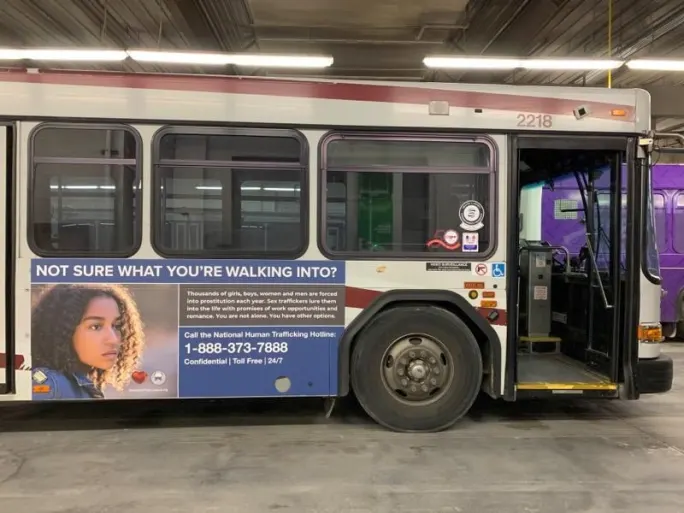
A bus in Peoria, Ill., displaying human trafficking information for National Human Trafficking Awareness Month.
Photo: TAT
The Importance of Vigilance
According to the National Outreach Survey for Transportation:
- 60% of trafficking survivors reported a bus (e.g., intercity, public, long-distance, shuttle) was used during their recruitment into trafficking.
- 75% reported using public transportation during their exploitation.
- 35% went to a bus or subway station while being trafficked.
- 28% reported a bus was used during their escape from trafficking.
This is why TAT (Truckers Against Trafficking) is on a mission to educate every transit professional across North America about human trafficking and how to spot and report it.
Frontline transit employees may observe red flags that a passenger on their bus or train is being exploited, or can even play a preventative role by noticing signs of grooming or recruitment.
Take, for example, the San Diego Metropolitan Transit System’s security officers who noticed a man at one of their transit centers acting aggressively toward a young woman, and then noticed the same man returning to the transit center at other times and approaching other young women. Their report to law enforcement culminated in the arrest of the man at a motel near Los Angeles, where he and an accomplice were holding a young woman against her will.
Consider the ticket agent in Texas who assisted a young man that walked into the bus station looking for a ticket home but had no money or ID with him. He didn’t know where he was and described having come to the area with a traveling construction crew whose leader had taken control of his work documents and withheld his pay.
Because the ticket agent was able to recognize signs of labor trafficking, they were able to connect the young man to a local service provider to receive the assistance he needed.
Think about the Oklahoma City bus driver who picked up a passenger in distress while driving his regular route. She was crying and seemed frightened. She was dirty, disheveled, and had cuts and bruises on her body. When he asked if she was okay, she told him that he couldn’t help her… she was running away from “bad people.”
In 2022, that bus driver was the recipient of TAT’s Harriet Tubman Award, alongside two colleagues who helped connect the woman to services and law enforcement.
All of these are real life examples of members of the transit industry who, with the proper awareness and training, were able to make a report that assisted victims of trafficking and, in some cases, helped stop traffickers from victimizing other individuals in the future.
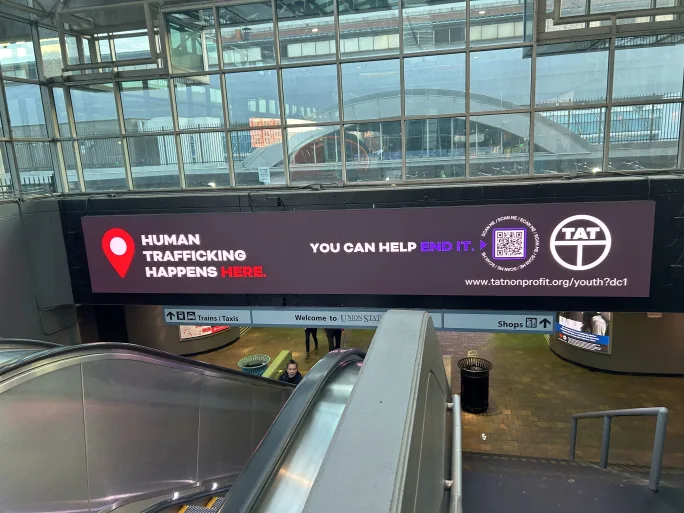
TAT’s youth-focused campaign is currently displayed at Union Station’s Bus Facility in Washington, D.C.
Photo: TAT
What You Can Do?
Since launching its bus program in 2017, TAT (Truckers Against Trafficking) has seen the transit industry embrace their role in combating human trafficking.
To date, tens of thousands of transit professionals have joined a mobile army of over two million members of the transportation industry who are committed to standing up against human trafficking.
This January, TAT is asking every transit manager, driver, ticket agent, dispatcher, and security personnel to consider how they can continue to play a role in protecting the passengers they transport every day from this heinous crime.
Here are three ways you can get involved this month:
- Learn more. TAT’s free online course for transit professionals can be completed in just 30 minutes, and offers an overview of the issue and steps transit employees can take to play a role in fighting this heinous crime.
- Implement training. TAT also provides free, industry-specific training materials that can be used for training and safety meetings to educate staff on the issue of human trafficking.
- Join the movement. In May, TAT will host the first annual Youth on Transportation Safety Month, which will unite transportation stakeholders for a campaign dedicated to educating youth about human trafficking in age-appropriate ways. Learn more about how you can participate at www.tatnonprofit.org/safety-month.
If every transit employee — bus driver, dispatcher, security guard, etc. — could be trained to identify the signs of human trafficking and how to report it effectively, imagine how many victims could be recovered and, potentially, how many traffickers could be arrested.
Quick Answers
It is a month designated in the U.S. to raise awareness and promote actions to combat human trafficking and slavery.
*Summarized by AI
More Blog Posts
Improving Transit Accessibility by Offering Assistive Listening
Did you know that there are literally tens of millions of people worldwide with hearing loss, many of whom will use some form of public transit at some point?
Read More →
35 Years of the ADA, Making Travel Easier for Seniors
Thirty-five years after the passage of the Americans with Disabilities Act of 1990 (ADA), the impact of this landmark piece of civil rights legislation cannot be overstated.
Read More →
Driving Performance with Purpose: How I Lead One of Greyhound’s Top Teams
Safety, on-time performance, and customer experience are critical elements in intercity bus operations. But getting them right doesn’t come down to plans or protocols alone. It comes down to execution. How well your team performs on the ground, in real time, is what defines success.
Read More →
Navigating Emerging Privacy Laws: A Call to Action for Service Providers in Mass Transit
With Data Privacy Day Jan. 28, I want to spotlight a critical challenge faced by service providers in the mass transit sector: managing personal information responsibly in an era of rapidly evolving privacy regulations.
Read More →
Want to Improve Transit Safety and Operations? Break Down the Silos
Retrieving and reviewing data and video can be a cumbersome process for fleet managers. Each system or tool provides a piece of the puzzle, but seeing the complete picture requires tedious manual synchronization.
Read More →
Ensuring Public Transit Cybersecurity Through Robust Protective Measures
In today’s highly connected world, cybersecurity is of utmost importance, particularly for transportation agencies overseeing transit bus systems that rely increasingly on sophisticated technologies, including the use of data analytics in traffic signal networks, to manage and operate their systems.
Read More →
How Advances in Thermal Management Revolutionize Urban Mobility
In the daily hustle and bustle of city life, transit buses serve as the backbone of urban transportation, allowing millions of city dwellers to get from point A to point B each day reliably.
Read More →
The Evolution of Bus Design
Thirty years ago, drivers not only had to drive the bus and navigate heavy traffic, but they were also responsible for tasks like supervising passenger loading and unloading, selling tickets, and providing passengers with various kinds of information, all while sitting in an often ill-fitting workstation.
Read More →
What 'Transit Safety 101' Really Means
Safety, Safety, Safety. This word is used repeatedly, and in many contexts, without most people understanding what it actually means.
Read More →
5 Ways AI Will Impact the Bus and Motorcoach Sector
The old joke that you wait ages for one bus and suddenly three come along at once may be consigned to the history bin thanks to developments in artificial intelligence (AI).
Read More →