



NYCT announces graduated fines for bus lane violations
Violations will be captured using a new automated bus-mounted camera system.

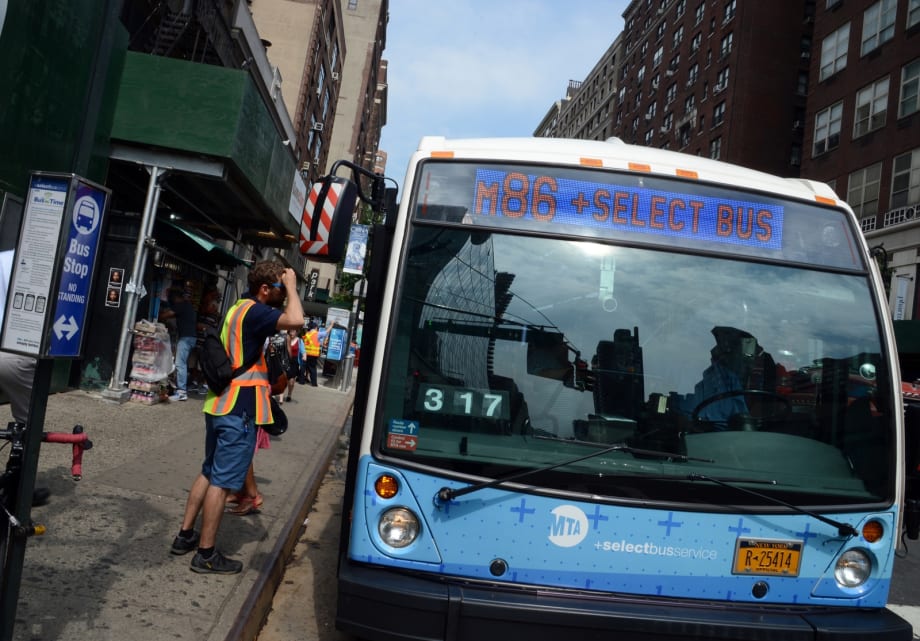
Cameras mounted on NYCT's buses serving the M15 Select Bus Service route will begin capturing real-time violations starting October 7.
Marc A. Hermann/MTA
Cameras mounted on NYCT's buses serving the M15 Select Bus Service route will begin capturing real-time violations starting October 7.
Marc A. Hermann/MTA
MTA New York City Transit announced that the fines associated with bus lane violations captured using a new automated bus-mounted camera system will be subject to a new graduated fee structure starting at $50 and going up to $250 for repeat bus blockers. Cameras mounted on buses serving the M15 Select Bus Service route will begin capturing real-time violations starting October 7.
NYC Transit is using an Automated Bus Lane Enforcement (ABLE) system on 51 buses that travel on the M15 SBS route using a dedicated bus lane implemented by the New York City Department of Transportation.
ABLE camera systems can capture evidence such as license plate information, photos and videos, as well location and timestamp information, of vehicles obstructing bus lanes to document clear cases of bus lane violation.
The system collects multiple pieces of evidence to ensure that vehicles making permitted turns from bus lanes are not ticketed.
This information will be transmitted to NYCDOT for review and processing, and the program will be administered in partnership with NYCDOT and the NYC Department of Finance.
Motorists who block bus lanes during the initial 60-day grace period are issued a warning, which does not carry a fine. After the grace period ends, motorists who continue to block bus lanes will be subject to a fine of $50 for the first violation, and for additional violations within a 12-month period: $100 for a second offense, $150 for a third offense, $200 for a fourth offense; and $250 for a fifth violation and each subsequent offense thereafter within a 12-month period. Each violation also carries a $25 late fee.
RELATED: NYCT to add 500 officers for safety, stem fare evasion
The automated bus lane enforcement program will expand to the B44 SBS and M14 SBS by the end of November, with the ABLE system to be deployed on a total of 123 buses across the three routes. The proposed 2020-2024 Capital Plan includes $85 million for further expansion of the program.
NYC Transit is working with NYCDOT and NYPD to increase bus lane enforcement in highly congested areas as part of NYC Transit’s Fast Forward plan to improve bus service, increase bus speeds and attract new ridership. Results so far have yielded faster bus speeds by as much as 19% on a portion of Fifth Avenue and as much as 30% near the Hugh L. Carey Tunnel’s Manhattan approach.
Other strategies include redesigning every borough’s bus network to better meet customer needs, installing traffic signal priority technology, implementing more transit priority street designs, and deploying new modern buses with better reliability and customer amenities.
More Management

METRO Opens Submissions for 2026 Motorcoach Awards
Nominations are now being accepted for METRO Magazine’s Operator of the Year and Innovative Operator of the Year awards.
Read More →
New York MTA Advances Final Contract for Second Avenue Subway Expansion
Contract Four is the largest in the Second Avenue Subway Phase 2 project and includes construction of station infrastructure, tracks, and signals for the subway expansion, MTA officials said. Work on Contract Four will begin in 2027.
Read More →
Transit Agencies Highlight Safety Gains at National Summit
Leaders from 15 major transit systems shared crime-reduction results and safety initiatives while discussing the role of continued federal support.
Read More →

NITA Names New Leadership, Expands Reduced-Fare Program at First Board Meeting
The new regional transit authority appointed its first board chair and interim executive director while extending reduced fares across CTA, Metra, and Pace for eligible riders.
Read More →
Beyond the Checklist: A Structured Approach to Transit Maintenance
Reliability-Centered Maintenance helps transit agencies move beyond routine checklists to focus limited resources on the assets and failures that have the greatest impact on safety, reliability, and service.
Read More →
APTA 2026 Nominating Committee Selects Leadership Slate, Names Chair and Vice Chair Nominees
Leadership changes will help shape the association’s priorities and its representation of the transportation industry during the 2026–2027 term.
Read More →
DART Launches Major Security, Fare Enforcement Initiative
The 90-day demonstration will deploy coordinated security teams at five light rail stations while testing controlled access and gathering data to guide future investments.
Read More →
Advancing Fare Collection Through Technology and Innovation
Learn about delivering 1300 gates at 91 stations while managing fare evasion. Explore the large scale deployment, solution customization and real-world results that affect the region. Prepare for deployment in your region now.
Read More →
Game Day in Motion: Moving Millions During the 2026 World Cup
Between packed transit stations and team motorcoaches, see how agencies and operators across North America tackled the transportation demands of the 2026 FIFA World Cup.
Read More →
Surface Transportation Extension Averts Shutdown, Leaves Transit Funding Gap
The stopgap keeps federal transportation programs moving, but missing advance funding could complicate the transit and rail projects agencies are planning next.
Read More →