Canadian town transforms fixed-route bus fleet to on-demand service
In September, the City of Belleville, Ontario started operating a new service, in partnership with Toronto-based technology company Pantonium.
by Luke Mellor
November 18, 2018
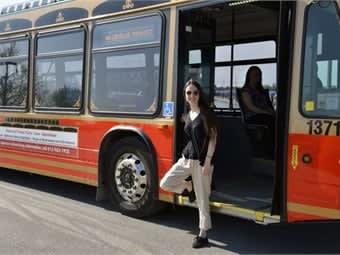
In September, the City of Belleville, Ontario started operating a new service designed to let riders order buses, on demand, to take them to and from any bus stop.
City of Belleville
3 min to read
In September, the City of Belleville, Ontario started operating a new service designed to let riders order buses, on demand, to take them to and from any bus stop.
City of Belleville
Public transit ridership around North America is in decline and transit agencies are scratching their heads at what to do to turn this trend around. Public transit is an essential service in modern communities and is necessary to allow people to go about their daily lives, including getting to-and-from work, socializing, and running errands. To make fixed-route public transit affordable, especially in rural and suburban jurisdictions, has often meant long rides and wait times to ensure access to everyone. The need to increase ridership, the main way to get more funding, becomes challenging for agencies to balance covering their entire service area with their current resources.
Belleville, Ontario is trying a new approach to public transit. In September, they started operating a new service, in partnership with Toronto-based technology company Pantonium. The service was designed to let riders order buses, on demand, to take them to and from any bus stop.
Ad Loading...
TECH TAKEAWAYS
• When and where on-demand public transit service will be most useful: It is not just low-density areas that work for this service type, Belleville has a density of roughly 500 people per square mile.
• The importance of having flexibility in service to handle riders requesting trips: Not everyone owns a smartphone, not everyone wants to call a dispatcher, not everyone knows about the pilot or service changes. You need to take riders on an ad-hoc basis, from any stop, and allow drivers to input these ad-hoc riders into the system.
• Automation is critical for both routing and on-boarding in an on-demand model: Automation enables cheaper service scaling; rather than hiring more and more dispatchers, the system only needs more computational power to grow.
• Software can help transit agencies maximize their existing infrastructure: Rather than replacing transit with Ubers or taxis, the more sustainable option is to apply a layer of technology to existing infrastructure to improve efficiency and public access.
Fixed route not always best route The basic premise is simple; a bus driving along fixed routes is not always the best option. Fixed routes at night time or in low-density areas are usually expensive, unproductive, and offer poor service to riders.
The artificially intelligent routing system developed for this pilot is unique due to the requirements for Belleville’s night bus service. The system had to run without human supervision because every night Belleville’s dispatchers go home before the buses hit the road. Rather than assisting dispatchers to build and change plans, the technology works autonomously, with the help of connected mobile applications that allow the software to communicate with riders and drivers in real time. Once it can monitor the locations of vehicles and demand, whenever something changes that could impact the plan, the system logs it as an “event,” which triggers several thousand iterations of planning.
Calculating optimal routes These planning sessions are attempts to locate a globally optimal solution for all transit vehicles and trips in Belleville. Doing this is one of the most complex problems in mathematics, titled the “vehicle routing problem.” This is notorious for its difficulty, as the necessary number of calculations increases at a factorial rate.
For example, solving a day of travel for moving only 10 people to 10 different stops has millions of different options. At 20 stops, the options go into the trillions. On an average night, the system will run itself a new planning session hundreds of times and can complete each session in about two seconds. The result is that every bus stop in Belleville is now accessible in less than 30 minutes, but the bus will only travel to one if riders are planning to be there.
The pilot will run until early 2019, when Belleville will decide to continue or expand the service. So far, the biggest challenge facing Belleville Transit has been the extent of the increase in demand for its services. Buses that used to carry only a few passengers per night are now being filled. The latest news from the City Council Transit Committee is that more vehicles are needed to cope with the increased demand.
Luke Mellor is the Marketing Director for Pantonium Inc.
CEO Magnus Friberg discusses Luminator’s shift toward becoming a digital partner, the growing importance of software and interoperability, and how AI can help agencies improve operations and passenger experience.
In METRO's latest installment, we take a look at recent news from Complete Coach Works, Beep, FlixBus, and more partnerships making headlines across the transportation sector.
In a recent episode of METROspectives, CharterUP Founder/CEO Armir Harris discussed the company’s evolution from an online charter bus marketplace into a technology platform supporting public- and private-sector mobility and much more.
Through its NAVI program, JTA is showing how autonomous vehicles, intelligent infrastructure, and coordinated operations can work together to deliver everyday public transportation.
From manufacturers and suppliers to transit agencies and motorcoach operators, these updates offer a snapshot of the projects, partnerships and business moves driving the industry forward.
Former LA Metro Chief Innovation Officer Joshua Schank discusses why good ideas aren't enough, how transit agencies can overcome resistance to change, and why today's challenges demand more innovation.
From manufacturers and suppliers to transit agencies and motorcoach operators, these updates offer a snapshot of the projects, partnerships and business moves driving the industry forward.
Vice President of New Mobility Stephen Joos discusses how CharterUP is leveraging its nationwide transportation network, technology platform, and autonomous vehicle partnerships to expand into workforce mobility, campus shuttles, and transit solutions.