



ABA's Pantuso releases statement on motorcoach safety
"While motorcoaches historically have been one of the safest forms of transportation, it is always a tragedy when accidents occur. In truth, fatal motorcoach accidents have been a rare occurrence over the past ten years, but one fatality is one too many."

American Bus Association (ABA) President/CEO Peter J. Pantuso released the statement below on the Safety Profile of the Motorcoach Industry:
"Each year, privately owned motorcoaches play a key role in our nation's passenger transportation system, accounting for over 762 million passenger trips. The 3,200 companies that make up an industry of small businesses form the backbone of a transportation network that provides essential mobility, economic and environmental solutions for millions of Americans.
Logging over 1.8 billion miles, today's motorcoach operators provide safe and efficient transportation as stated in published reports from the Fatal Accident Research Statistics (FARS) and reported by the National Highway Traffic Safety Administration (NHTSA) and by third-party groups like the National Safety Council. An examination of the data for just intercity bus service reveals that over the last 10 years motorcoaches are the safest form of highway transportation.
While motorcoaches historically have been one of the safest forms of transportation, it is always a tragedy when accidents occur. In truth, fatal motorcoach accidents have been a rare occurrence over the past ten years, but one fatality is one too many.
The American Bus Association has worked with the U.S. Department of Transportation and lawmakers to enact legislation that aims to reduce bus accidents. We believe that through aggressive enforcement, driver training, advanced safety equipment and inspections, we can reduce the number of accidents.
ABA fully supports the 'Motorcoach Safety Action Plan,' put into place by the Secretary of Transportation Ray LaHood. The Secretary's Plan takes a holistic approach to motorcoach safety, including more aggressive enforcement to get rogue operators off the road, providing educational outreach to enhance operator safety oversight, establishing new performance standards for motorcoach structures and component parts such as seatbelts and focusing on enhancing emerging technologies such as crash avoidance and event data recorder systems.
But existing and new regulatory and legislative mandates will not get bad operators off our nation's roads. When a documented history of safety mismanagement is identified, enforcement needs to be better coordinated with activities at the federal, state, and local levels. While ABA supports and embraces the enforcement efforts of the Federal Motor Carriers Safety Administration (FMCSA), and its leadership, more needs to be done to shut down unsafe bus operations.
In some cases 'more' means confiscating buses and closing down their facilities to keep unsafe operators from transporting passengers, not just a letter revoking operating authority. Following a review of fatal motorcoach accidents occurring from 1999-2009, more than 50 percent of the fatalities could have been prevented if the operators involved had not been allowed to operate. Many of the carriers involved in those tragic accidents had serious safety violations that should have placed them permanently out of service.
The U.S. Department of Transportation has found that only half the States had any commercial motor vehicle (CMV) inspection program comparable to, or as effective as, the federal inspection requirements (63 Fed. Reg. 8516-8517, Feb. 19, 1998). Of that number, only half a dozen states have been determined to have a dedicated bus inspection program.
Moreover, between FY 2005 and FY 2009 there have been fewer than 200,000 combined bus vehicle and driver inspections for out-of-service violations annually, compared with over five million combined truck vehicle and driver inspections each year. That is, only one out of every twenty-five inspections involved a bus, the carrier of fifty-five passengers, and unfortunately many of those bus inspections were conducted on the same few large fleet operators.
We hope that in this era of tightening budgets, that the number of inspectors and state police available to enforce the existing rules for motor carriers is not reduced. ABA supports Secretary LaHood's call for increased federal funds for the Motor Carrier Safety Assistance Program (MSCAP) to help bolster enforcement at all levels. ABA would ask that at least 10 percent of those funds be made available for a certified motorcoach inspection program.
Motorcoach safety has and continues to be our industry's #1 priority."
More Motorcoach

People Movement: Dan Dipert Coaches Adds Third-Generation Leader, Keolis Names New Valley Metro VP/GM, and More
In this edition, we also cover recent appointments and announcements at the Wabtec, SilverRide, HNTB, and more, showcasing the individuals helping to shape the future of transportation.
Read More →
METRO Opens Submissions for 2026 Motorcoach Awards
Nominations are now being accepted for METRO Magazine’s Operator of the Year and Innovative Operator of the Year awards.
Read More →
Biz Briefs: Alstom Lands Canadian Contract, LYT to Supply California TSP, and More
In METRO's latest installment, we take a look at recent news from Complete Coach Works, Beep, FlixBus, and more partnerships making headlines across the transportation sector.
Read More →
Biz Briefs: RIPTA Unveils New Frontrunners, Clevland RTA Adds New Siemens, and More
In METRO's latest installment, we take a look at recent news from Siemens, Prevost, Dodge, and more partnerships making headlines across the transportation sector.
Read More →
People Movement: Holly Arnold Joins Transdev and More
In this edition, we also cover recent appointments and announcements at Pace, CamTran, MCI, and more, showcasing the individuals helping to shape the future of transportation.
Read More →
ABA Report: Motorcoach Travel Generates $161.6B Economic Impact
The 2025 analysis finds motorcoach travel supported nearly 900,000 jobs and generated $28 billion in federal, state, and local taxes.
Read More →
CharterUP’s Armir Harris on Technology, AI, and the Future of Group Mobility
In a recent episode of METROspectives, CharterUP Founder/CEO Armir Harris discussed the company’s evolution from an online charter bus marketplace into a technology platform supporting public- and private-sector mobility and much more.
Read More →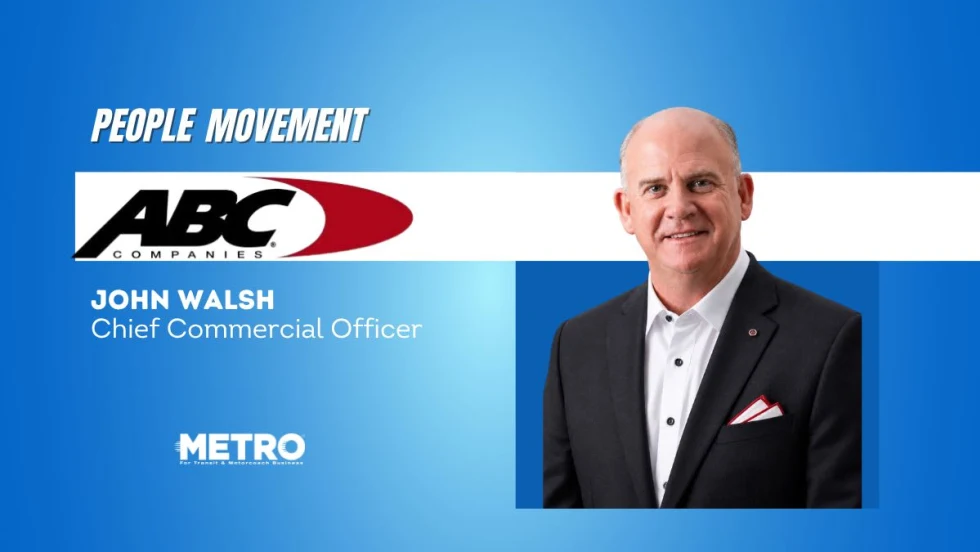
People Movement: ABC Names John Walsh as Chief Commercial Officer
In this edition, METRO also covers recent appointments and announcements at the DART, STV, and more, showcasing the individuals helping to shape the future of transportation.
Read More →
From Surviving to Thriving: Building Stronger Transportation Organizations
Bus Business Consultants founder Brian Dickson shares lessons on leadership, organizational health, and creating options for long-term success in a changing transportation industry.
Read More →
Biz Briefs: Luminator Marks Milestone and More
From manufacturers and suppliers to transit agencies and motorcoach operators, these updates offer a snapshot of the projects, partnerships and business moves driving the industry forward.
Read More →