



Alstom, partners testing 100% electric bus in France
Thanks to reduced maintenance and operating costs, and a longer service life than that of a bus, the cost of ownership of Aptis is equivalent to that of today's diesel buses, according to Alstom.

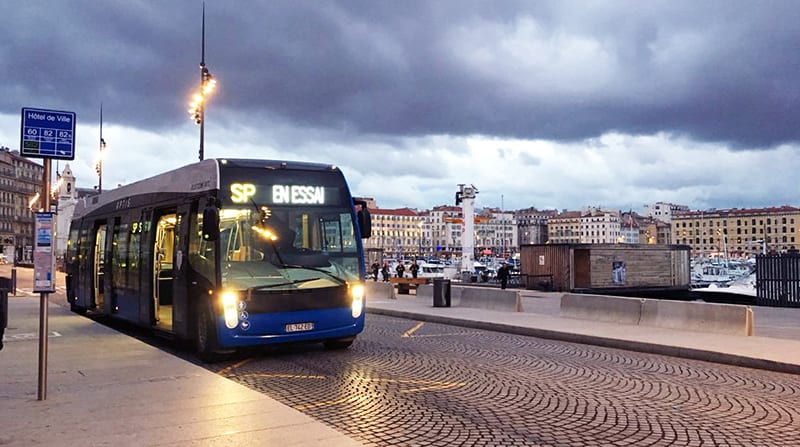
The vehicle fits perfectly into the urban environment thanks to its four steerable wheels that minimize the space needed to turn (-25% compared to a conventional bus).
Alstom - NTL
The vehicle fits perfectly into the urban environment thanks to its four steerable wheels that minimize the space needed to turn (-25% compared to a conventional bus).
Alstom - NTL
Alstom, NTL, and the RTM is testing Aptis this week on line 82 of the Aix-Marseille Provence Méditerranée Metropole network, under real operating conditions. Aptis, which won a prize at the Busworld Awards in Oct. 2017, is an innovative mobility solution co-developed by Alstom and NTL, the prototypes of which are manufactured at NTL’s site in Duppigheim (Bas-Rhin).
The tests are designed to evaluate the specific characteristics of Aptis in a new urban setting, its charging system, its autonomy, and its insertion performance in traffic following the first successful tests in Ile-de-France, Lyon, Strasbourg and Belgium.
Two prototypes of Aptis, co-developed by NTL and Alstom, are currently being tested: the two-door version, which was tested in Paris on the RATP network (lines 21 and 147), Lyon, Strasbourg, Belgium, and now in Marseille; and the three-door version, which is being tested for one year by Ile-de-France Mobilités on the Keolis network between Vélizy and Versailles.
These prototypes were manufactured at the NTL site in Duppigheim. Five Alstom sites in France also contributed to their design and manufacture: Saint-Ouen for the design, systems integration and project management, Tarbes for the traction, Ornans for the motors, and Villeurbanne for the electronic components of the traction chain. Finally, Alstom’s site in Vitrolles (Bouches-du-Rhône) is developing one of the recharging solutions (SRS).
Aptis, a bus inspired by the world of the tram, provides a unique comfort experience for passengers. Low floors throughout the vehicle and wide double doors allow smooth passenger flows and easy access for wheelchairs and pushchairs. Panoramic windows at the front and rear of the bus provide 20% more window surfaces than a conventional bus, as well as a lounge area at the rear. Aptis also benefits from low noise levels.
The vehicle fits perfectly into the urban environment thanks to its four steerable wheels that minimize the space needed to turn (-25% compared to a conventional bus). This performance is an advantage at bus stops, as it reduces the space required for parking and helps to gain extra space for other vehicles. At night, Aptis can be recharged inside the depot. Alstom will also provide a daytime charging solution at the end of each line. Rapid charging is carried out either via an inverted pantograph or via SRS, Alstom's innovative ground-based static charging system. Thanks to reduced maintenance and operating costs, and a longer service life than that of a bus, the cost of ownership of Aptis is equivalent to that of today's diesel buses, according to Alstom.
More Technology

From Hardware to Digital Partner: Luminator Charts Its Next Chapter
CEO Magnus Friberg discusses Luminator’s shift toward becoming a digital partner, the growing importance of software and interoperability, and how AI can help agencies improve operations and passenger experience.
Read More →
Beyond the Checklist: A Structured Approach to Transit Maintenance
Reliability-Centered Maintenance helps transit agencies move beyond routine checklists to focus limited resources on the assets and failures that have the greatest impact on safety, reliability, and service.
Read More →
NJ TRANSIT Advances Bus Technology Upgrades Across Statewide Fleet
More than 1,500 buses now feature upgraded technology designed to improve arrival predictions and provide free Wi-Fi, with deployment expected to reach nearly 2,000 buses by the end of 2026.
Read More →

Building a Flexible Path to Transit Electrification
John Hroncich discusses BAE Systems’ modular and scalable approach, lessons learned from decades of real-world operations, and how agencies can identify electrification strategies that fit their fleets.
Read More →
Biz Briefs: Alstom Lands Canadian Contract, LYT to Supply California TSP, and More
In METRO's latest installment, we take a look at recent news from Complete Coach Works, Beep, FlixBus, and more partnerships making headlines across the transportation sector.
Read More →
From Legacy Silos to Conversational Intelligence
What if transit leaders could ask any operational question and get a trusted answer in seconds? Conversational AI is transforming how agencies use their data.
Read More →
USDOT Announces Rail Vehicle Replacement Grants, Chattanooga AV Shuttle Funding
More than $191 million in federal funding will help three transit agencies replace aging rail vehicles and support a new autonomous shuttle service in Chattanooga.
Read More →
Bus Tech Talk: Keeping Transit Technicians Ahead of the Technology Curve
LA Metro’s Obed Mejia discusses technician training, evolving maintenance technology, fleet replacement, and strategies for getting the most out of today’s transit fleets.
Read More →
Biz Briefs: RIPTA Unveils New Frontrunners, Clevland RTA Adds New Siemens, and More
In METRO's latest installment, we take a look at recent news from Siemens, Prevost, Dodge, and more partnerships making headlines across the transportation sector.
Read More →
Why Simulating Pedestrian Movement Has Become Essential for Modern Rail Stations
Pedestrian microsimulation is helping rail planners identify bottlenecks, test station designs, and prepare complex transit hubs for growing passenger volumes.
Read More →