



APTA Expo takes off in Houston, spotlights city’s transit transformation
The General Session kicked off Monday morning in the George R. Brown Convention Center as APTA welcomed the crowd to a city undergoing a transportation renaissance. Speakers emphasized the transformation happening in public transit across the U.S., with exponential ridership growth and the challenge to gain a stable funding source to plan so many in-demand projects.

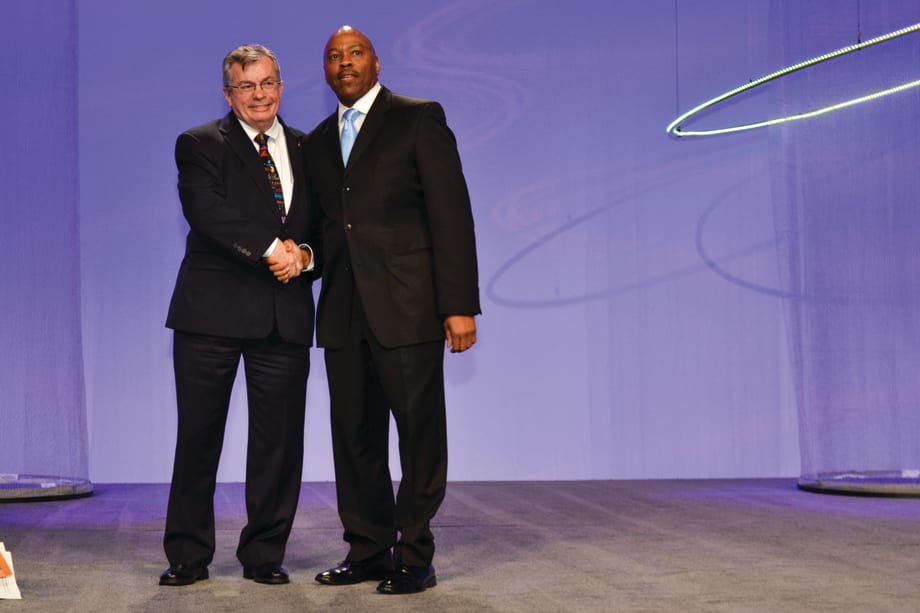
Outgoing APTA Chair Pete Varga welcomes incoming Chair Phil Washington.
The APTA Expo General Session kicked off with a bang on Monday morning in the George R. Brown Convention Center as APTA welcomed the crowd to the triennial event in a city undergoing an urban and transportation renaissance.
Michael Melaniphy, president and CEO of APTA, promised the event would live up to the adage, “Everything is bigger in Texas,” with over 800 global exhibitors and 15,000 attendees.
Annise D. Parker, the mayor of Houston; Tom Lambert, president and CEO, Metropolitan Transit Authority of Harris County (Metro); and Gilbert Andrew Garcia, Chairman of the board of directors, Metro, discussed Houston’s commitment to investing in transit, highlighting its launch of a new rail line last year that is exceeding ridership projections.
All speakers emphasized the transformation happening in public transit across the U.S., with exponential ridership growth and the challenge to gain a stable funding source to plan so many in-demand projects.
Outgoing APTA Chair Peter Varga, CEO, The Interurban Transit Partnership (The Rapid), welcomed incoming chair Phil Washington, GM, Denver Regional Transportation District. Washington discussed his intent to increase emphasis on safety and security; funding; shifting workforce demographics; changing customer lifestyles and demographics; and accelerated technological innovations.
“This country has been on an infrastructure vacation,” he said, and vowed that APTA would be able to change that.
The keynote speaker, Dr. Stephen Klineberg, co-director, Kinder Institute for Urban Research, department of sociology, Rice University, explained how Houston is at the forefront of an economic transformation and reflects what the U.S. will look like in the next 40 years.
Klineberg discussed his 30-year survey, “Who We’ll Live With: Racial Composition Preferences of Whites, Blacks, and Latinos” show the key factors sparking the city’s transformation have been globalization; more racial diversity, particularly from gaining more Latino and Asian residents; and more residents are joining the baby boomer demographic. As the city becomes more diverse, more people from all groups are seeking walkable urban communities, Klineberg said.
“Latinos and Asian groups are bringing their commitment to hard work to the city,” he said. That along with their value of education is helping to boost Houston’s economy, which currently boasts 5.7% unemployment, one percentage point lower than the U.S. average, he said.
Additionally, as they city continues to reinvent itself as a powerful driver of the knowledge economy, it acknowledges it will have to add more public transportation, which the city, Houston Metro and residents are working to provide; Taxpayers voted for a $100 million tax to build transit, more bike trails and green space, Klineberg said.
Other speakers included Bernard Tabary, CEO of Keolis, the sponsor of the event, and Hon. Judge Ed Emmett, Harris County.
More Paratransit

Biz Briefs: RIPTA Unveils New Frontrunners, Clevland RTA Adds New Siemens, and More
In METRO's latest installment, we take a look at recent news from Siemens, Prevost, Dodge, and more partnerships making headlines across the transportation sector.
Read More →
King County Metro Makes ADA Paratransit Easier to Navigate
METRO's Innovative Solutions Award winner replaces complex service-area descriptions with an accessible, interactive map that puts paratransit information directly in customers’ hands.
Read More →
Jacksonville’s NAVI Project Charts a New Course for Autonomous Public Transportation
Through its NAVI program, JTA is showing how autonomous vehicles, intelligent infrastructure, and coordinated operations can work together to deliver everyday public transportation.
Read More →
Driving Smarter Paratransit
John Hanlon shares how AlphaRoute is leveraging AI-powered technology to help paratransit providers optimize operations, support frontline staff, and enhance the rider experience.
Read More →
METRO Magazine Announces 2026 Innovative Solutions Awards Winners
Projects Recognized for Advancing Mobility Through Technology, Accessibility, Workforce Innovation, and Operational Excellence
Read More →
Biz Briefs: STV teams with Amtrak, Motorcoach Operators Boost Fleet and Land Contracts, and More
From manufacturers and suppliers to transit agencies and motorcoach operators, these updates offer a snapshot of the projects, partnerships and business moves driving the industry forward.
Read More →
Biz Briefs: Masabi Teams with St. Louis Metro and More
In METRO's latest installment, we take a look at recent news from Transdev, Hitachi, and more partnerships making headlines across the transportation sector.
Read More →
New York MTA Leverages Zoning Program to Advance Station Accessibility
Accessibility enhancements at Nevins St Station will be financed through a development agreement tied to the MTA's Zoning for Accessibility initiative.
Read More →
Reinventing Fleet Maintenance with Real-time Visibility and AI
Transit leaders need to know what needs fixing, where to look, who is responsible, when work is completed, and what it costs without having to chase information across disconnected systems.
Read More →
SamTrans Sets Priorities for Potential Connect Bay Area Revenue
The board-approved framework allocates future funding to maintaining service, rider improvements, equity initiatives, and infrastructure repairs.
Read More →