




RELATED: Q&A with Nathaniel P. Ford Sr.
APTA, industry leaders oppose Administration's deep cuts to public transit
The Administration offered cuts to crucial programs that fund public transit infrastructure to pay for their proposed infrastructure plan.
March 19, 2018
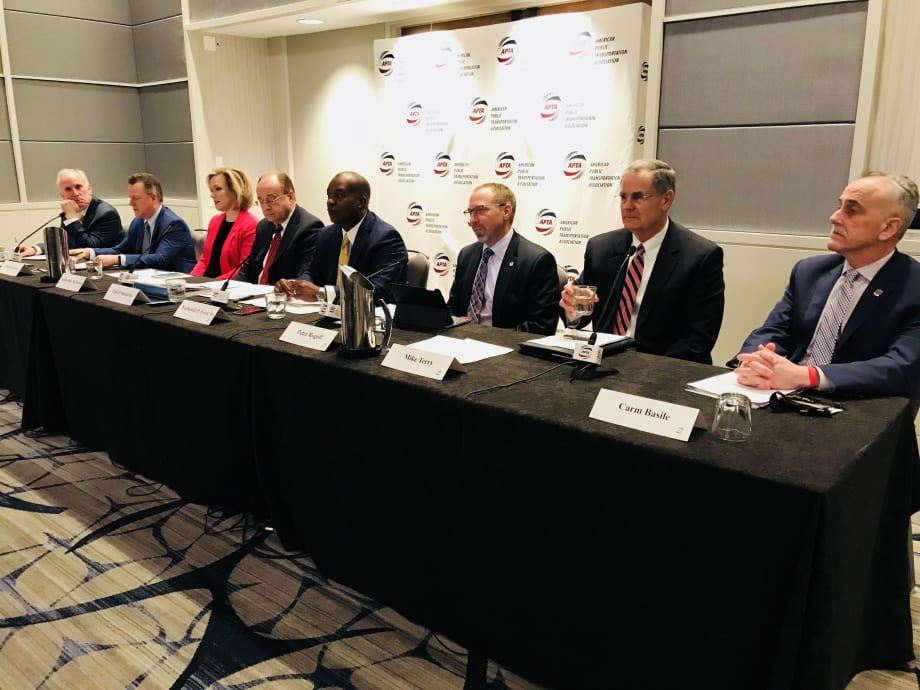
APTA and transit leaders addressed the Administration's deep cuts to transit at a press conference on Monday.
4 min to read
APTA and transit leaders addressed the Administration's deep cuts to transit at a press conference on Monday.
Public transit leaders from across the country spoke out at a press briefing on Monday to strongly oppose the President's deep cuts to public transit in the Administration's fiscal year 2019 proposed budget. If fully implemented, these cuts would put at risk 800,000 jobs, including 502,000 construction and related jobs; and an additional 300,000 longer term jobs associated with economic productivity, according to the American Public Transportation Association (APTA).
CEOs of local public transit agencies participating in the event were from Jacksonville, Fla.; Seattle; Pittsburgh; Indianapolis; Albany, N.Y.; Denver; and Washington, DC.
"The proposed budget cuts to public transit will affect accessibility for millions of Americans across the nation that rely on our bus and rail systems to get to and from jobs, healthcare and education," said APTA Chair and Jacksonville Transportation Authority CEO Nathaniel P. Ford Sr. "Without this funding, projects that rely on Capital Investment Grants will not be implemented and communities will suffer."
Overall, these proposed cuts would result in a possible loss of $90 billion in economic output, according to an analysis “The Economic Implications of Proposed Public Transit Capital Funding Cuts” that was prepared by the Economic Development Research Group for APTA. The Administration offered cuts to crucial programs that fund public transit infrastructure to pay for their proposed infrastructure plan.
"Cutting investments in America's public transit infrastructure to fund an infrastructure initiative is like robbing Peter to pay Paul," said APTA President/CEO Paul P. Skoutelas. "However, we are encouraged that lawmakers on both sides of the aisle support increased investments in public transit that will boost our economy and the quality of life in our local communities. We are calling on Congress to reject these budget cuts."
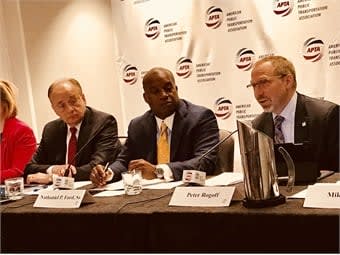
From left APTA President/CEO Paul Skoutelas; APTA Chair and JTA CEO Nathaniel P. Ford Sr; and Sound Transit President/CEO Peter Rogoff.
The Administration proposes cuts to the Capital Investment Grants (CIG), Transportation Investment Generating Economic Recovery program (TIGER), Amtrak, and the local DC metro's budget in its fiscal year 2019 proposed budget. The cuts to the CIG program will put 53 public transit new start projects at risk. The projects total $51.7 billion in investments in America's public transit infrastructure.
These projects also have local and state funds committed with the expectation that the federal government will fulfill its financial obligations promised in the 2015 Fixing America's Surface Transportation (FAST) Act, which was overwhelmingly approved by bipartisan votes of 83 to 16 in the U.S. Senate and 359-65 in the House of Representatives.
"Federal funding is critical to the safety and reliability of our transit system, which supports a million trips each weekday here in the nation's capital," said Paul J. Wiedefeld, CEO of Washington Metro. "At a time when many of our nation's transit systems are falling dangerously behind on maintenance due to funding challenges, we need more investment, not less."
Public transit leaders discussed the community and economic impact of these proposed cuts to local public transit projects and how they leverage new federal investments in public transit infrastructure.
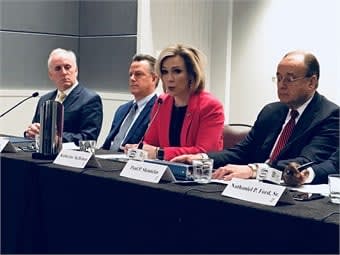
Port Authority of Allegheny County's Katherine Eagan Kelleman said CIG funds would be used to make more efficient connections to Downtown Pittsburgh and neighborhoods that are home to several major hospitals and universities.
"Puget Sound taxpayers have done their part to keep commuters and our economy moving by adopting the most ambitious transit expansion program in the nation. They reasonably expect the continuation of the longtime federal funding partnership that is needed to complete transit extensions on time and accommodate the 1.2 million new jobs that we know are coming to the region in the years ahead,” said Peter Rogoff, president/CEO of Seattle’s Sound Transit. “Local funds are set to pay for more than 60 percent of extending light rail to the City of Lynnwood and 75 percent to reach the City of Federal Way. We look forward to working with the Administration and Congress to get these projects built."
"In Allegheny County, the Capital Investment Grant would be used to make more efficient connections to Downtown Pittsburgh and neighborhoods that are home to several major hospitals and universities, allowing America's Most Livable City to continue its evolution into a major technology center for our region,” added Katherine Eagan Kelleman, CEO of Pittsburgh’s Port Authority of Allegheny County. “Projects like this are only possible when we leverage federal funding with local dollars, and we greatly appreciate and cherish that support. Ultimately, we will only be successful when we work with all of our partners.
More Management

METRO Opens Submissions for 2026 Motorcoach Awards
Nominations are now being accepted for METRO Magazine’s Operator of the Year and Innovative Operator of the Year awards.
Read More →
New York MTA Advances Final Contract for Second Avenue Subway Expansion
Contract Four is the largest in the Second Avenue Subway Phase 2 project and includes construction of station infrastructure, tracks, and signals for the subway expansion, MTA officials said. Work on Contract Four will begin in 2027.
Read More →
Transit Agencies Highlight Safety Gains at National Summit
Leaders from 15 major transit systems shared crime-reduction results and safety initiatives while discussing the role of continued federal support.
Read More →

NITA Names New Leadership, Expands Reduced-Fare Program at First Board Meeting
The new regional transit authority appointed its first board chair and interim executive director while extending reduced fares across CTA, Metra, and Pace for eligible riders.
Read More →
Beyond the Checklist: A Structured Approach to Transit Maintenance
Reliability-Centered Maintenance helps transit agencies move beyond routine checklists to focus limited resources on the assets and failures that have the greatest impact on safety, reliability, and service.
Read More →
APTA 2026 Nominating Committee Selects Leadership Slate, Names Chair and Vice Chair Nominees
Leadership changes will help shape the association’s priorities and its representation of the transportation industry during the 2026–2027 term.
Read More →
DART Launches Major Security, Fare Enforcement Initiative
The 90-day demonstration will deploy coordinated security teams at five light rail stations while testing controlled access and gathering data to guide future investments.
Read More →
Sponsored•September 9, 2026
Advancing Fare Collection Through Technology and Innovation
Learn about delivering 1300 gates at 91 stations while managing fare evasion. Explore the large scale deployment, solution customization and real-world results that affect the region. Prepare for deployment in your region now.
Read More →
Game Day in Motion: Moving Millions During the 2026 World Cup
Between packed transit stations and team motorcoaches, see how agencies and operators across North America tackled the transportation demands of the 2026 FIFA World Cup.
Read More →
Surface Transportation Extension Averts Shutdown, Leaves Transit Funding Gap
The stopgap keeps federal transportation programs moving, but missing advance funding could complicate the transit and rail projects agencies are planning next.
Read More →