




RELATED: How Wayfinding Tech Delivers Transit Info to Customers
Are big-city transportation systems too complex for human minds?
the researchers found that navigating transport networks in major cities — including London, New York City, Toyko and Paris — can come perilously close to exceeding humans’ cognitive powers.
February 23, 2016
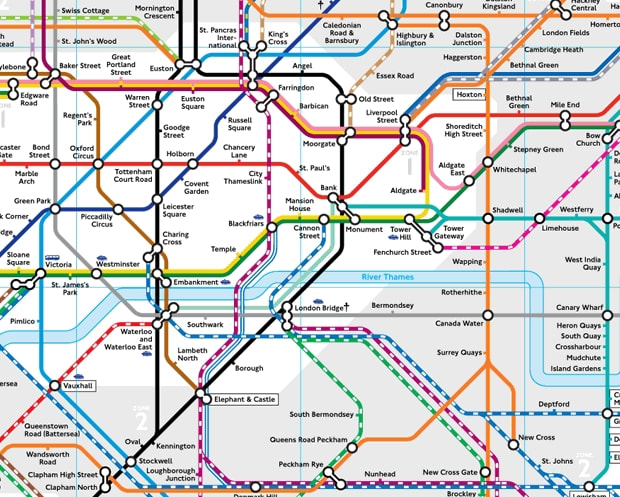
London Tube map. Transport for London
2 min to read
London Tube map. Transport for London
Many of us know the feeling of standing in front of a subway map in a strange city, baffled by the multi-coloured web staring back at us and seemingly unable to plot a route from point A to point B.
According to a new study published in the journal Science Advances, navigating routes through a complex urban transport system can often exceed the human brain's cognitive limits.
After analysing the world’s 15 largest metropolitan transport networks, the researchers at Oxford University estimated that the information limit for planning a trip is around 8 bits. (A ‘bit’ is a binary digit — the most basic unit of information.)
Additionally, similar to the "Dunbar number," which estimates a limit to the size of an individual’s friendship circle, this cognitive limit for transportation suggests that maps should not consist of more than 250 connection points to be easily readable.
Using journeys with exactly two connections as their basis (that is, visiting four stations in total), the researchers found that navigating transport networks in major cities — including London — can come perilously close to exceeding humans’ cognitive powers.
And when further interchanges or other modes of transport — such as buses or trams — are added to the mix, the complexity of networks can rise well above the 8-bit threshold. The researchers demonstrated this using the multimodal transportation networks from New York City, Tokyo, and Paris.
"Human cognitive capacity is limited, and cities and their transportation networks have grown to the point where they have reached a level of complexity that is beyond human processing capability to navigate around them," said Mason Porter, Professor of Nonlinear and Complex Systems in the Mathematical Institute at the University of Oxford. "In particular, the search for a simplest path becomes inefficient when multiple modes of transport are involved and when a transportation system has too many interconnections."
He adds that, in many cases, the maps currently in use need to be rethought and redesigned. Journey-planner apps of course help, but the maps themselves need to be redesigned.
The research – a collaboration between the University of Oxford, Institut de Physique Théorique at CEA-Saclay, and Centre d’Analyse et de Mathématique Sociales at EHESS Paris – is published in the journal Science Advances.
More Management

METRO Opens Submissions for 2026 Motorcoach Awards
Nominations are now being accepted for METRO Magazine’s Operator of the Year and Innovative Operator of the Year awards.
Read More →
New York MTA Advances Final Contract for Second Avenue Subway Expansion
Contract Four is the largest in the Second Avenue Subway Phase 2 project and includes construction of station infrastructure, tracks, and signals for the subway expansion, MTA officials said. Work on Contract Four will begin in 2027.
Read More →
Transit Agencies Highlight Safety Gains at National Summit
Leaders from 15 major transit systems shared crime-reduction results and safety initiatives while discussing the role of continued federal support.
Read More →

NITA Names New Leadership, Expands Reduced-Fare Program at First Board Meeting
The new regional transit authority appointed its first board chair and interim executive director while extending reduced fares across CTA, Metra, and Pace for eligible riders.
Read More →
Beyond the Checklist: A Structured Approach to Transit Maintenance
Reliability-Centered Maintenance helps transit agencies move beyond routine checklists to focus limited resources on the assets and failures that have the greatest impact on safety, reliability, and service.
Read More →
APTA 2026 Nominating Committee Selects Leadership Slate, Names Chair and Vice Chair Nominees
Leadership changes will help shape the association’s priorities and its representation of the transportation industry during the 2026–2027 term.
Read More →
DART Launches Major Security, Fare Enforcement Initiative
The 90-day demonstration will deploy coordinated security teams at five light rail stations while testing controlled access and gathering data to guide future investments.
Read More →
Sponsored•September 9, 2026
Advancing Fare Collection Through Technology and Innovation
Learn about delivering 1300 gates at 91 stations while managing fare evasion. Explore the large scale deployment, solution customization and real-world results that affect the region. Prepare for deployment in your region now.
Read More →
Game Day in Motion: Moving Millions During the 2026 World Cup
Between packed transit stations and team motorcoaches, see how agencies and operators across North America tackled the transportation demands of the 2026 FIFA World Cup.
Read More →
Surface Transportation Extension Averts Shutdown, Leaves Transit Funding Gap
The stopgap keeps federal transportation programs moving, but missing advance funding could complicate the transit and rail projects agencies are planning next.
Read More →