



Audit finds NYC subway cleanliness 'woefully inadequate'
The vast majority of New York City’s underground subway tracks — filled with rats and vermin, dirt, garbage and other debris — are cleaned sporadically, and stations with peeling paint that desperately need attention are ignored, according to a new audit released Thursday by New York City Comptroller Scott M. Stringer.

Photo: MTA
Photo: MTA
The vast majority of New York City’s underground subway tracks — filled with rats and vermin, dirt, garbage and other debris — are cleaned sporadically, and the Metropolitan Transportation Authority’s (MTA) New York City Transit (NYCT) has ignored stations with peeling paint that desperately need attention, according to a new audit released Thursday by New York City Comptroller Scott M. Stringer.
Only three percent of the tracks in 276 underground stations were cleaned according to NYCT’s own standards — potentially exposing millions of commuters to track fires, train delays and rat infestation in hundreds of stations.
“The MTA is constantly reminding riders to clean up after themselves, but they’re setting a poor example by letting piles of trash on the tracks fester for months on end,” Comptroller Stringer said. “Our auditors observed rats scurrying over the tracks and onto subway platforms, and it’s almost as if they were walking upright – waiting to take the train to their next meal. This is a daily, stomach-turning insult to millions of straphangers, and it’s unworthy of a world-class City.”
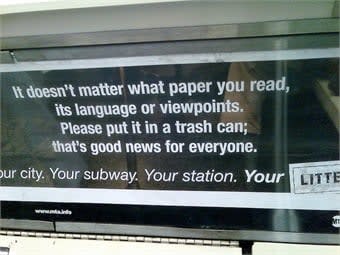
NY subway sign
Photo: Satish Krishnamurthy/Flickr
The Comptroller’s audit checked to see if NYCT was meeting its own goals for cleaning tracks and painting stations from July 1, 2013 to June 2014. During this period, NYCT paid $240 million to 2,485 employees to clean and maintain subway stations. While the agency’s operating revenue grew 34% between 2008 and 2013, the percentage of that revenue spent on cleaning stations fell from 6.3% to 5.4% and the agency also slashed the number of track cleaning employees by nearly 50%.
According to the MTA’s standards, cleaning crews are expected to visit each underground station and clean track beds once every three weeks. Tracks are also to be cleaned every six months by one of the NYCT’s VAK-TRAK trains, which vacuum up trash from the tracks. In 2012, NYCT also launched “Fastrack,” in which segments of subway lines are shut down at night to perform maintenance, cleaning and repair, including full-scale station painting.
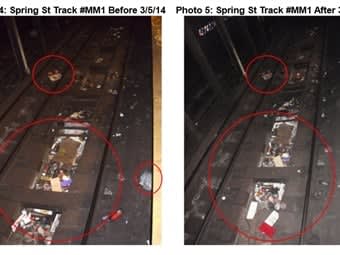
New York City train tracks before (left) and after (right) they were cleaned by a vacuum train. NYC Comptroller's Office
The Comptroller’s audit revealed that none of NYCT’s goals for cleaning and painting were fully met:
Tracks aren’t cleaned properly, leaving garbage and rats: Auditors found that 269 of 276 underground station tracks were cleaned less than once every three weeks, falling short of NYCT’s goals. Some 88% of stations were cleaned less than 8 times per year. At Atlantic
Avenue-Barclays Center station, two tracks weren’t cleaned at all for four months. When crews finally got around to cleaning them, they collected 122 bags of trash from the tracks.
Vacuum trains constantly break down and only clean 1/3 of each track, if they clean at all: NYCT owns two vacuum trains, one of which was out of service for most of the audit period. When it was operating, auditors found that it failed to pick up debris on the track 70 percent of the time. In total, 12% of the stations examined were not cleaned at all by a VAK-TRAK, instead of twice a year as is the standard.
Fastrack doesn’t prioritize painting stations in poor conditions: 31 of 39 stations scheduled for Fastrack work had extensive peeling paint, but only seven of those were scheduled for full- scale painting. During the first three months of this year, NYCT painted several stations that were not rated as having poor paint conditions by their own station condition survey.
“Fares keep going up, but anyone who takes the trains can tell you that we haven’t seen a meaningful reduction in rats, garbage and peeling paint,” Stringer said. “New York City Transit management needs to get its priorities straight and start deploying its resources to help improve conditions underground.”
Auditors made several recommendations to NYCT, virtually all of which the agency agreed with, including:
Allocating more funds and employees to improve maintenance and cleanliness;
Buying newer, more effective vacuum cars;
Developing a system to clean track beds to ensure they are cleaned frequently; and
Increasing staffing levels for painters and prioritizing poorly maintained stations for Fastrack repairs.
More Management

METRO Opens Submissions for 2026 Motorcoach Awards
Nominations are now being accepted for METRO Magazine’s Operator of the Year and Innovative Operator of the Year awards.
Read More →
New York MTA Advances Final Contract for Second Avenue Subway Expansion
Contract Four is the largest in the Second Avenue Subway Phase 2 project and includes construction of station infrastructure, tracks, and signals for the subway expansion, MTA officials said. Work on Contract Four will begin in 2027.
Read More →
Transit Agencies Highlight Safety Gains at National Summit
Leaders from 15 major transit systems shared crime-reduction results and safety initiatives while discussing the role of continued federal support.
Read More →

NITA Names New Leadership, Expands Reduced-Fare Program at First Board Meeting
The new regional transit authority appointed its first board chair and interim executive director while extending reduced fares across CTA, Metra, and Pace for eligible riders.
Read More →
Beyond the Checklist: A Structured Approach to Transit Maintenance
Reliability-Centered Maintenance helps transit agencies move beyond routine checklists to focus limited resources on the assets and failures that have the greatest impact on safety, reliability, and service.
Read More →
APTA 2026 Nominating Committee Selects Leadership Slate, Names Chair and Vice Chair Nominees
Leadership changes will help shape the association’s priorities and its representation of the transportation industry during the 2026–2027 term.
Read More →
DART Launches Major Security, Fare Enforcement Initiative
The 90-day demonstration will deploy coordinated security teams at five light rail stations while testing controlled access and gathering data to guide future investments.
Read More →
Advancing Fare Collection Through Technology and Innovation
Learn about delivering 1300 gates at 91 stations while managing fare evasion. Explore the large scale deployment, solution customization and real-world results that affect the region. Prepare for deployment in your region now.
Read More →
Game Day in Motion: Moving Millions During the 2026 World Cup
Between packed transit stations and team motorcoaches, see how agencies and operators across North America tackled the transportation demands of the 2026 FIFA World Cup.
Read More →
Surface Transportation Extension Averts Shutdown, Leaves Transit Funding Gap
The stopgap keeps federal transportation programs moving, but missing advance funding could complicate the transit and rail projects agencies are planning next.
Read More →