




RELATED: S.F. trying to find new homes for tech shuttle hubs
Bay Area 'tech' shuttle services growing, study says
During a three-year period (210-2014), the number of shuttle vehicles on Bay Area roadways jumped by more than 60 percent and ridership increased by 45 percent.
September 15, 2016
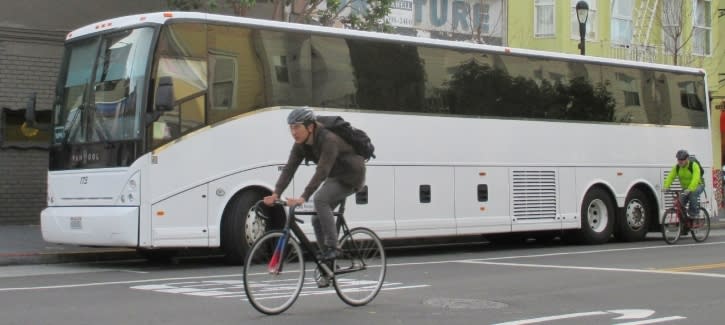
Photo: Metropolitan Transportation Commission
2 min to read
Photo: Metropolitan Transportation Commission
Public and private shuttle services around the Bay Area carried more passengers in the 2014-15 fiscal year than all but six of the region’s public transit agencies, according to the 2016 Bay Area Shuttle Census, released this month by the Metropolitan Transportation Commission (MTC) and the Bay Area Council.
Produced through a year-long effort by MTC and the San Francisco-based business group, the 2016 Shuttle Census marks the first comprehensive assessment of the region’s varied shuttle resources ever conducted; and includes three years (2012-14) of origin and destination information, as well as data on capacity, ridership, fleet size and service mileage reported by 35 shuttle sponsors and operators, including Apple, Google, Salesforce, Stanford University, UC Berkeley, and many others. During this time, the number of shuttle vehicles on Bay Area roadways jumped by more than 60 percent and ridership increased by 45 percent.
“Shuttles have become a much more important piece of the Bay Area transportation puzzle in the last five years,” observed MTC Chair and Santa Clara County Supervisor Dave Cortese. “We expect to update the Shuttle Census regularly; and we expect it to not only shape MTC’s regional planning work but also to help local governments, transit agencies and even Caltrans adapt to and accommodate shuttle services’ operations and their growth.”
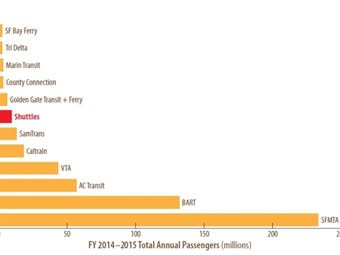
Regionwide, the number of shuttle vehicles grew to 765 in 2014 from 473 in 2012, with total daily capacity soaring to 34,000 from 18,000 and aggregate annual boardings rising to 9.6 million from 6.6 million. This makes shuttles’ annual ridership larger than any Bay Area transit agency except Muni, BART, AC Transit, VTA, Caltrain or SamTrans.
Graphic: Metropolitan Transportation Commission
Silicon Valley has emerged as the heart of the Bay Area shuttle market; with the lion’s share of regional service linking Santa Clara County with San Francisco, Alameda, San Mateo and Santa Cruz counties. Other major shuttle corridors connect San Mateo County with San Francisco and the East Bay. Top intra-county shuttle markets include Santa Clara, San Mateo, San Francisco and Alameda counties. The complete 2016 Bay Area Shuttle Census — including a full list of participating shuttle sponsors and operators — may be accessed online via this link.
MTC is the transportation planning, financing and coordinating agency for the nine-county San Francisco Bay Area. The Bay Area Council is a public policy advocacy organization sponsored by businesses throughout the region.
More Motorcoach

METRO Opens Submissions for 2026 Motorcoach Awards
Nominations are now being accepted for METRO Magazine’s Operator of the Year and Innovative Operator of the Year awards.
Read More →
Biz Briefs: Alstom Lands Canadian Contract, LYT to Supply California TSP, and More
In METRO's latest installment, we take a look at recent news from Complete Coach Works, Beep, FlixBus, and more partnerships making headlines across the transportation sector.
Read More →
Biz Briefs: RIPTA Unveils New Frontrunners, Clevland RTA Adds New Siemens, and More
In METRO's latest installment, we take a look at recent news from Siemens, Prevost, Dodge, and more partnerships making headlines across the transportation sector.
Read More →
People Movement: Holly Arnold Joins Transdev and More
In this edition, we also cover recent appointments and announcements at Pace, CamTran, MCI, and more, showcasing the individuals helping to shape the future of transportation.
Read More →
ABA Report: Motorcoach Travel Generates $161.6B Economic Impact
The 2025 analysis finds motorcoach travel supported nearly 900,000 jobs and generated $28 billion in federal, state, and local taxes.
Read More →
CharterUP’s Armir Harris on Technology, AI, and the Future of Group Mobility
In a recent episode of METROspectives, CharterUP Founder/CEO Armir Harris discussed the company’s evolution from an online charter bus marketplace into a technology platform supporting public- and private-sector mobility and much more.
Read More →
People Movement: ABC Names John Walsh as Chief Commercial Officer
In this edition, METRO also covers recent appointments and announcements at the DART, STV, and more, showcasing the individuals helping to shape the future of transportation.
Read More →
From Surviving to Thriving: Building Stronger Transportation Organizations
Bus Business Consultants founder Brian Dickson shares lessons on leadership, organizational health, and creating options for long-term success in a changing transportation industry.
Read More →
Biz Briefs: Luminator Marks Milestone and More
From manufacturers and suppliers to transit agencies and motorcoach operators, these updates offer a snapshot of the projects, partnerships and business moves driving the industry forward.
Read More →
ABAF Study Reveals Growing Insurance Crisis for Motorcoach Operators
Preliminary findings show 98% of operators faced premium increases over the past five years, while shrinking insurer participation is putting added pressure on businesses and customers.
Read More →