




Cities will benefit from less congestion and cleaner air, but could be disadvantaged by falling ridership on public transit, fear of which could result in some cities proactively trying to regulate the number of SAEVs on the road.
By 2030, 25% of miles driven in U.S. could be in shared self-driving e-cars
Convergence of three trends — ride sharing, autonomous driving, and vehicle electrification — will offer big-city dwellers cheap, convenient transportation, transforming the automotive industry, says report.
April 11, 2017
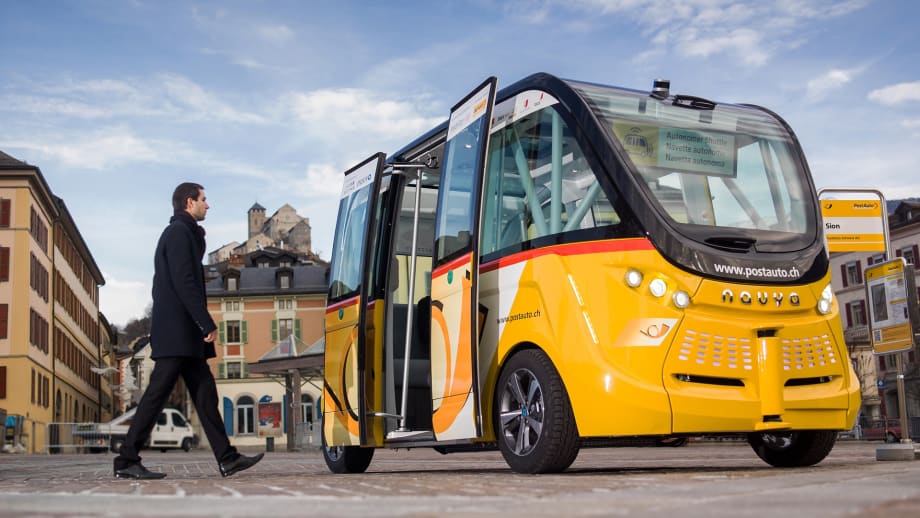
Navya electric shuttle. Courtesy Navya
5 min to read
Navya electric shuttle. Courtesy Navya
By 2030, around a quarter of all miles driven in the U.S. could be in shared autonomous electric vehicles, which will offer consumers in large cities the lowest-cost, most convenient form of transportation, according to new research.
The convergence of three trends — ride sharing (services such as Uber and Lyft), autonomous driving, and vehicle electrification — create a far more compelling economic case than any of these forces alone, according to the study by The Boston Consulting Group (BCG). Due to their ability to cut travel costs by 60%, shared autonomous electric vehicles (SAEVs) could shift about 25% of miles traveled from private automobiles — creating enormous benefits for consumers as well as causing major disruption to the automotive industry.
While total vehicle demand will only be affected slightly, by 2030 more than 5 million conventional cars per year could be replaced by a combination of fully autonomous electric vehicles for urban fleets and partially autonomous cars for personal use. Cities will benefit from less congestion and cleaner air, but could be disadvantaged by falling ridership on public transit, fear of which could result in some cities proactively trying to regulate the number of SAEVs on the road.
SAEV is an apt acronym for these vehicles, as fleets would save time, money, and lives. By using SAEVs, a typical Chicagoan who owns a car and drives 10,000 miles a year could cut the cost of travel from around $1.20 per mile to around 50 cents per mile. Over the course of a year, that could put more than $7,000 in that driver’s pocket — effectively doubling consumer discretionary income.
Unlike most industry studies which look at trends such as autonomous driving and powertrain electrification in isolation, BCG’s research aims to provide an integrated view of the future of mobility in the U.S. The consultants combine insights from a variety of sources — including a proprietary survey of more than 6,000 US consumers; detailed modeling and analysis of traffic patterns and population density in over 100 cities of varying sizes; economic forecasting; past BCG studies; and interviews with a wide range of industry experts. The results focus on implications for automobile and parts manufacturers, car dealers, service providers, and city governments, as well as other key stakeholders, such as energy and insurance companies.
Radical Shift Will Be Concentrated in Large Cities
BCG’s conservative estimate is that 23% to 26% of miles driven in the U.S., or about 800 billion to 925 billion miles, could be traveled in SAEVs by 2030. The shift to SAEVs, which would be gradual and would begin by the early 2020s, would likely occur in cities with more than 1 million people, where there is sufficient demand to keep fleet utilization high and there are significant pain points associated with private vehicle ownership (expensive insurance, difficulty finding parking, and congestion).
Adoption could be even faster and more widespread if innovations in technology and pricing models reduce costs further for consumers. Innovations could include radically different vehicle designs (such as driverless pods), new tailored services (such as pooled ride sharing), and new revenue streams (such as in-vehicle advertising). At a lower price point, SAEV service might be attractive in more mid-size cities (with populations of 500,000 to 1 million).
Nonetheless, significant hurdles remain. Major technical and infrastructure challenges must be solved. For example, BCG concludes that SAEVs are unlikely to be economically viable in small cities and rural areas. And even in larger cities, their survey findings suggest that many consumers remain skeptical of the technology or are unwilling to give up the many conveniences and benefits of private vehicle ownership.
Shift Will Have Massive Impact
Moving up to a quarter of all miles driven would have massive impact, not only on household economics and lifestyles, but also on society as a whole, urban planning, the automotive industry, and key supporting industries such as energy, finance, and insurance.
Automakers and parts suppliers would face the most profound challenge to their business models in a century. While total vehicle demand isn’t likely to change materially, the types of cars required will be vastly different. BCG estimates that in 2030, a total of 4.7 million autonomous electric vehicles will replace 5.1 million conventional autos sold in the U.S. This shift undermines the current industry business model, with its focus on engine technology and its long product cycles, and opens the market to a range of new competitors. Hundreds of billions of dollars worth of industry assets could turn into liabilities. Dealers will be less relevant as fleets make up a much bigger portion of sales. Current aftermarket businesses will take a hit because SAEVs will require less maintenance and have fewer accidents. But at the same time, whole new businesses will develop to manage large urban fleets and service them daily.
The new model would also have important implications for cities. In addition to benefits such as less congestion, fewer traffic deaths, cleaner air, and reduced need for parking space, cities may also face financial hardship because of the impact on public transit. The economics of shared autonomous electric vehicles makes them competitive with public transportation for short trips — and more convenient (no schedules, door-to-door service). According to BCG analysis of traffic patterns and “pain points” of mass transit riders in Chicago, as many as 20% of public transit miles could shift to the new transportation mode. This could leave cities in the position of maintaining aging transit infrastructure with reduced ridership and fare income. However, cities can plan for the loss of transit income by finding other sources of tax revenue, such as fees on SAEV fleets and trips. They could even consider investing in publicly owned fleets.
Additional effects would include a sharp drop in fuel demand. And the sharp reduction of traffic accidents and related injuries from autonomous and semi-autonomous vehicles could reshape the auto insurance business. Tech companies, data providers, and electric utilities would benefit.
“The automotive industry is on the brink of a major transformation, and it’ll be here faster than people realize,” said BCG's Justin Rose. “For millions of Americans living in large cities, the next vehicle they purchase may be the last car they ever own.”
More New Mobility

From Hardware to Digital Partner: Luminator Charts Its Next Chapter
CEO Magnus Friberg discusses Luminator’s shift toward becoming a digital partner, the growing importance of software and interoperability, and how AI can help agencies improve operations and passenger experience.
Read More →
Biz Briefs: Alstom Lands Canadian Contract, LYT to Supply California TSP, and More
In METRO's latest installment, we take a look at recent news from Complete Coach Works, Beep, FlixBus, and more partnerships making headlines across the transportation sector.
Read More →
CharterUP’s Armir Harris on Technology, AI, and the Future of Group Mobility
In a recent episode of METROspectives, CharterUP Founder/CEO Armir Harris discussed the company’s evolution from an online charter bus marketplace into a technology platform supporting public- and private-sector mobility and much more.
Read More →
Jacksonville’s NAVI Project Charts a New Course for Autonomous Public Transportation
Through its NAVI program, JTA is showing how autonomous vehicles, intelligent infrastructure, and coordinated operations can work together to deliver everyday public transportation.
Read More →
Biz Briefs: Luminator Marks Milestone and More
From manufacturers and suppliers to transit agencies and motorcoach operators, these updates offer a snapshot of the projects, partnerships and business moves driving the industry forward.
Read More →
New Tricks for Old Bureaucracies: Joshua Schank on Making Transit Innovation Stick
Former LA Metro Chief Innovation Officer Joshua Schank discusses why good ideas aren't enough, how transit agencies can overcome resistance to change, and why today's challenges demand more innovation.
Read More →
How DART's GoPass Is Redefining Regional Mobility
Serving 14 transit agencies, GoPass simplifies multimodal travel by allowing riders to plan, pay for, and manage an entire trip through one app.
Read More →
Biz Briefs: OCTA Taps Clean Energy for Hydrogen Station, Stadler to Supply Via Rail Vehicles, and More
From manufacturers and suppliers to transit agencies and motorcoach operators, these updates offer a snapshot of the projects, partnerships and business moves driving the industry forward.
Read More →CharterUP Expands Into New Mobility and Autonomous Transportation
Vice President of New Mobility Stephen Joos discusses how CharterUP is leveraging its nationwide transportation network, technology platform, and autonomous vehicle partnerships to expand into workforce mobility, campus shuttles, and transit solutions.
Read More →
METRO Magazine Announces 2026 Innovative Solutions Awards Winners
Projects Recognized for Advancing Mobility Through Technology, Accessibility, Workforce Innovation, and Operational Excellence
Read More →