




RELATED: High-Speed Rail is at a Crossroads
California's Governor calls for scaling down of high-speed rail project
The state’s high-speed rail authority will focus now on building only the Central Valley segment of the planned San Francisco to Los Angeles train.
February 12, 2019
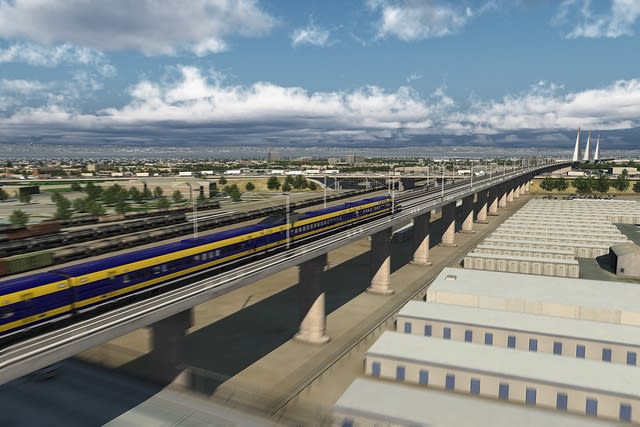
A rendering of the Bakersfield portion of the California High-Speed Rail project via the California High-Speed Rail Authority
3 min to read

During his first State of the State address, Gov. Gavin Newsom discussed plans to scale back two major California infrastructure projects, including the state’s beleaguered high-speed rail project.
The state’s high-speed rail authority will focus now on building only the Central Valley segment of the planned San Francisco to Los Angeles train.
“Right now, there simply isn’t a path to get from Sacramento to San Diego, let alone from San Francisco to LA,” Newsom said during his address. “However, we do have the capacity to complete a high-speed rail link between Merced and Bakersfield.”
He also bristled at the notion that the high-speed rail system was a “train to nowhere.”
“I know that some critics will say this is a ‘train to nowhere.’ But that’s wrong and offensive,” said Newsom. “The people of the Central Valley endure the worst air pollution in America as well as some of the longest commutes. And they have suffered too many years of neglect from policymakers here in Sacramento. They deserve better.”
The Governor added that high-speed rail is more than a train project, but an economic transformation that could unlock “the enormous potential of the Valley,” before adding that this doesn’t necessarily mark the end of the project’s larger goal.
“Look, we will continue our regional projects north and south,” he said. “We’ll finish Phase 1 environmental work. We’ll connect the revitalized Central Valley to other parts of the state, and continue to push for more federal funding and private dollars. But let’s just get something done.”
Newsom added that for those who want to abandon the project entirely would mean that the state will have wasted billions of dollars with nothing but broken promises and lawsuits to show for it, and wasn’t “interested in sending $3.5 billion in federal funding that was allocated to this project back to Donald Trump.”
In closing, the Governor said there will be new transparency measures implemented, including holding contractors and consultants accountable to explain how taxpayer dollars are spent — including change orders, cost overruns, and even travel expenses — which will be available online.
“You’re also going to see some governance changes, starting with my pick for the next chair of the High-Speed Rail Authority, Lenny Mendonca, my economic development director,” Newsom said. “Because at the end of the day, transportation and economic development must go hand in hand.”
Following the announcement, APTA President/CEO Paul P. Skoutelas released the following statement:
"The American Public Transportation Association appreciates and applauds California Governor Gavin Newsom's commitment to the long-term goal of bringing high-speed rail to California and to continued improvements of local and regional public transportation systems.
"The Governor said that the state will focus first on completing the 119-mile Central Valley phase in the near term, while completing environmental assessments and seeking funding for the entire project.
"The investments made to date have created thousands of jobs and will produce dramatic improvements in mobility through clean, efficient public transportation.
"APTA is committed to working with Governors and local leaders to support their efforts in advancing vital investment projects that require strong federal, state and local partnerships.
"Improving and expanding our nation's transportation system is critical, and APTA urges Congress and the Trump Administration to make infrastructure investment a priority this year, which will benefit millions of Americans across the country."
[This story was updated on Feb.14]
More Rail
FRA Announces $5.3B in Rail Investments, Including $2B for Amtrak
Funding will support grade-crossing improvements, infrastructure upgrades, and new Amtrak equipment in 23 states.
Read More →
Finding the ‘Happy Medium’: Optimizing Maintenance Without Sacrificing Reliability
The key to maintenance optimization isn’t doing less work—it’s doing the right work at the right time on the right assets.
Read More →
OKC Streetcar Makes Zero-Fare Service Permanent
Ridership increased an average of 71% compared with the same period a year earlier during the fare-free pilot.
Read More →
DART Customer Satisfaction Reaches Six-Year High
Overall satisfaction rose to 74.9%, while the agency’s Net Promoter Score reached a record 33.7.
Read More →
How DART's GoPass Is Redefining Regional Mobility
Serving 14 transit agencies, GoPass simplifies multimodal travel by allowing riders to plan, pay for, and manage an entire trip through one app.
Read More →
Amtrak Board Advances Plan to Restructure Organization, Seeks Public Input
The proposal, developed by Amtrak management and approved by the board for further consideration, is intended to modernize the organization's structure while improving accountability, operational efficiency, and customer service.
Read More →
Biz Briefs: STV teams with Amtrak, Motorcoach Operators Boost Fleet and Land Contracts, and More
From manufacturers and suppliers to transit agencies and motorcoach operators, these updates offer a snapshot of the projects, partnerships and business moves driving the industry forward.
Read More →
Metra Celebrates 100 Years of Electric Rail, Looks to the Future
The event was also a celebration of recent reforms to public transportation in the Chicago area, changes that could be as transformative in the future as the major civic achievement a century ago, said officials.
Read More →
LA Metro Marks Banner Year, Sets Ambitious Goals for New Fiscal Year
Incoming LA Metro Board Chair and Los Angeles Mayor Karen Bass joined outgoing Board Chair Fernando Dutra and LA Metro CEO Stephanie Wiggins to review accomplishments from fiscal year 2026, which included the opening of new rail extensions, advancement of major transit projects, expanded safety programs, and new rider amenities.
Read More →
DART Taps Nathaniel P. Ford Sr. as Next President/CEO
Since 2012, Ford has served as the CEO of the Jacksonville Transportation Authority
Read More →