



CATA CEO Draggoo announces plan to retire
She is currently the longest-serving transit CEO in the nation. Her career with the authority spans 43 years, 32 of them as CATA’s CEO.

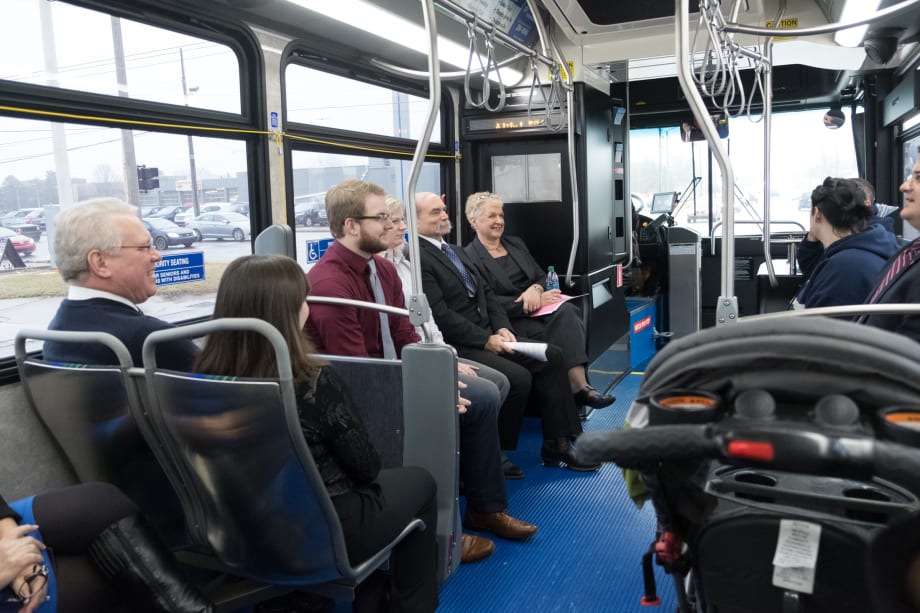
CATA CEO Sandy Draggoo (shown seated in center of photo). Courtesy CATA
CATA CEO Sandy Draggoo (shown seated in center of photo). Courtesy CATA
At the Capital Area Transportation Authority's (CATA) regularly-scheduled board of directors meeting Wednesday, CEO Sandy Draggoo announced her plan to retire in February 2018. Draggoo is currently the longest-serving transit CEO in the nation. Her career with the authority spans 43 years, 32 of them as CATA’s CEO.
Draggoo began her career at Lansing, Mich.'s CATA as an executive secretary, eventually landing the top job. She became one of a select few females in the country to successfully lead a public transportation system.
Draggoo spearheaded the construction of a new transportation center in downtown Lansing in 1997. She negotiated public transportation services in 1999 and opened Ramp 1 in 2004 on Michigan State University’s campus. In 2016, Draggoo celebrated the grand opening of the Capital Area Multimodal Gateway, operated by CATA. Draggoo oversaw the quality of CATA’s daily delivery of service, increasing ridership from 4.5 million trips in fiscal year 1985 to 10.9 million in fiscal year 2016.

CATA CEO Sandy Draggoo. Courtesy CATA
In 2003, Draggoo was named CEO of The Year by the American Public Transportation Association (APTA), representing agencies in both the U.S. and Canada. Under her leadership, CATA received APTA’s Outstanding Achievement Award in 1991 and 2007, and was recognized as the No. 1 system of its size — an honor bestowed upon few agencies in the country.
Draggoo currently serves on the Lansing Economic Area Partnership board of directors, is an active member of the Rotary Club of Lansing, and volunteers for Meals on Wheels. She served as Chair of the Elders for The Peoples Church.
More Management

METRO Opens Submissions for 2026 Motorcoach Awards
Nominations are now being accepted for METRO Magazine’s Operator of the Year and Innovative Operator of the Year awards.
Read More →
New York MTA Advances Final Contract for Second Avenue Subway Expansion
Contract Four is the largest in the Second Avenue Subway Phase 2 project and includes construction of station infrastructure, tracks, and signals for the subway expansion, MTA officials said. Work on Contract Four will begin in 2027.
Read More →
Transit Agencies Highlight Safety Gains at National Summit
Leaders from 15 major transit systems shared crime-reduction results and safety initiatives while discussing the role of continued federal support.
Read More →

NITA Names New Leadership, Expands Reduced-Fare Program at First Board Meeting
The new regional transit authority appointed its first board chair and interim executive director while extending reduced fares across CTA, Metra, and Pace for eligible riders.
Read More →
Beyond the Checklist: A Structured Approach to Transit Maintenance
Reliability-Centered Maintenance helps transit agencies move beyond routine checklists to focus limited resources on the assets and failures that have the greatest impact on safety, reliability, and service.
Read More →
APTA 2026 Nominating Committee Selects Leadership Slate, Names Chair and Vice Chair Nominees
Leadership changes will help shape the association’s priorities and its representation of the transportation industry during the 2026–2027 term.
Read More →
DART Launches Major Security, Fare Enforcement Initiative
The 90-day demonstration will deploy coordinated security teams at five light rail stations while testing controlled access and gathering data to guide future investments.
Read More →
Advancing Fare Collection Through Technology and Innovation
Learn about delivering 1300 gates at 91 stations while managing fare evasion. Explore the large scale deployment, solution customization and real-world results that affect the region. Prepare for deployment in your region now.
Read More →
Game Day in Motion: Moving Millions During the 2026 World Cup
Between packed transit stations and team motorcoaches, see how agencies and operators across North America tackled the transportation demands of the 2026 FIFA World Cup.
Read More →
Surface Transportation Extension Averts Shutdown, Leaves Transit Funding Gap
The stopgap keeps federal transportation programs moving, but missing advance funding could complicate the transit and rail projects agencies are planning next.
Read More →