




“Universal mobility” is the philosophy of “community mobility” used by occupational therapists combined with the tenets of “universal design” used by architects. It is the belief that mobility is a human right, and access to high-quality accessible transportation is fundamental to exercising that right. The concept further believes transportation should be useable for people of all ages and abilities.
Chicago region's transportation fails people with disabilities, seniors: Study
New report issued by the Metropolitan Planning Council makes 32 recommendations for improvement in eight different categories.
December 3, 2019
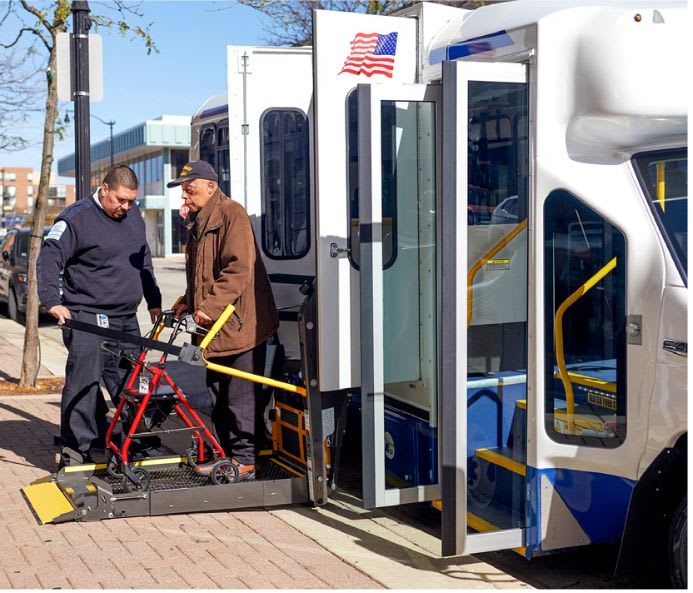
A new report reveals that people with disabilities are often severely limited in their ability to participate in society as a result of transportation problems in the Chicago region.
Regional Transportation Authority
4 min to read
A new report reveals that people with disabilities are often severely limited in their ability to participate in society as a result of transportation problems in the Chicago region.
Regional Transportation Authority
A new report by the Chicago region’s urban planning and policy organization highlights the failures of the region’s transportation system to meet the needs of people with disabilities and seniors. The report, Toward Universal Mobility: Charting a Path to Improve Transportation Accessibility, issued by the Metropolitan Planning Council (MPC), makes 32 recommendations for improvement in eight different categories.
MarySue Barrett, President of the Metropolitan Planning Council (MPC), said, “As someone who developed a visual disability in my ‘30s, I have become more reliant on public transit myself. I understand the frustrations people face when trying to navigate a system not designed to accommodate their unique needs.” She added, “When the MPC staff and advisors took on the challenge of studying how people with disabilities and the elderly navigate the region’s transportation system, we were inundated with examples of the enormous hurdles people face.”
In reviewing the accessibility of the transportation of northeastern Illinois, Audrey Wennink, Director of Transportation at MPC, commented on the report’s most significant finding and said, “The system is a patchwork of services created by different agencies for different purposes, and has a multitude of rules and requirements. The goal is to streamline these services so they are more consistent and easier to use.” She added, “Our chief recommendation is a regional Mobility Coordinator to take a customer focus so services are coordinated, and riders can have a better experience using the existing system.”z
Adam Ballard, a disability advocate who uses a power chair and contributed to the report said, “Rather than maintaining an accessible vehicle of my own, it makes sense financially to use public transit, paratransit and taxis — everything I use here [in Chicago]. [People with disabilities] are still developing a political identity and a political voice around our disability identity.” Increased advocacy by those most affected by these transportation challenges is recommended in the report.
Why It Matters
The report reveals that people with disabilities are often severely limited in their ability to participate in society as a result of transportation problems. Michele Lee, a finance professional who uses a wheelchair and participated in development of the report said, “I kind of have to stick to my neighborhood, and I don’t get to explore as much because of transportation and accessibility constraints.”
The report also reveals that people with disabilities are four times less likely to be working than people without disabilities. According to a survey conducted by the Federal Highway Administration, nationally, only 20% of people age 18 to 64 work full- or part-time if they have travel-limiting disabilities. In contrast, over 75% of people without disabilities age 18 to 64 work.
Wennink added, “There are a lot of different transportation services, and we need to make them easier for people with disabilities to use. That can include better signs, signals, sidewalks, and better use of new technologies like smartphones to provide crucial information. Once we remove one small but critical barrier, a whole new world can open up for people.”
The report includes recommendations on a wide range of topics in the following eight categories:
Improve Service Coordination
To streamline accessible services, MPC’s top recommendation is the creation of a regional Mobility Coordinator to break down silos between transportation agencies, creating a more unified system.
Improve Wayfinding
MPC is also recommending that transit providers such as the Chicago Transit Authority (CTA), Metra Commuter Rail, and Pace Suburban Bus standardize their wayfinding signs, and municipalities provide audio cues at busy intersections to aid those with low vision.
Engage Private Sector Transportation Services
Acknowledging that companies such as Uber and Lyft are transforming transportation for everyone, MPC makes recommendations for these private-sector partners to better accommodate people with disabilities, including more training for drivers, and a pilot program to complement current transit services.
Upgrade Technology
Many of MPC’s recommendations include ways to better provide information using technologies such as smart phones.
Improve the Final Steps of Journeys
If any portion of the trip is not accessible, the whole trip is impossible. To improve the final steps of a journey, MPC is recommending increased emphasis on building accessible sidewalks.
Upgrade Fixed-Route Systems
Taking a comprehensive approach to making the existing fixed-route transit system universally accessible will be transformative for many of the region’s residents and may provide opportunities for more people to move around more of the region more spontaneously at an affordable cost. To accomplish this goal, MPC is recommending the RTA, CTA, Metra, and Pace prioritize their existing capital funds to make all existing rail stations and transfer points accessible and comfortable, and include upgrades to wayfinding for low-vision and deaf riders.
Improve Use of Existing Funds
MPC is focused on more effectively using existing transportation funding, including that provided via the new Rebuild Illinois capital bill, to generate improved mobility outcomes for people with disabilities. A Mobility Coordinator will help leverage existing transit funds better and streamline accessible transportation services. Another significant opportunity is ensuring funds provided by the RTA sales tax in suburban counties is used on transportation programs. In particular, the report reveals that several counties divert some or all of their RTA sales tax funds to programs other than transportation.
Empower People with Disabilities to Advocate for Change
Lastly, MPC is recommending that people with mobility challenges be empowered to advocate for high-quality pedestrian and transit infrastructure that will improve their mobility.
More New Mobility

From Hardware to Digital Partner: Luminator Charts Its Next Chapter
CEO Magnus Friberg discusses Luminator’s shift toward becoming a digital partner, the growing importance of software and interoperability, and how AI can help agencies improve operations and passenger experience.
Read More →
Biz Briefs: Alstom Lands Canadian Contract, LYT to Supply California TSP, and More
In METRO's latest installment, we take a look at recent news from Complete Coach Works, Beep, FlixBus, and more partnerships making headlines across the transportation sector.
Read More →
CharterUP’s Armir Harris on Technology, AI, and the Future of Group Mobility
In a recent episode of METROspectives, CharterUP Founder/CEO Armir Harris discussed the company’s evolution from an online charter bus marketplace into a technology platform supporting public- and private-sector mobility and much more.
Read More →
Jacksonville’s NAVI Project Charts a New Course for Autonomous Public Transportation
Through its NAVI program, JTA is showing how autonomous vehicles, intelligent infrastructure, and coordinated operations can work together to deliver everyday public transportation.
Read More →
Biz Briefs: Luminator Marks Milestone and More
From manufacturers and suppliers to transit agencies and motorcoach operators, these updates offer a snapshot of the projects, partnerships and business moves driving the industry forward.
Read More →
New Tricks for Old Bureaucracies: Joshua Schank on Making Transit Innovation Stick
Former LA Metro Chief Innovation Officer Joshua Schank discusses why good ideas aren't enough, how transit agencies can overcome resistance to change, and why today's challenges demand more innovation.
Read More →
How DART's GoPass Is Redefining Regional Mobility
Serving 14 transit agencies, GoPass simplifies multimodal travel by allowing riders to plan, pay for, and manage an entire trip through one app.
Read More →
Biz Briefs: OCTA Taps Clean Energy for Hydrogen Station, Stadler to Supply Via Rail Vehicles, and More
From manufacturers and suppliers to transit agencies and motorcoach operators, these updates offer a snapshot of the projects, partnerships and business moves driving the industry forward.
Read More →CharterUP Expands Into New Mobility and Autonomous Transportation
Vice President of New Mobility Stephen Joos discusses how CharterUP is leveraging its nationwide transportation network, technology platform, and autonomous vehicle partnerships to expand into workforce mobility, campus shuttles, and transit solutions.
Read More →
METRO Magazine Announces 2026 Innovative Solutions Awards Winners
Projects Recognized for Advancing Mobility Through Technology, Accessibility, Workforce Innovation, and Operational Excellence
Read More →