



Community Transit unveils first Swift BRT station
Stations will be equipped with two ticket vending machines and two ORCA smart card readers. Passengers will pay their fares at the stations rather than on board so the buses can depart quickly.

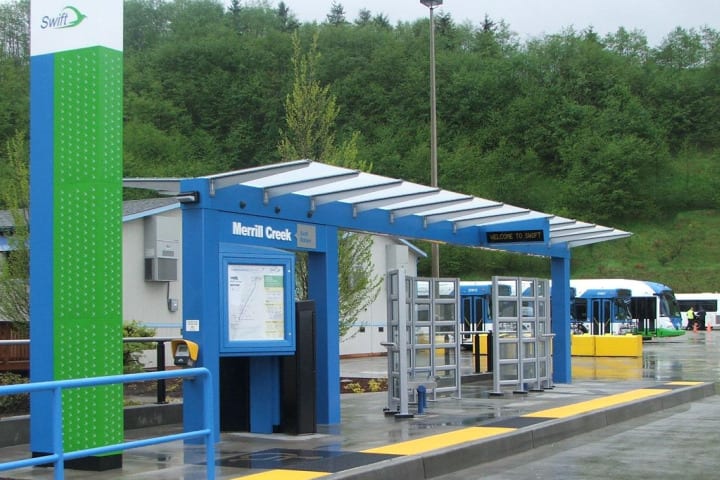
[IMAGE]Swift-station-full.jpg[/IMAGE]Community Transit unveiled the first Swift station and Swift bus at its operations base in Everett, Wash., on Tuesday and announced plans to build an additional four Swift stations in the city.
“The reality of bus rapid transit really hits home when you take a look at this beautiful Swift bus and great station we have here today,” Community Transit CEO Joyce Eleanor said. “We’ve seen drawings and had an idea what they would look like, but to actually get to see them is very impressive.”
Community Transit, along with its partner Everett Transit, is constructing 24 Swift stations and two terminals along a 17-mile route primarily on Highway 99 between Everett Station and the Aurora Village Transit Center in Shoreline. Everett Mayor Ray Stephanson announced a $3.6 million state grant that will allow the city to build an additional four stations.
“These stations will help fill some gaps in the current Swift route in Everett to provide even greater service to our customers,” said Stephanson. “In addition, this state grant allows us to install transit signal priority along the corridor in Everett.”
Transit signal priority is already installed in the southern portion of the Swift route. The technology allows signals to extend a green light a few seconds when a Swift bus approaches, saving minutes each trip along the corridor.
Swift will stop at stations about every 10 minutes on weekdays between 5 a.m. and 7 p.m. and every 20 minutes at night and weekends. With only 12 stops in each direction when it opens, Swift will fly down the corridor much faster than local bus service.
The first completed Swift station is a training station at Community Transit’s Merrill Creek base. The station allows bus drivers to practice precise stopping at the station’s raised curb and gives maintenance staff the opportunity to figure out how best to maintain the stations.
Stations will be equipped with two ticket vending machines and two ORCA smart card readers. Passengers will pay their fares at the stations rather than on board so the buses can depart quickly.
Stations also will have markings on the curb to indicate where wheelchair passengers and passengers with bikes should board. Information kiosks display instructions on how to ride Swift as well as local area information. Ample lighting and translucent weather barriers should make the short wait for the bus more comfortable. And each station will be easily recognizable by a tall roadside marker.
The buses are 60-foot articulated hybrid diesel-electric buses with a colorful paint design that sets them apart from other buses. Each Swift bus has three doors, wide seats with extra leg room and plenty of standing room for what is anticipated to be short rides. Bike racks are located on board in the rear of the bus.
Construction on Swift stations began last December, with work being done in two phases. The first phase involves the laying of concrete platforms and utility work; the second phase is the actual construction of the stations. The first phase is mostly complete in Everett and has moved into Lynnwood. The second phase is expected to begin in late May or early June.
More Bus

Scenes from APTA TRANSform & EXPO 2026
Transit leaders, manufacturers, and industry professionals gathered in Chicago to explore new technologies, share ideas, and discuss the future of public transportation.
Read More →
More Than a Summer Job: Building the Next Generation of Transit Talent
The Delaware River Port Authority and PATCO have transformed their internship program into a hands-on professional development experience that introduces students to the breadth of transportation careers — and creates a pipeline for future employees.
Read More →
LA Metro Board Awards 220 Battery-Electric Bus Contract to ENC
The contract, which is the largest base award of battery-electric buses by a U.S. transit agency, will be built in Southern California, sustaining good jobs as LA prepares to welcome the world in 2028
Read More →
Public Transit Conference Returning to GFX in 2027, Call for Papers Now Open
The Call for Papers is now open, allowing transit agency professionals and industry experts to help shape the PTC educational program by submitting session ideas for consideration.
Read More →
Indian River Transit’s Community-Focused Approach Earns National Recognition
Named APTA’s 2026 Outstanding Public Transportation System in its size category, Florida’s Indian River County transit system continues to grow ridership through fare-free service and a focus on evolving community needs.
Read More →
ENC Lands MATA Contract and More in Biz Briefs
In this edition of Biz Briefs, we spotlight the latest developments shaping the future of mobility.
Read More →
From Surviving to Thriving: Building Stronger Transportation Organizations
Bus Business Consultants founder Brian Dickson shares lessons on leadership, organizational health, and creating options for long-term success in a changing transportation industry.
Read More →
Everett Transit, Community Transit Outline Consolidation Agreement
The proposed agreement calls for a 50% increase in bus service in Everett, a new microtransit zone, continued paratransit service, and the transfer of Everett Transit operations to Community Transit.
Read More →
SEPTA Details Accelerate Vision for Transit System
The plan outlines investments in trolley modernization, new Metro and Regional Rail vehicles, accessible stations, and more frequent bus and rail service.
Read More →
Report: Transit Bus Manufacturing Supports 34,100 Jobs, $5.1B in GDP
The “Buses Mean Business” report examines the transit bus manufacturing industry’s economic footprint, supply chain, and rising demand for vehicle replacements.
Read More →