




More News: Toronto Adds New Battery-Electric Buses
Cuts to Public Transit Cost Vancouver Households $1000 Per Year
TransLink's $600 million annual funding gap could lead to transit cuts, raising the cost of living in Metro Vancouver.
September 30, 2024
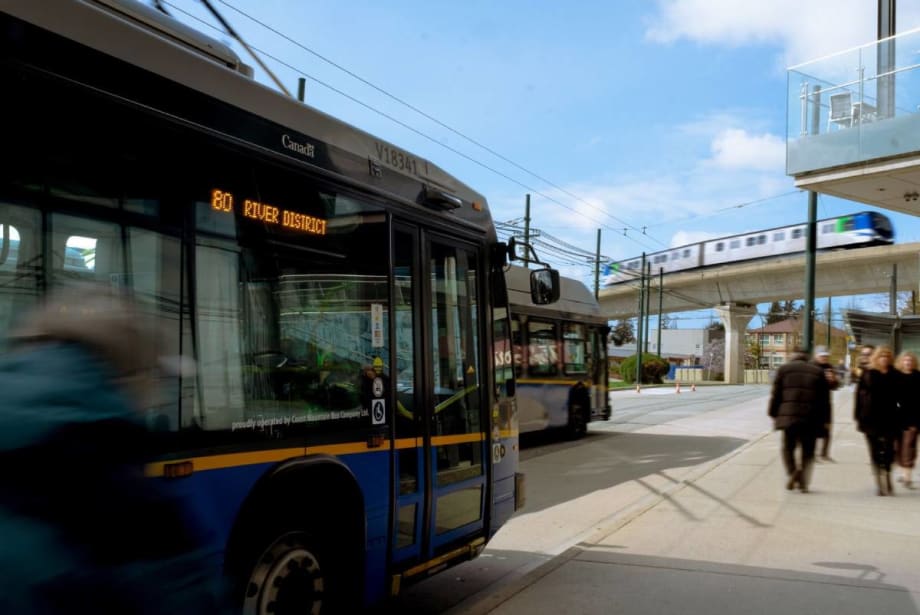
Reduced transit in Metro Vancouver could lead to more difficulty getting to and from work.
Photo: TransLink
3 min to read
The TransLink Mayors’ Council on Regional Transportation received a report showing how TransLink’s financial crisis could affect residents if not addressed.
InterVISTAS Consulting Inc. calculated a total cost of $1 billion every year for the region if Trans Link’s $600 million annual funding gap remains. This would cost households around $1000 per year.
The impact of the increased cost of living would also affect housing affordability, access to jobs, and traffic in the area.
TransLink released details of the reductions in transit services that would be made without new funding.
“The impacts to our communities from losing transit service is shocking, and anyone who is running to be the Premier of this province needs to be paying attention,” said Mayor Brad West, chair of the Mayors’ Council. “It is absolutely clear that reducing transit services is unacceptable, especially at a time when so many people are facing higher costs of living, longer commutes due to traffic congestion and challenges finding affordable housing. Voters in Metro Vancouver deserve to know what the provincial political parties will do to avoid these impacts.”
Increased Traffic
The report shows that cuts to transit services could lead to a 20% increase in traffic congestion. Over 200 million hours of automobile and truck congestion could be added to the region.
First responders in the area would also be affected by this leading to further delays to their life saving services.
Economic Impacts
InterVISTAS residents could pay more than $55 million in vehicle operating and maintenance costs each year.
Residents also may need to spend more on housing to reduce the need for travel. Conversely if the higher cost of housing is unattainable residents may need to spend more on travel.
Unless the provincial government takes action, 500,000 to 675,000 would no longer be within walking distance of public transportation.
The service cuts would disproportionally affect low wage earners, students, and newcomers to the region.
The report states: “Ultimately, it is the individuals who are least likely to be financially able to access other means of transportation who would be most impacted by TransLink service cuts.”
“Rising unemployment, aggregate wage declines, and reductions in GDP are all likely consequences of transit services being reduced. Moreover, Metro Vancouver would face challenges attracting and retaining businesses and skilled labour within the region,” according to InterVISTAS. “This will compromise Metro Vancouver’s current and future growth trajectories, limiting economic prosperity and driving greater inequity.”
Access for Everyone
The Mayors’ Council sent an open letter to B.C. political party leaders calling them to commit to immediate funding for TransLink post-election. They also requested that party leaders roll out the first phase of the Access for Everyone transit expansion plan starting in April 2025.
The Access for Everyone plan would double bus service over the next decade. It would also build nine new Bus Rapid Transit lines and invest in vital new projects such as extending SkyTrain to UBS and improve the region's major road network.
Metro Vancouver residents are encouraged to visit the Access for Everyone website and send letters directly to local candidates and provincial party leaders to encourage them to invest in public transit.
Changes Being Made
TransLink is already seeking additional revenue and identifying cost saving measures.
TransLink initiated a series of efficiency measures in June 2024. These will generate approximately $91 million per year by reducing costs by $75 million and generating an additional $16 million in revenue.
More Management

METRO Opens Submissions for 2026 Motorcoach Awards
Nominations are now being accepted for METRO Magazine’s Operator of the Year and Innovative Operator of the Year awards.
Read More →
New York MTA Advances Final Contract for Second Avenue Subway Expansion
Contract Four is the largest in the Second Avenue Subway Phase 2 project and includes construction of station infrastructure, tracks, and signals for the subway expansion, MTA officials said. Work on Contract Four will begin in 2027.
Read More →
Transit Agencies Highlight Safety Gains at National Summit
Leaders from 15 major transit systems shared crime-reduction results and safety initiatives while discussing the role of continued federal support.
Read More →

NITA Names New Leadership, Expands Reduced-Fare Program at First Board Meeting
The new regional transit authority appointed its first board chair and interim executive director while extending reduced fares across CTA, Metra, and Pace for eligible riders.
Read More →
Beyond the Checklist: A Structured Approach to Transit Maintenance
Reliability-Centered Maintenance helps transit agencies move beyond routine checklists to focus limited resources on the assets and failures that have the greatest impact on safety, reliability, and service.
Read More →
APTA 2026 Nominating Committee Selects Leadership Slate, Names Chair and Vice Chair Nominees
Leadership changes will help shape the association’s priorities and its representation of the transportation industry during the 2026–2027 term.
Read More →
DART Launches Major Security, Fare Enforcement Initiative
The 90-day demonstration will deploy coordinated security teams at five light rail stations while testing controlled access and gathering data to guide future investments.
Read More →
Sponsored•September 9, 2026
Advancing Fare Collection Through Technology and Innovation
Learn about delivering 1300 gates at 91 stations while managing fare evasion. Explore the large scale deployment, solution customization and real-world results that affect the region. Prepare for deployment in your region now.
Read More →
Game Day in Motion: Moving Millions During the 2026 World Cup
Between packed transit stations and team motorcoaches, see how agencies and operators across North America tackled the transportation demands of the 2026 FIFA World Cup.
Read More →
Surface Transportation Extension Averts Shutdown, Leaves Transit Funding Gap
The stopgap keeps federal transportation programs moving, but missing advance funding could complicate the transit and rail projects agencies are planning next.
Read More →